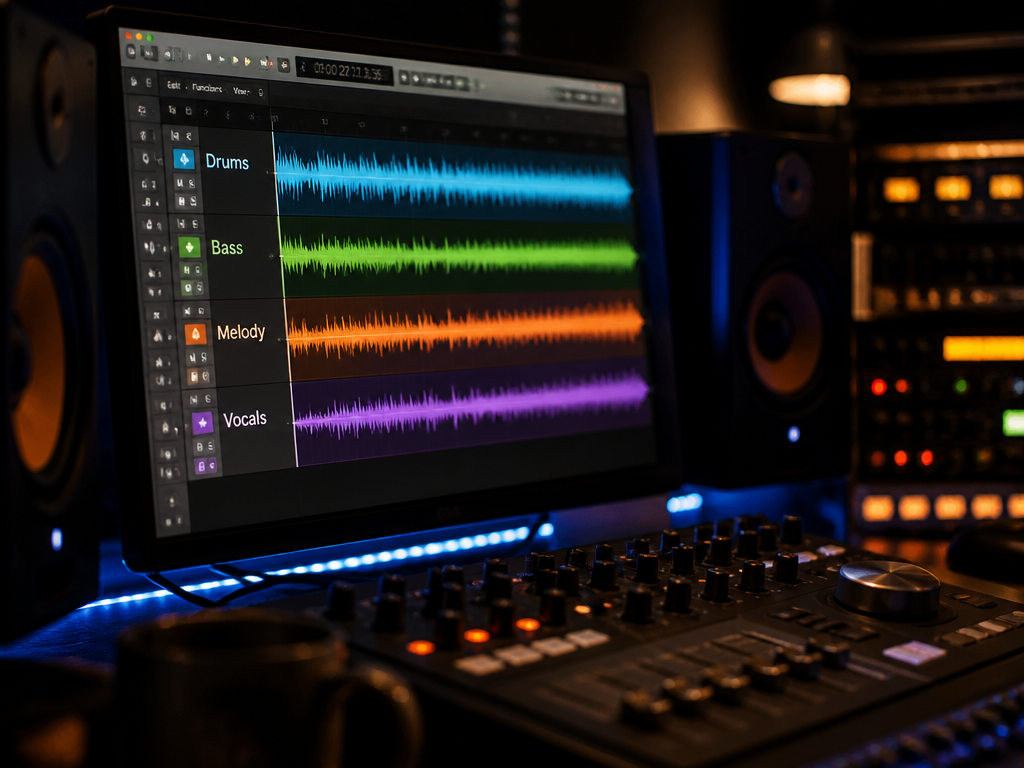
Last Tuesday I ran a stupid little experiment on the clock, mostly to settle an argument with myself. I took a 2013 session of mine — a dead master, no stems surviving, a 92 BPM downtempo thing in F minor — and fed it to a stem separator to pull the drums back out. Fourteen seconds of processing. The kick came back clean enough to re-trigger; the hi-hats smeared a little in the decay, the way they always do. Then, same afternoon, I opened a generation tool and typed a prompt for a "broken 808 under a detuned Rhodes, 92 BPM, F minor" and hit render. Also about fourteen seconds. Also useful. Also nothing like the first thing I did.
Both of those get filed under the same three words online: using AI. That's the problem in miniature.
Here is the verdict up front, because you came here to defend a tool choice and I'm not going to make you wait for it: AI music adoption among working producers is genuinely high, but the headline number hides that "using AI" covers everything from stem separation to full song generation, and those are not the same job — so a blanket criticism aimed at all of it lands on almost none of it.
The line that travels because it's half-true
You've seen the sentence. Some version of "it's talentless people typing prompts." It spreads because it describes something real. There are spam operators uploading hundreds of generated tracks a day to farm fractions of a streaming penny. There are cloned voices trained without consent. Those are not phantoms, and I'm not going to wave them away to make you feel better about your plugin folder.
The argument gets stretched when the same sentence is pointed at a songwriter who ran a chord idea through a generator forty times to find one voicing, or an engineer who used a separator to rescue a client's phone-recorded vocal. The meme flattens a stem separator, a mastering assistant, and a bot farm into one silhouette. Then it asks you to answer for all of it. You can't, and you shouldn't try.
What the adoption numbers actually measure
The surveys floating around show adoption rates that look startling — large majorities of surveyed musicians reporting they use AI in some form. Read the methodology before you quote the figure. A lot of these numbers come from people recruited through the tools themselves — a company that makes a separation plugin surveys its own newsletter and finds, shock, that its users use its product. That's not fraud, it's sampling. It tells you about momentum inside specific communities. It does not tell you that every songwriter in a room has adopted anything.
So treat the big percentage as directional, not universal. As of writing, the honest read is: adoption is high and climbing in the communities most connected to these vendors, lower and warier elsewhere, and — this is the part that matters — concentrated overwhelmingly in a handful of unglamorous tasks. The interesting question was never how many. It's which one.
Eight jobs wearing one coat
Here's the taxonomy I use when someone tries to make me answer for the whole category. "Using AI" in a production context usually means one of these, and they're wildly different kinds of labor:
- Stem separation — pulling drums, vocals, bass out of a finished mix. Restoration work. The creative decision came years ago; you're recovering it.
- Denoise and restoration — killing hiss, hum, room. Nobody calls a de-esser cheating; this is the same lineage.
- Reference and idea generation — rendering a sketch to react against, then throwing it away. A mood, not a master.
- Full song generation — prompt in, finished-ish track out. This is the one the meme actually pictures.
- Mastering assistance — automated loudness and tonal balancing. Been semi-automated for years already.
- Vocal synthesis and cloning — the genuinely fraught one, where consent and likeness live.
- Sample and one-shot generation — making a texture, a pad, a hit to chop up like any other sample.
- Tagging, stem labeling, library automation — the boring backend that saves an afternoon.

Six of those eight are closer to a better compressor than to a jukebox. The debate almost always collapses to number four and number six, then gets charged to all eight. When someone comes at your workflow, the first move is naming which job you actually did.
Two hundred passes is not two hundred outputs
Consider a songwriter who generates two hundred passes chasing a hook. And consider a spam account that publishes two hundred tracks in a night. Same count. Opposite activity. One is iteration — auditioning, rejecting, comping, editing, arriving at a single thing they'll defend. The other is volume for volume's sake, output as its own product. The tally doesn't separate them; the editing does. Two hundred takes on a guitar solo was never evidence of talentlessness, and running two hundred renders to find one usable eight-bar bed isn't either. What you keep and what you cut is the work.
Or the videographer with a cut due Friday who needs ninety seconds of unremarkable tension under a drone shot. They were never going to commission a composer for that; the realistic alternative was a stock-library subscription with a commercial-use clause buried three PDFs deep. Generating a bed they can license cleanly isn't taking a job from a scoring composer. It's replacing a stock loop. Naming the actual counterfactual kills most of the argument on its own.
The harms are real, and they're specific
None of this excuses the ugly parts. Voices cloned without permission is theft of likeness, full stop. Models trained on catalogs without licensing or payment is a live legal and ethical fight, and "it sounds cool" is not an answer to it. Streaming spam dilutes an already miserable royalty pool. A serious position holds both things: iterative production is legitimate work, and the extraction economy around generation is doing damage. You can defend your compression-and-comping workflow without carrying water for a clone farm.
How I'd judge my own workflow
When I want to know whether I'm doing craft or hiding behind a render, I ask four concrete things:
- Authorship — did I make the decisions, or did the prompt make them and I shipped the first result?
- Editing labor — is there evidence of choosing, cutting, arranging? Or is it raw output?
- Licensing clarity — do I actually know the commercial terms of what I generated, in writing, or am I assuming?
- Disclosure — would I be comfortable telling the client exactly which of the eight jobs I used a tool for?
If those answers are clean, no meme has standing over you.
Who this is for, who should skip it
This framing is for the producer, engineer, or songwriter who's tired of defending a stem separator as though it were a plagiarism machine. If you're running a generation farm for playlist pennies, none of the above launders that, and you already know it.
I keep that 2013 track's recovered kick in a folder now, next to the F-minor render I made the same afternoon. One is restoration. One is a sketch I'll probably gut. Neither is the thing the internet is angry about, and I can say which is which in a sentence.
So this week, try this: open whatever session you last touched, write down which of the eight jobs above you actually did, and put that one line in your project notes. Next time someone comes at your tools, you won't argue the whole category — you'll name the job.
Not sure which tool to use?
Compare the top AI music and sound tools side by side — honest reviews, real pricing, no sponsorships.