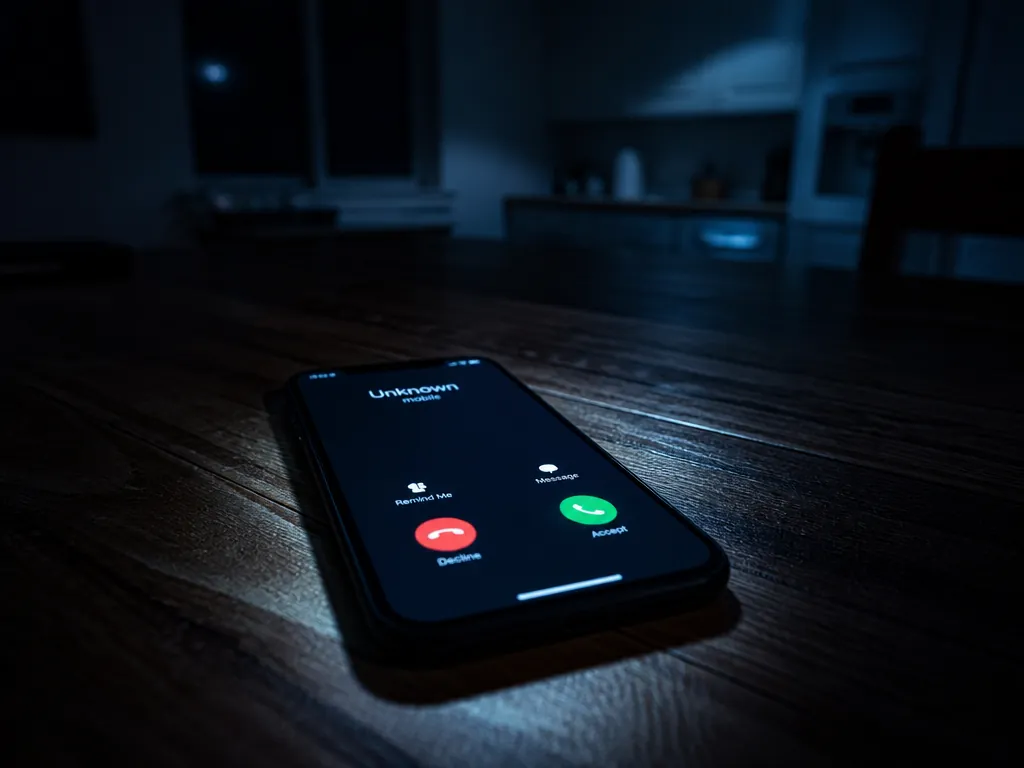
The first time a cloned voice fooled me, I was sitting at my own mixing desk. A friend sent me eight seconds of a synthetic version of me as a joke — scraped from a podcast I'd done — saying a sentence I never recorded. I build voices for a living. Ten years shaping dialogue for indie games and short films, four broken synths in the closet, and I could not hear the seam. That is the uncomfortable center of AI voice cloning scams: the same tools I use to fake a character's line for a Friday deadline are the tools a stranger uses to sound like your daughter at 2 a.m.
Here is the one sentence I would underline for anyone in metro Atlanta who still answers unknown numbers: the voice on the phone is no longer evidence of who is calling, and the only defense that holds up is a habit, not a sharp ear.
This is not a hype piece about a scary new machine. It is a working producer telling you how the sound is actually made, why your instincts betray you, and the three things I do when my phone lights up with a number I don't know.
What most people do
Most people trust the voice. That is not a character flaw — it is thirty years of conditioning. Your brain treats a familiar voice as a password it never has to type. When your son's voice comes through the speaker saying he's been in a wreck and needs money moved right now, the part of you that would normally ask questions is already gone.
So the common script goes like this. The call comes in. It sounds right — the cadence, the little verbal tics, the way the vowels sit. Panic does the rest. People stay on the line, because hanging up on your own kid feels monstrous. They answer the caller's questions, and in doing so they hand over the exact details the scammer didn't have. Then comes the ask: a wire transfer, gift cards read aloud, a payment app, cash in an envelope handed to a courier. All of it structured so the money moves before anyone thinks to verify.
The belief underneath all of this is that you'll be able to tell. You won't, and I say that as someone whose whole job is telling. Here is what a clone captures easily: timbre, pitch, the rhythm of how someone talks. Here is what it still fumbles, at least as of writing: genuine back-and-forth conversation, specific shared memories, and the messy emotional texture of a real person under stress. But scammers know this, which is why the whole call is engineered around urgency. Urgency is the tool that stops you from testing the two or three things that would expose the fake.
What the evidence suggests
Strip away the folklore and a few durable facts remain.
Cloning a voice no longer takes a studio or a data set. A few seconds of clean audio is enough for consumer-grade tools to produce a convincing model — and most of us have donated that audio for free, in voicemails, video posts, podcast guest spots, the outgoing message on our own phones. The barrier to entry that used to protect you is gone.
Caller ID is theater. Spoofing the number so it reads as a familiar contact, a local Atlanta prefix, or even a bank's real line is trivial and has been for years. The name on your screen is a suggestion, not a fact.
On the scale of the problem, I'll be careful not to invent a number for you. What federal reporting has shown consistently is that imposter scams — someone pretending to be a relative, a government office, a company you trust — sit among the most-reported and most costly categories of consumer fraud, year after year. Voice cloning doesn't create a new crime here. It supercharges the oldest one: pretending to be someone you love.
The most useful finding for your Tuesday, though, is about detection. Trying to catch a fake by listening is unreliable, and it gets less reliable every quarter as the models improve. What is reliable is verification through a second, independent channel — a callback to a number you already have, a question only the real person could answer. The evidence points away from your ears and toward your process.
What I actually do
When an unknown number calls, I let it go to voicemail. That is the whole first move. A real emergency survives ninety seconds; a scam usually does not, because the pressure only works live.
If I do pick up and something feels off — a relative in trouble, a bank, the IRS, anyone demanding fast money — I hang up. Not rude, not dramatic. I say some version of thanks, I'll check on that, and I end the call. Then I call back on a number I already trust: the one saved in my phone, the one printed on the actual bank card. I never use the number that called me, and I never let them route me to a "verification line." If the person on the other end objects to me hanging up and calling back, that objection is the tell.
My family has a passphrase. Nothing clever, just a word that would never come up in a scripted panic call. If a voice claiming to be one of us can't produce it, the voice isn't one of us. This costs nothing and it is the single most effective thing in here, because it moves the proof from something a machine can fake to something only a person can know.
I also stopped confirming my own identity to inbound callers. When a "bank" calls and asks me to confirm my details to proceed, I don't. They called me; they can prove who they are, or I hang up and dial the bank myself.
And I've made a kind of peace with the part I can't fix. My voice is already out there — I make things for a living, and audio of me exists in a dozen places I no longer control. You probably can't scrub your voice off the internet either. So I don't build my defense on keeping my voice private. I build it on the assumption that anyone can sound like me, and that being someone's relative is not the same as being able to prove it in a payment app at 2 a.m.
Treat the combination of urgency plus an unusual payment method as the fire alarm. Not the voice. The behavior.
Here is where my confidence runs out, and I'd rather tell you than fake an ending. The obvious fix would be a reliable detector — software that listens to a call and flags a synthetic voice before you're fooled. But detection and generation are locked in an arms race, and right now the fakers are moving faster than the catchers. Watermarking synthetic audio at the source might help; it might also be stripped out or ignored by the tools that matter. I genuinely don't know whether a machine will ever hear the seam that I couldn't at my own desk — or whether the only lasting defense will always be a human habit and a shared word. If you find out before I do, call me. On a number I already have.
Not sure which tool to use?
Compare the top AI music and sound tools side by side — honest reviews, real pricing, no sponsorships.