The number that traveled this year wasn't a total, it was a share: on one large streaming service, more than half the tracks uploaded on an average day were generated by software. Not half the catalog — half of a single day's new arrivals. If you earn a living from sound, this is the sort of AI-generated music statistics headline that lands in your stomach before you finish the sentence. It sounds like a takeover. Whether it is depends entirely on which number you read next.
Because a share of uploads is the most quoted and least honest figure in this whole argument. Uploads are cheap — a prompt and a render — and they've climbed steeply: from roughly a quarter of daily uploads, to something near half, inside a couple of years, depending on whose platform and whose counting method you trust. What that figure does not tell you is whether anyone pressed play.
Does AI music actually get listened to?
Not at anything close to the rate it gets uploaded. Across the platforms reporting numbers, AI-generated tracks make up a large and rising slice of what arrives but a small slice of what plays — often a low single-digit percentage of total streams. The gap between "uploaded" and "heard" is the real story, and it's where the industry's three main responses either make sense or fall apart. So the honest way to weigh those responses is against what each one actually targets: the flood of uploads, the trickle of fraudulent streams, or the artist whose royalty pool is quietly diluted.
Three approaches are on the table right now. They are not the same tool, and they don't solve the same problem.
Detection and demonetization
The first response is to find AI tracks and cut off their money — no payout below a stream threshold, removal of tracks flagged as spam, harder limits on uploads from a single account. Judged on fraud, this is the strongest of the three. The clearest harm from AI music isn't a great machine song outcompeting yours; it's a bot farm uploading ten thousand thirty-second ambient renders and streaming them on loop to skim a royalty pool that's split from a fixed pot. Detection-and-demonetization goes straight at that.
Judged on accuracy, it's shakier. Detection tools infer, they don't know; a fully AI track and a human demo cut in a bedroom on stock plugins can look alarmingly alike to a classifier. False positives hit exactly the independent artists the policy claims to protect. And judged on the dilution problem — your slice of the pool shrinking because the catalog tripled — it does almost nothing, because most diluting uploads aren't fraud. They're legal, low-effort, and numerous.
Labeling and disclosure
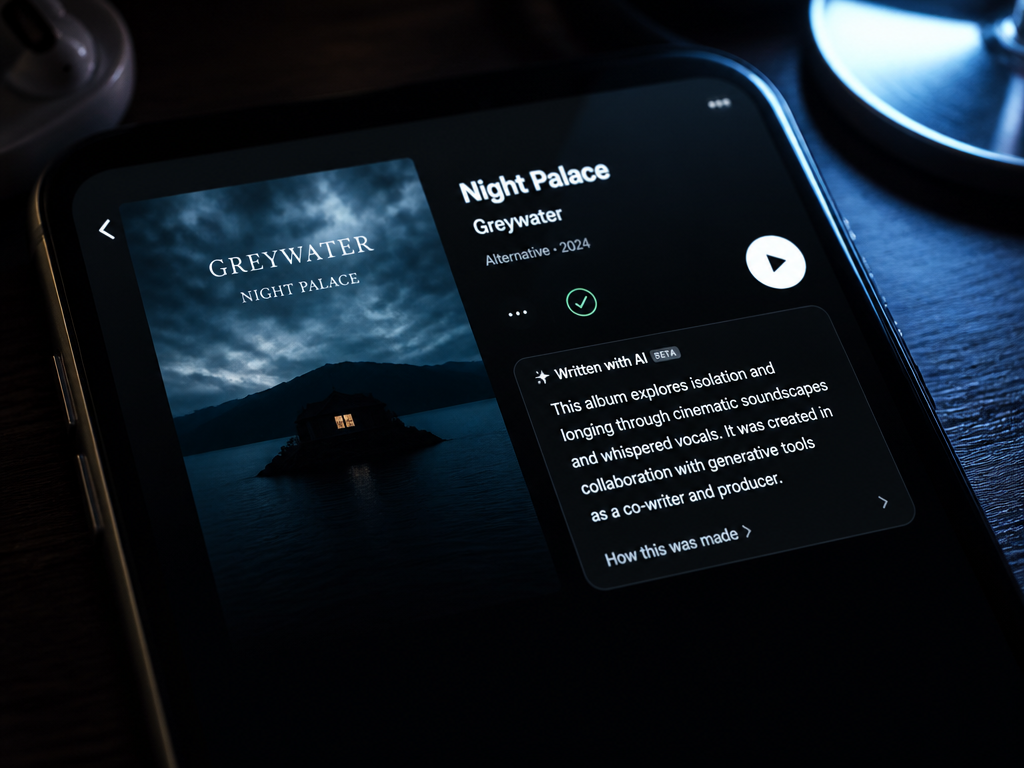
The second response is transparency: tag AI-generated or AI-assisted tracks, require uploaders to declare it, let listeners and playlist editors decide. On honesty, this one respects the audience, and it's the least punitive to legitimate AI-assisted work — the producer who used a model for a texture and played everything else stays visible instead of getting swept into a spam dragnet.
On enforceability, it's the weakest of the three. Disclosure is self-reported, and the incentive to lie scales with the payout. "AI-assisted" also covers everything from a mastering helper to a fully generated vocal, so a single tag flattens distinctions that matter enormously. Labeling changes what you can see. It doesn't change what gets paid, and it doesn't touch the upload flood except to annotate it.
Licensing deals
The third response is the one the majors have started reaching for: strike agreements with AI companies so models are trained on licensed catalogs and rights-holders get paid, rather than fighting every render after the fact. On the dilution problem, this is the only approach that even tries to redirect money toward artists instead of merely refusing money to machines. It treats AI music as a licensing category — the way sampling eventually became one — rather than a pest.
On who it protects, it's the narrowest. A deal negotiated between a large platform and a large label routes value to catalogs big enough to be at the table. The independent scoring the indie game, the songwriter without a major behind them — the readers most exposed to royalty dilution — are usually not party to it. Licensing is the most durable of the three and the least evenly distributed.
What each one actually fixes
| Response | Best at | Weakest on | Who it helps |
|---|---|---|---|
| Detection / demonetization | Stopping stream fraud | False positives | Everyone sharing the pool |
| Labeling / disclosure | Listener honesty | Enforcement | Legitimate AI-assisted artists |
| Licensing deals | Redirecting value | Coverage | Large rights-holders |
Read the table across, not down, and the verdict assembles itself: no single response covers the field. Fraud detection guards the pool but misjudges the edges. Labeling tells the truth but changes nothing downstream. Licensing pays somebody, rarely you. Platforms treating these as alternatives — pick one, announce it, move on — are managing a headline. The ones stacking all three are the only ones describing the problem's real shape, which is that "AI music" is at least three different problems wearing one name.
None of this is settled, and the honest posture is to say so. Detection improves and gets fooled again. Disclosure rules get written and quietly ignored. Licensing terms are still being drawn, and the reader arriving six months from now will find the specifics have moved.
Which brings us back to that opening share — more than half of a day's uploads, machine-made. Put it next to the play count that never travels as far, and the number stops reading as a takeover. It reads as a sorting problem: an industry deciding, in real time and with three imperfect tools, which of those tracks it will pay for, which it will merely tolerate, and which it will pay itself to have made. The upload figure tells you the flood is real. It just doesn't tell you who drowns — and that part is still being written.
Not sure which tool to use?
Compare the top AI music and sound tools side by side — honest reviews, real pricing, no sponsorships.