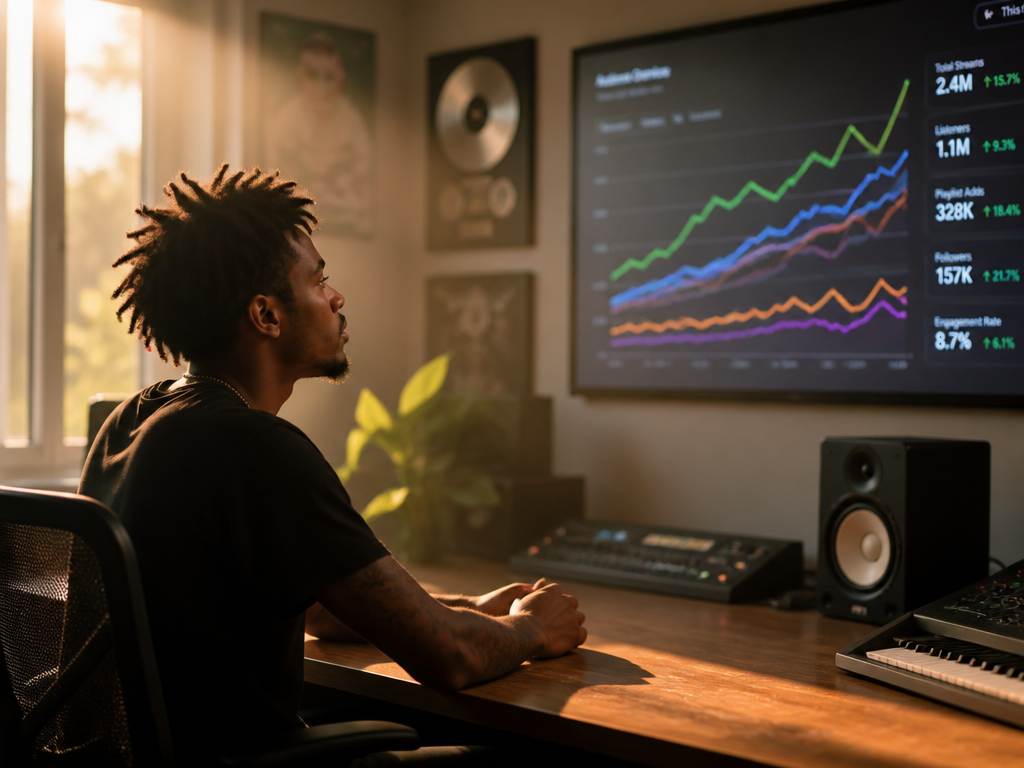
You have an artist with one good single, a release date, and roughly forty minutes a day of posting energy that someone — the artist, you, a 19-year-old intern — has to spend. The question lands on your desk in a Slack message: do we move the energy to Threads now that it's huge, or keep grinding the X account we've spent three years building? It is a real budgeting decision dressed up as a vibes decision, and most people answer it by reading a headline number and guessing.
Quick disclosure before we go further: City of Punk builds an AI music tool, not a social platform, so we have no horse in the Threads-versus-X race. We do, however, spend a lot of time watching where music audiences actually gather, because that is where the things we help people make end up living or dying.
Here's the short version, the one you can underline and forward: Threads growth metrics are genuinely large and worth taking seriously, but a monthly-user count tells you almost nothing about where engaged music conversation happens — and the honest answer to "should we be there?" depends on your genre and what you want the platform to do.
What the Threads growth metrics actually tell you
The trajectory matters more than the milestone. Threads arrived attached to Instagram's enormous installed base, which let it post some of the fastest sign-up figures any consumer app has ever recorded — and then, like most apps that grow by borrowing an existing audience, it cooled. The growth curve looks like a sprint followed by a long, uneven jog. By the time the platform was reporting hundreds of millions of monthly active users, the more interesting story was no longer how many people had an account but how many opened the app on a given day and did something other than scroll past.
That gap — monthly active versus daily active versus actually-posting — is where the analysis lives. Monthly active users is a number a platform's marketing team loves because it is large and goes up. For an artist deciding where to spend posting energy, it is close to useless on its own. A feed full of accounts that signed up once and never returned is not an audience you can release a record into. What you want to know is narrower: when something happens in your corner of music — a feature drop, a beef, a leak, a tour announcement — where does the conversation ignite first, and how long does it stay lit?
As of writing, the platforms answer that question differently, and not always in Threads' favor.
Where the music audience is actually clustering
If you go looking for the largest, most visibly active music communities on Threads, you find what you find almost everywhere fandom concentrates online: K-pop, dominant and organized, followed by a long tail of pop fanbases that migrated their group-chat behavior wholesale. These are mobilized audiences. They show up, they amplify, they brigade a hashtag into existence on command. If you work in that world, the case for Threads is straightforward — the people are there and they behave like a street team.
The picture gets murkier for everything else. Real-time music discourse — the breaking-news, hot-take, "have you heard this" layer that drives discovery for indie, electronic, hip-hop, and the genre-fluid internet underground — still skews toward X, partly out of incumbency and partly because X's reply-and-quote culture is structurally built for argument and fast amplification. Threads, by design and by parentage, leans softer and more Instagram-adjacent: more announcement, less brawl. That is not a value judgment. A platform optimized for pleasant feeds is a different instrument than one optimized for friction, and discovery has always been a little frictiony.
How I'd actually decide
Forget the headline number. Run the account through five questions instead.
- Engagement type. Are you trying to nurture an existing fanbase (community) or get strangers to encounter the music for the first time (discovery)? Threads is currently better at the former; X retains an edge at the latter for most non-pop genres.
- Reply and repost culture. Does your artist's content live or die on conversation? If a post only matters when people argue with it, you want the platform where arguing is the native behavior.
- Link treatment. Both platforms have, at various points, throttled or de-prioritized outbound links. Check how your "go stream it" posts perform before you commit a campaign to either — this varies and changes often.
- Audience overlap with Instagram. If your artist already has a real Instagram presence, Threads gives you a low-cost extension of an audience you've built. That's a different math than starting cold.
- Post longevity. Algorithmic feeds resurface posts unpredictably; chronological and community spaces don't. Know which model you're feeding before you decide a post "failed."
Who this is for, and who should skip it
If you work in K-pop or organized-fandom pop, Threads is not optional — your audience is already there and already mobilized, and ignoring it is malpractice. If you're managing a teenage artist whose whole world is Instagram, the extension cost is low enough to be worth it almost regardless.
If you're working in genres where discovery and real-time discourse still drive the needle — most of the independent and electronic spectrum — Threads is a maintenance presence, not a campaign engine, at least for now. Don't move your forty minutes there. Cross-post and watch the numbers.
And if you're chasing the milestone announcement itself — the big round number a platform put in a press release — skip the whole exercise. That number was written for analysts and investors, not for the person trying to get four hundred people to a Tuesday show.
The thing nobody can answer yet is whether an algorithmic, feed-first platform can actually sustain a music subculture the way the messier, more chronological spaces once did — whether scenes can form where the software decides what you see, or whether scenes need the friction. We don't know. Watch where the arguments happen, and you'll learn it before the press releases do.
Not sure which tool to use?
Compare the top AI music and sound tools side by side — honest reviews, real pricing, no sponsorships.