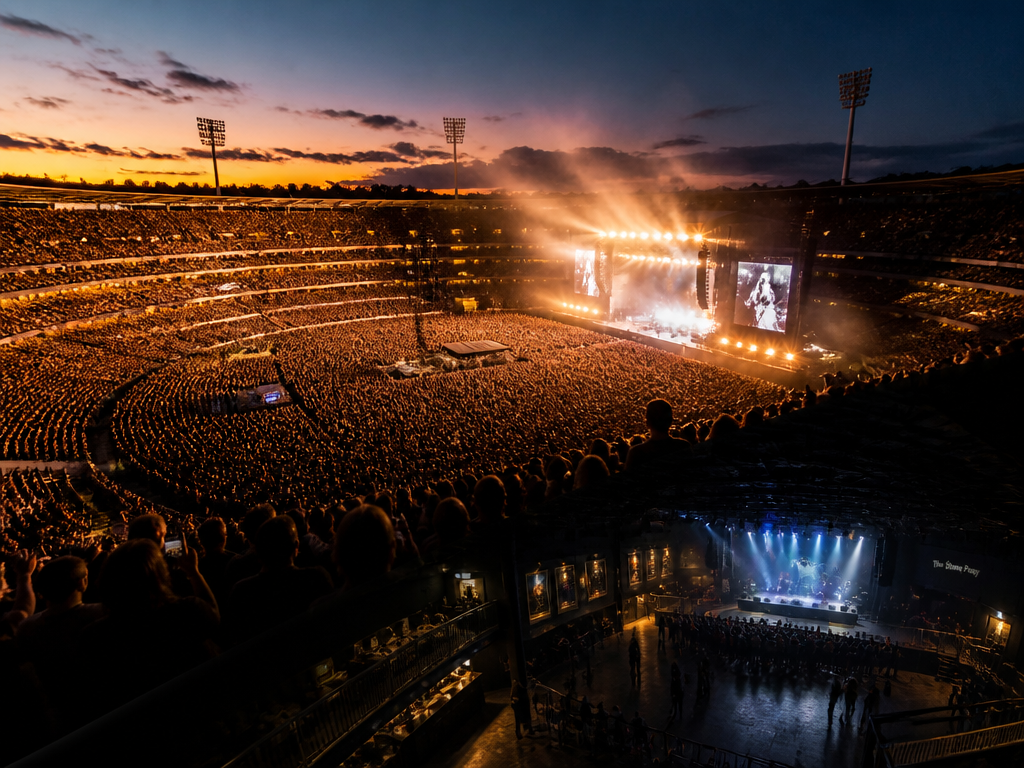
Here is a question you have probably asked yourself standing at the back of your own room at 9pm on a Friday: when six people show up together on one set of tickets, who actually decided they were coming?
Not who paid at the door. Who picked the night, floated it in the group chat, chased the stragglers, and booked the table after. Because in the live music industry, that person is the one you are really selling to, and a large body of audience research keeps pointing at the same answer — it is more often a woman than the room's design would suggest. Women make up a substantial share of live music fandom worldwide. Yet most marketing, line-up framing, and venue experience still treats them as attendees who got dragged along rather than the people doing the dragging.
That gap is the whole story. Let me try to answer the question honestly, including the parts where the honest answer is "it depends."
So who is actually spending the money?
The short version, drawn from the better audience studies of the last few years: women report being live music fans at rates close to or above men, and in many markets they account for a comparable or larger slice of ticket and on-night spend. The featured-snippet version most people want — "women spend X% more per show" — does not survive contact with the data. It varies enormously by genre, age, and country. Pop and contemporary tours skew one way; metal, certain electronic scenes, and legacy rock skew another.
What is more durable, and more useful to you, is the shape of the spending rather than a single figure. Across studies, women's spend tends to bundle: not one ticket, but several. Not the ticket alone, but the meal before, the merch, the cab home, the hotel for a destination show. When you only count heads through the turnstile, you systematically undercount the economic event you actually hosted.
The thing the turnstile can't see
Counting heads also hides the most valuable behaviour, which is coordination. A great deal of live attendance is not an individual decision. It is a group decision with an organizer, and that organizer carries outsized influence: they choose the night, the act, the venue, and crucially whether the group comes back.
Research into how groups assemble around gigs keeps surfacing the same pattern — women disproportionately occupy that organizer seat. They are the node the booking runs through. If you win that one person, you did not sell one ticket; you sold the table. If you lose her — bad sightlines for shorter people, a toilet queue that eats half the set, door staff who card the women and wave the men through — you did not lose one ticket either.
This is the reframe that matters for the live music sector: the highest-leverage customer in your building may not be the heaviest individual spender. She is the person who decides on behalf of five others, and whose verdict on the night determines repeat attendance for the whole group.
Where it honestly gets complicated
Here is the part the tidy version skips. "Women" is not a segment. It is half the planet, and treating it as one audience is exactly the lazy thinking that created the gap in the first place.
- Age moves everything. A 22-year-old's calculus on a sold-out general-admission floor is not a 45-year-old's calculus on a seated touring show. One is optimizing for proximity and energy; the other often for sightlines, a seat, and a clean exit.
- Genre subcultures have their own codes. What reads as a welcoming room in one scene reads as exclusionary in another. Do not import a pop-tour playbook into a hardcore basement and call it inclusion.
- Safety and accessibility are not soft factors. They are conversion factors. If a meaningful share of your potential organizers quietly rule out late-night solo travel from your venue, that decision happened before you ever ran an ad, and no discount code reaches it.

So when a promoter asks "what do women want from my events," the accurate answer is genuinely "it depends, and you should ask yours." But "it depends" is not the same as "nothing is actionable." Plenty is.
A short audit you can run this month
Walk your own night as if you were the group organizer, not the operator. Then check the things that quietly decide whether her group rebooks:
| Touchpoint | What to check | Why it changes the spend |
|---|---|---|
| Booking flow | Can she buy 6 tickets together and sit/stand together? | Friction here kills group conversions outright |
| Sightlines | Stand at 5'4". Can you see the stage past the front rows? | Determines whether half the group feels they "got" the show |
| Facilities | Time the longest toilet queue against set length | A 25-minute queue is a 25-minute review of your venue |
| Door experience | Are entry, ID, and search applied evenly and calmly? | Sets the room's tone before the first song |
| Getting home | Is there a clear, safe, late exit and transport plan? | Often the deciding factor on whether she'll organize a return trip |
| Post-show contact | Do you capture the organizer, not just the buyer? | You cannot earn repeat attendance from someone you never identified |
None of this is about pink-washing a poster. It is about removing the specific frictions that fall hardest on the person most likely to be coordinating the group — and therefore most likely to be deciding your next six tickets.
The metric nobody keeps
Most venues can tell you their attendance and their bar take. Very few can tell you their repeat-group rate: of the groups who came once, how many came back within a year, and who organized both visits. That is the number that turns a one-off audience into a venue with a base.
If you want one change that compounds, it is this: start identifying the organizer at the point of sale, and follow up with her, not the generic ticket-holder list. A "your usual crew is overdue a night out, here's first dibs on the on-sale" beats a blast email to 4,000 strangers. You are not buying reach. You are reactivating the node.
This is also, frankly, where the obviousness of the whole thing stings a little. The industry has spent years optimizing for the loudest data point — the marginal heavy spender — while underbuilding for the quiet decision-maker who books everyone else. The room was telling us all along, if we had counted who walked in together.
The question still left open
Here is where I have to stop short of a clean conclusion. We can see, repeatedly, that better sightlines, even-handed door policy, and serious facilities correlate with higher repeat attendance among women-organized groups. What we cannot yet cleanly separate is cause from selection: do those venues earn more repeat trips because they fixed the frictions, or do venues that already attract committed organizers simply have the resources to fix them?
Until someone runs the controlled before-and-after — same room, same line-up, one variable changed — that remains a genuinely open question. So the honest version of this brief ends not with a slogan but with the experiment you are now in a position to run: change one thing on the list above, hold the rest steady, and tell the rest of us whether she came back.
Not sure which tool to use?
Compare the top AI music and sound tools side by side — honest reviews, real pricing, no sponsorships.