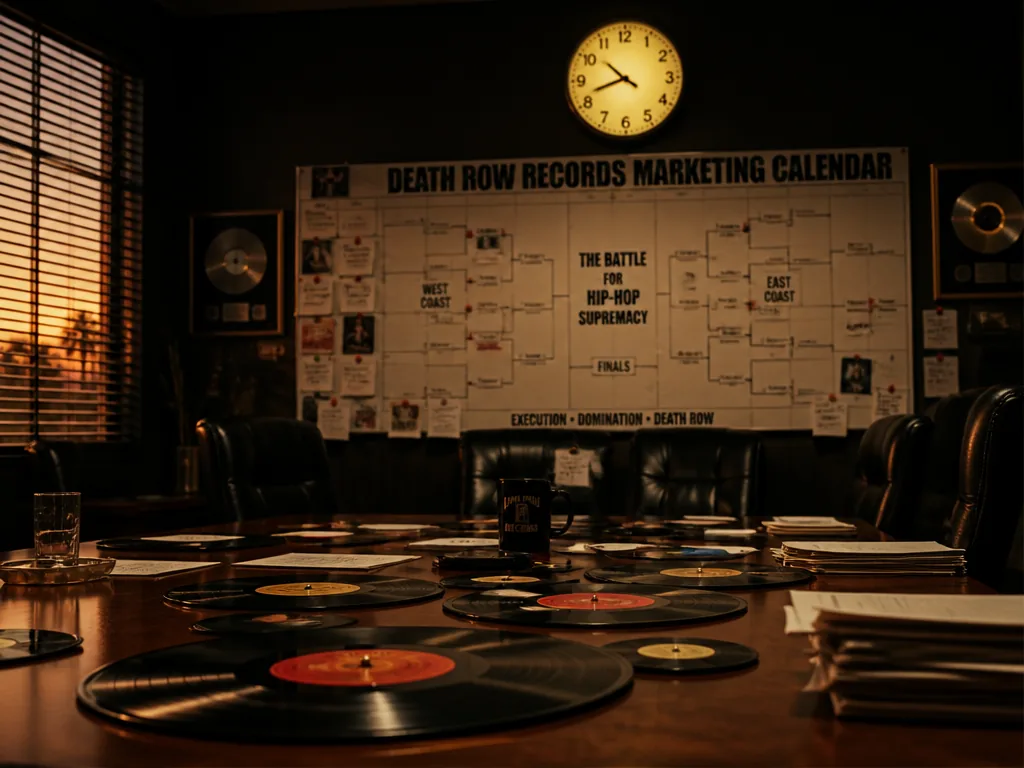
Sometime last year a legacy rock act rolled out an album with a bracket. Not a tour bracket — a World Cup-style knockout tournament, band members captaining fictional teams, fans voting through a streaming app, the whole thing dressed up like a cultural event you could lose sleep over. It was clever. It was topical. It got written up. And when you looked for the part where the fan who voted actually won something, or the part where the vote connected to anything but a press cycle, there wasn't one. The campaign was the product. The album was the pretext.
This is the shape modern music marketing keeps returning to, and it's worth asking why the industry believes so hard in the big coordinated launch — because the belief has a source, and the source is thinner than the confidence built on top of it.
Where did the "album launch campaign" idea even come from?
The idea that a record needs a campaign — a synchronized push of teasers, exclusives, and a splashy central stunt — is roughly as old as the music business having enough money to spend on one. It didn't emerge from evidence that campaigns sell records. It emerged from the fact that labels had budgets, sales teams, and a calendar to fill, and a "campaign" was how you justified all three.
Trace it back and you get a chain of doctrines, each one hardening from tactic into gospel.
The single-driven radio push. For decades the launch was a science of getting one song onto enough stations in enough markets in a tight enough window that it charted. This worked. It also required, at its worst, paying for the privilege — the payola scandals of the late 1950s and again in the 2000s are what happens when "the campaign" becomes the only thing that matters and the music becomes the delivery vehicle for the spend.
The MTV world premiere. In the video era the campaign got a face. A world premiere at a fixed hour, a moment the audience had to be present for. Michael Jackson's "Thriller" is the case everyone cites, and it's a real one. But it also became the template that a thousand lesser videos were built to imitate, most of which premiered to a shrug.
The surprise drop. Beyoncé's self-titled 2013 album detonated the old logic — no campaign, no lead single, just a midnight release. The industry's takeaway wasn't "campaigns don't matter." It was "the surprise IS the campaign." So the anti-campaign became a campaign format, planned months out, leaked strategically, and copied by artists who did not have Beyoncé's audience waiting up.
The streaming moment. Now the launch has to be an event inside an app — a countdown, a livestream, a fan-vote gimmick, a bracket. Something that generates engagement metrics a partner platform can point to and a reporter can cover.
The case studies were survivors
Here's the crack in the foundation. Almost every campaign the industry canonizes is a story about an artist who was already going to be enormous.
"Thriller" would have sold with a worse rollout. Beyoncé dropped to an audience that had spent six years learning to drop everything when she moved. The stunt didn't create the demand — it gave existing demand a shape, and a headline. What got credited to the campaign was often just the artist, the moment, and the audience meeting where they were always going to meet.
This is survivorship bias wearing a marketing budget. We remember the brackets and the surprise drops that landed because the acts behind them were unmissable. We don't build case studies out of the identical stunt run by a mid-tier act, because nobody covers those, and so the failure never enters the record. The belief in the big campaign is maintained by only ever examining the wins.
Anatomy of the modern stunt — and the gap in it
The legacy-act bracket is a good specimen because it shows the machinery clearly. You get:
- A tie-in to a live cultural event, borrowing heat the band didn't generate.
- A gamified layer — vote, bracket, leaderboard — to convert passive listening into a countable action.
- A platform partner that wants the engagement numbers as badly as the label wants the coverage.
What you rarely get is the payoff. The fan votes; the fan gets… the satisfaction of having voted. There's no reward tier, no unlockable, no reason the participation should persist past the news cycle that the participation was designed to feed. The campaign is engineered to look like fan engagement while functioning as a media event. That's not a scandal. It's just worth naming, because the fan can feel the difference even when they can't name it.
What actually moves a release now
If you're launching something this quarter and you don't have a stadium act's gravity to lend the stunt its weight, the unglamorous mechanics are where the work is.
| Tactic | What it's actually doing | Honest limit |
|---|---|---|
| Editorial playlist pitch | Placing you in front of listeners already leaning your way | You're one of thousands pitching |
| Pre-save / pre-add | Front-loading day-one velocity the algorithm reads | Only converts fans you already have |
| Catalog depth | Giving a new listener somewhere to go after the hit | Takes years, not a campaign cycle |
| A single genuinely good stunt | Earning coverage and a memory | Dies fast without a follow-through hook |
None of that photographs as well as a World Cup bracket. All of it outperforms a bracket with nothing behind it.
For the sound designers, editors, and producers reading this at City of Punk — the lesson travels. Whether you're releasing an EP or scoring a launch trailer, the campaign is not a substitute for the thing being worth returning to. A stunt buys attention. Only the work buys the second listen.
So here's the contrast to underline.
The myth: a bold, well-produced launch campaign is what makes an album land.
The truer version: a launch campaign gives an audience that already exists a place to gather — and no amount of bracket, countdown, or borrowed cultural heat can manufacture the audience that the campaign only ever redirects.
Not sure which tool to use?
Compare the top AI music and sound tools side by side — honest reviews, real pricing, no sponsorships.