The session ran past 1am and the song was already finished: 84 BPM, F# minor, a detuned Juno pad under a kick that lands a hair behind the grid, a vocal recorded close enough that you can hear the room breathe between lines. Dark-pop, the kind that only makes sense after midnight. The artist had one question when we bounced the master, and it had nothing to do with the mix. It was: how many times can I post this before people get sick of it?
That is the entire TikTok music marketing strategy conversation for independent artists, compressed into ten words. Not "what should I post" — everyone knows the answer is video, roughly daily, with the song under it. The blocker is quieter than that. It's the private conviction that posting the same song for the fourth week running makes you look desperate, or broke, or like someone whose career is a single track long.
So let's answer the question honestly, including the parts where the answer is genuinely it depends.
The fear isn't saturation, it's being seen trying
The artists I work with rarely say "I'm worried about audience fatigue." They say some version of "it feels weird." Weird to make a fifth video about a song released in March. Weird to lip-sync the same eight bars while your producer friends are dropping new beats every week. That's not a marketing analysis, it's embarrassment wearing a marketing analysis as a costume.
Worth naming, because the fix for embarrassment is different from the fix for a bad plan. Embarrassment gets fixed by looking at where your views come from. A bad plan gets fixed by building a render list, which we'll get to.
How many times can you post the same song on TikTok?
More than feels comfortable, and the reason is structural: on a discovery-driven feed, most people who see any given post are seeing you for the first time. Your existing followers are a small slice of a video's reach; the rest are strangers who have never heard those eight bars in their lives. Repetition feels like repetition to you because you're the only person who watched all sixty posts. For the audience, post forty-one is a first listen.
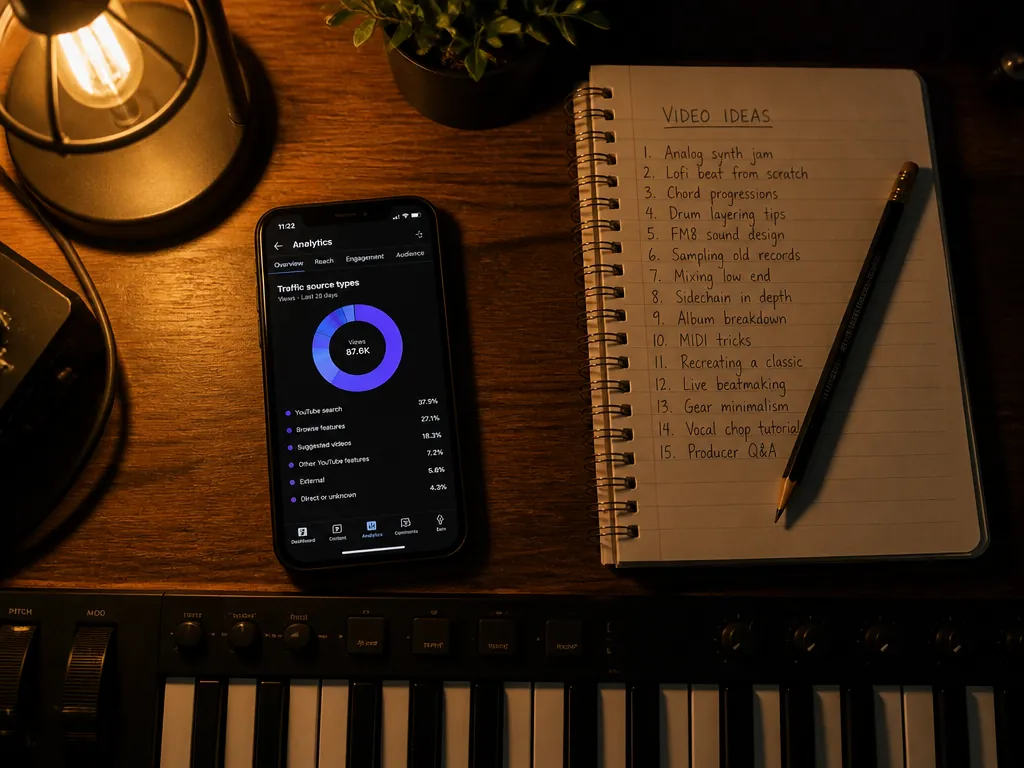
Here's where it depends. Open your TikTok analytics and find the traffic-source breakdown for your recent posts — the split between For You and Following. If the overwhelming share is For You, you have a discovery problem solved and a volume opportunity, and you can run one song for months. If a large share of your views comes from Following, you are mostly playing to people who already know the track, and repetition costs you something real. Same for retention: if watch time on your song posts is sliding week over week while reach holds steady, that's fatigue, and it's measurable rather than vibes.
The other dependency is the hook itself. A dark-pop song survives repetition when its first four seconds do something specific — a whispered line, a filter sweep that resolves into the drop, a lyric that reads as a text message someone shouldn't have sent. If your best moment lives at 1:12, you don't have a repetition problem, you have an edit problem, and you should be cutting a version that starts at 1:12.
Build a render list, not a release calendar
This is the part where being a sound designer helps more than being a marketer. You are not obligated to post the same file sixty times. You're obligated to post the same song, and a song is a set of possible renders you mostly haven't made yet.
Before you shoot anything, spend an evening in your DAW and bounce a folder. Everything at 48kHz WAV so it survives being re-encoded four times by four different apps, and do not master any of it louder in the hope of standing out — platforms normalize loudness, and all you'll gain is a squashed transient on a phone speaker. Mix so the low-mids read on a $9 driver, because that's the monitoring environment that actually matters here.
| Render | What changes | Why it's a different post |
|---|---|---|
| Sped-up (~110–125% of original tempo) | Brighter vocal formants, faster pocket | Its own micro-genre; often outperforms the original on short-form |
| Slowed + reverb | Long tail, blurred consonants | Reads as a different mood entirely — late-night, driving |
| Instrumental | Vocal removed | Backing for someone else's video, storytime, or your own voiceover |
| A cappella / stems | Everything but the voice removed | Duets, remix bait, producers flipping it for you |
| 8-bar hook loop | Structure gone, hook only | Text-on-screen posts, behind-the-scenes b-roll |
| Stripped version (piano or guitar, one take) | Arrangement gone | Proves the song is a song, not a production trick |
| Alt-genre flip | New instrumentation, same key and tempo | Drum-and-bass, country, bossa — a different audience finds it |
| Phone-speaker demo | Deliberately raw, room mic, no polish | The version people believe |
Eight renders. If each one supports four to six posts with different framing — the lyric, the story behind the second verse, a comment reply, the failed take — you have a quarter of content from a single track and never had to write a new song under deadline pressure, which is how bad songs get made.
The Sunday hour
A repeatable system beats an inspired one. Here's the session I recommend, and what tells you each step landed.
- Pick one render for the week. Load it into your editor as the only audio you'll use for seven days. You should have a folder with one file in it — that constraint is the point.
- Shoot five to seven clips in one sitting, same lighting, different framing. Vertical, one subject, no cuts. When it worked, the clips look like they came from the same week, not the same take.
- Write the first line of on-screen text before you write the caption. It should be a claim, a confession, or a question — not a description of the song. If the text still makes sense with the sound off, rewrite it.
- Cut so the hook starts inside the first second. Trim the pre-roll silence to zero. When it worked, you'll hear the vocal or the drop before the first frame finishes rendering in preview.
- Check playback on your actual phone at 50% volume. If the bass disappears and the vocal turns brittle, go back and fix the mix on that render, not the video.
- Schedule the batch across the week and stop touching it. Reviewing performance daily makes you rewrite a strategy that hasn't finished running.
- On the next Sunday, look at three numbers only: average watch time, For You share, and saves. Rising saves with flat views means the song is landing and the delivery isn't. That's a shooting problem, not a song problem.
Where AI tools help, and where they leave a mess
Stem separation is the honest win. Pulling a clean instrumental and a usable a cappella out of your own master takes minutes now, and for a sparse dark-pop arrangement — pad, sub, vocal, a couple of percussion layers — the results are frequently release-quality. Push it on a dense mix with heavy sidechain and layered harmonies and you'll hear it: smeared cymbals, a phasey "underwater" quality on sustained vowels, sibilance that goes glassy. Check the isolated vocal on headphones before you build a post around it.
Generative tools are more of a coin flip. An alt-genre flip of your own song is prompt roulette — you may burn twenty renders before one is usable, and vocals remain the hardest thing for these models to make sound like a person rather than an impression of one. Keeping tempo and key fixed is what makes the good render usable:
Instrumental only, 84 BPM, F# minor, dark-pop reimagined as late-night
jazz: brushed drums, upright bass, felt piano, room tone audible.
No synthesizers, no vocals, sparse arrangement, space between phrases.
The reasoning matters more than the wording. Locking tempo and key means your existing a cappella drops straight over the result with no time-stretch artifacts. Naming what to remove ("no synthesizers") stops the model from quietly rebuilding the track you already have. And asking for space is how you get a bed that a voice can sit on.
Two caution flags. First, licensing: if a generated flip is going under your official audio or getting monetized, read the terms of the tool that made it on the day you use it — ownership, commercial use, and whether the output is exclusive to you vary by vendor and change with plan tiers. We keep those terms compared here at City of Punk, but the version that binds you is the one on the vendor's site. Second, if you're also uploading variants to streaming or YouTube, be aware that multiple near-identical versions of your own recording can trigger rights-matching claims against you. That's an administrative headache, not a catastrophe, but it's easier to prevent than to appeal.
When this doesn't work
If your discovery share is low and your audience is mostly people who already follow you, sixty posts of one song is sixty chances to annoy the few hundred people who care. Fix reach first with fewer, better posts.
If the song's best idea takes forty seconds to arrive, no render list saves it. Some songs are album songs. Making them into short-form ammunition damages them.
And if you genuinely hate being on camera, the render list still works — instrumental posts, lyric cards, studio b-roll, stem giveaways for producers — but the ceiling is lower, and pretending otherwise wastes your year. Volume on a feed rewards a face doing a specific thing repeatedly, and it's fair to decide that isn't the trade you want.
What you should not do is keep writing new songs to avoid the discomfort of promoting the one you already finished. That isn't productivity. It's a very expensive way to hide.
Nobody is sick of your song. Most of them haven't heard it yet.
Not sure which tool to use?
Compare the top AI music and sound tools side by side — honest reviews, real pricing, no sponsorships.