Last month a small electronic label sent me a screenshot before they spent a euro. One line item: €10,000, all of it queued for Meta, because that's where the last three releases had gone and nobody had asked why. The campaign hadn't launched. The question hadn't been asked. The budget had simply inherited the shape of every budget before it.
That inheritance is the most expensive thing in independent music marketing, and it rarely shows up on the invoice.
If you're tracking music advertising trends as someone who actually allocates spend — a label manager with four releases a quarter, a marketer babysitting a single artist's launch — the live question right now is whether Meta still deserves its default status, or whether a chunk of that budget works harder somewhere else. This isn't a manifesto about platform death. Meta still moves enormous volume for music. The question is narrower and more useful: for your release, in your genre, where does the next euro buy the most attention?
One disclosure up front, because you should know it before you trust a word: City of Punk makes an AI music tool. We're in the business of helping people produce audio, not in the business of selling ad placements on any platform. I have no stake in whether you spend on Meta or TikTok. What I have is a decade of watching indie campaigns succeed and faceplant, and a strong allergy to budgets that move on autopilot.
The default that nobody audits
Here's the wisdom you absorbed without choosing to: Meta — Facebook and Instagram — is the adult in the room. Mature ad manager, deep targeting, predictable reporting, a decade of music marketers' muscle memory. You know how to build a campaign there in your sleep. That fluency is real, and it's worth money.
But fluency is also how you stop noticing the price creeping up. Music isn't competing for Meta inventory only against other music. It's competing against e-commerce, mobile games, DTC mattress brands, and political spend, all of whom often have deeper pockets and harder conversion goals than "get someone to save a track." When auction pressure rises, the genres with the softest conversion signal — and streaming a song is about as soft as conversions get — tend to pay for it.
Meanwhile short-form video platforms have spent the last few years becoming where music is discovered, not where it's merely advertised. That's the shift worth examining. Not "Meta is finished," but "the discovery behavior moved, and the ad inventory followed the behavior."
How I'd decide
I don't trust platform comparisons that lead with a verdict, because the verdict is always someone's. So here are the criteria I'd actually weigh, and I'd weigh them in roughly this order for a music release.
- Cost per meaningful result. Not CPM in a vacuum. What does it cost to produce an action you care about — a save, a profile follow, a pre-save, a click that survives to a stream? CPMs can look cheap while the downstream action stays expensive.
- Attribution honesty. Can you actually see what worked, or are you reading tea leaves? Post-iOS tracking changes gutted a lot of clean attribution everywhere. Some platforms hide the murk better than others, which is worse, not better.
- Format fit for music. Music is an audio product being sold in mostly muted feeds. The platform whose native behavior is sound-on has a structural advantage for what you're selling.
- Audience discovery. Are you paying to re-reach people who already know the artist, or paying to find listeners who don't? These are different jobs and they cost differently.
- Creative production cost. The ad spend is only half the spend. The other half is what it costs to feed the platform creative it won't reject as boring. This line item is almost always under-budgeted.
- What you're allowed to run. The music in your ad has licensing implications. If you're advertising the artist's own master, fine. If you're using anything else as a hook, read the terms before the lawyer does.
Now the two platforms against those criteria.
Meta, honestly
What Meta still does well for music is volume and control. If your job is to take a release that already has some traction and pour fuel on it — retargeting people who watched a video, building lookalikes off a warm list, reaching an artist's existing followers across two apps — Meta's machinery is mature and the targeting is granular in ways short-form still isn't. For a catalog play, a tour announcement, a merch drop tied to a release, this matters. You can build a funnel and watch it behave more or less rationally.
Meta also tolerates lower-effort creative better than people admit. A clean static visual with the cover art, a 15-second clip, an animated lyric card — these won't win awards but they'll run, and they'll convert a retargeting audience that already likes the artist. You don't need a creative team on retainer to keep a Meta campaign alive.

The honest negative: discovery on Meta has gotten expensive and noisy for cold audiences in music. You're buying interruption in a feed where the user did not arrive expecting to hear a song, often with the sound off by default. And the attribution since the tracking changes is softer than the dashboard's confidence implies — modeled conversions are estimates wearing the costume of measurements. I've watched campaigns report healthy results that didn't show up in the streaming numbers two weeks later. Meta isn't lying to you exactly, but it's optimistic on its own behalf, and you should read its reporting the way you'd read a press release.
TikTok, honestly
What TikTok does that Meta structurally can't is put your audio in front of people while their sound is on, inside a feed where discovery — not social graph — is the entire point. The recommendation engine doesn't much care who follows whom. It cares whether the thing holds attention. For a new artist with no warm list to retarget, that's not a marginal advantage, it's a different kind of opportunity: you can reach listeners who've never heard of the act and who are, by the platform's own behavior, primed to encounter new music.
In several music categories the cost to reach a thousand people has run cheaper than the equivalent on Meta — sometimes meaningfully so, sometimes only at the start before the creative fatigues. I won't quote you a fixed multiplier, because the number moves by genre, by season, by how good your creative is, and anyone selling you a single magic ratio is selling you a snapshot as if it were a law. What's durable is the direction: for discovery of music, sound-on short-form has a format that fits the product.
The honest negatives, and there are several. TikTok eats creative. An ad that worked on Tuesday is tired by Friday. The platform punishes repetition, and the thing that makes it cheap to reach people — constant novelty — is exactly the thing that makes it expensive to keep feeding. Attribution is even more fragile than Meta's. You will often see a campaign "work" in the sense that a sound takes off, while the dashboard's straight-line attribution shrugs. And the creative has to be genuinely native — an ad that looks like an ad gets scrolled, fast. A repurposed Meta static will die there. You're not buying placements so much as buying the right to compete for attention, every single day.
The two against the criteria
Here's the comparison laid out on the things that actually decide it. Read this as the shape of the tradeoff, not as fixed scores — your genre and creative move every cell.
| Criterion | Meta | TikTok |
|---|---|---|
| Cost per meaningful result | Stable, predictable, rising in cold audiences | Often lower to start, volatile as creative fatigues |
| Attribution honesty | Soft since tracking changes; confident UI | Softer still; sound takeoff often outpaces the dashboard |
| Format fit for music | Sound-off feed; audio is a handicap | Sound-on by default; structural fit for audio |
| Audience discovery | Strong for warm/lookalike; pricey cold | Strong for cold discovery; weaker for re-reach |
| Creative production cost | Tolerant of static and low effort | Hungry; demands constant native video |
| Best job | Retargeting, catalog, funnel completion | New artist discovery, breaking a hook |
Notice what the table refuses to do: name a winner. That's not diplomacy, it's the actual finding. These platforms are good at different jobs, and the mistake the €10k-all-Meta label made wasn't choosing Meta — it was assuming there was one job to do.
Genre changes the answer
Anyone who hands you platform advice without asking what kind of music you make is guessing. The behavior differs sharply.
Hip-hop and pop with a hook. Short-form was practically built for a song with a moment — a four-bar phrase, a beat switch, a quotable line. If the track has a section that makes someone want to do something on camera, TikTok's discovery engine has fuel to work with, and the cost to find new listeners can be genuinely low while the creative stays fresh. This is the category where the reallocation argument is strongest.
Electronic and instrumental. Murkier. Dance music can absolutely move on short-form when there's a drop that lands in a clip, but ambient, IDM, downtempo — music whose pleasure is duration and texture rather than a hook — fights the format. A 15-second window is hostile to a track that earns its payoff over six minutes. For this material I'd be slower to abandon Meta's warm-audience strength and the longer video tolerance, and I'd lean on the artist's existing community rather than cold discovery.
Singer-songwriter and folk. This one surprises people. Intimate, story-forward music does well in short-form when the creative is a face and a confession, not a glossy promo. A phone-shot clip of the writer explaining the song before it plays can outperform anything polished. Meta still serves the warm-list job here, but the discovery upside on short-form is real if the artist is willing to be a person on camera. Many aren't, and that's a creative-cost problem, not a media problem.
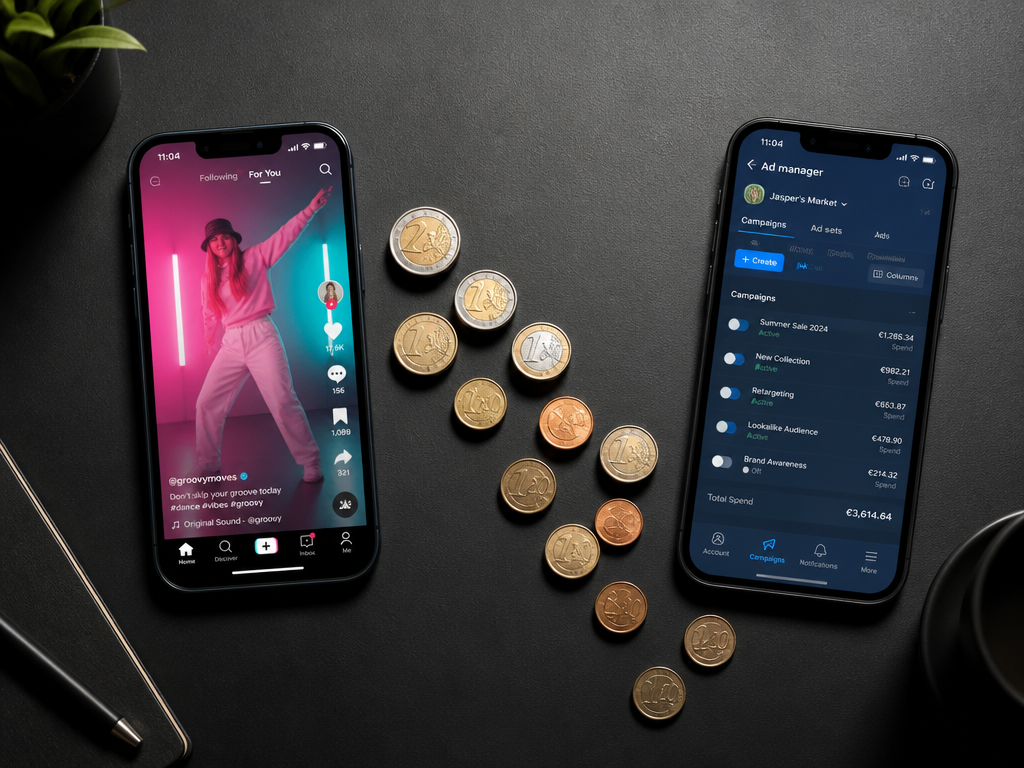
The pattern: the more your music depends on a moment, the more the discovery platform earns the spend. The more it depends on duration and atmosphere, the more the mature retargeting machinery keeps its value.
The line item nobody budgets
Here's the thing that wrecks reallocation plans: people move the media dollars and forget to move the creative dollars.
A Meta campaign can survive on a handful of assets refreshed every few weeks. Shift that same budget to short-form and you've signed up for a content treadmill. You now need a steady supply of native clips, ideally several angles tested per week, because the platform's cheapness is paid for with novelty. If you reallocate €4,000 of media to TikTok without allocating any new hours or money to making things to run there, you haven't reduced your cost — you've hidden it inside someone's nights and weekends, and the campaign will quietly starve when that person burns out.
This is where I'll make the AI-tooling point honestly, since it's my beat and you'd be right to suspect it: the creative treadmill is exactly the pressure that pushes people toward generated assets — quick instrumental variations for different clip edits, alternate hooks, background beds. It can help feed the machine. It does not solve the deeper problem, which is that native creative requires taste and a point of view, and no generator supplies those. If your reallocation depends on machine-filling the content gap with generic loops, the platform will smell it and scroll. Budget the creative as seriously as the media, or don't reallocate.
Who this is for, who should skip it
Reallocate toward discovery short-form if: - You're breaking a new artist with no warm list to retarget. - The track has a genuine moment — a hook, a drop, a quotable line. - You have, or can build, a real pipeline of native vertical video. Not repurposed statics. Actual clips. - The artist will appear on camera, or you have characters/creators who will.
Stay weighted toward Meta if: - You're working a catalog, a tour, merch, or a release with an existing warm audience to re-reach. - Your music is duration-and-texture rather than moment — ambient, long-form, instrumental. - You don't have creative capacity to feed a content-hungry feed, and pretending you do will sink the campaign. - Your reporting needs to satisfy a stakeholder who wants funnel-shaped dashboards, even imperfect ones.
Skip the whole reallocation debate if your total budget is small enough that splitting it leaves both halves too thin to learn anything. A €1,500 spend spread across two platforms teaches you nothing on either. Pick one, run it long enough to get a signal, then decide.
The verdict, such as it is
The label that queued €10k all-Meta wasn't wrong about Meta. They were wrong about the question. The honest finding from looking at current music advertising trends isn't "switch to TikTok." It's "stop letting last quarter's budget decide this quarter's."
For most indie releases I'd now structure the split, not the switch. Keep a Meta allocation sized to the warm-audience and funnel-completion job it does well, and carve out a discovery allocation for sound-on short-form sized to the creative you can actually sustain. The ratio between them is set by two things: how much of a moment your music has, and how much native creative you can realistically produce. Hook-forward release with a content pipeline? Tilt hard toward discovery. Atmospheric record with a small team and a warm list? Keep your weight on the mature machinery and treat short-form as the experiment, not the plan.
The reallocation that fails is the one that moves money without moving the work. The one that succeeds treats each platform as a tool sized to a specific job, and refuses to inherit the shape of the last campaign.
What this looked like for me
I'll show you the logic lived out instead of dressed up as advice. The last release I helped split was a producer's single with a beat switch about forty seconds in — a real moment, the kind short-form can grab. I put roughly a third of the budget on Meta, aimed entirely at the artist's existing followers and a tight lookalike, running a clean clip of the cover art and the drop. That part I barely touched after launch; it did the warm-audience job and reported its modest, slightly-too-confident numbers.
The other two-thirds went to short-form, and I didn't spend a euro of it until I had eleven native clips cut from the same session — different openings, different first lines of text, the producer's hands on the gear in some, a face in others. I ran them in small batches, killed the ones that fatigued by day three, and reinvested into the two that held. The cold-discovery cost ran lower than the Meta cold equivalent had on the previous single, but only because the creative kept moving. The week I ran out of fresh clips, the cost crept right back up — exactly on schedule, exactly as the format demands its rent.
That's the whole article in one campaign: the platform wasn't cheap, the creative was, and the moment I stopped feeding it, it stopped feeding me.
Not sure which tool to use?
Compare the top AI music and sound tools side by side — honest reviews, real pricing, no sponsorships.