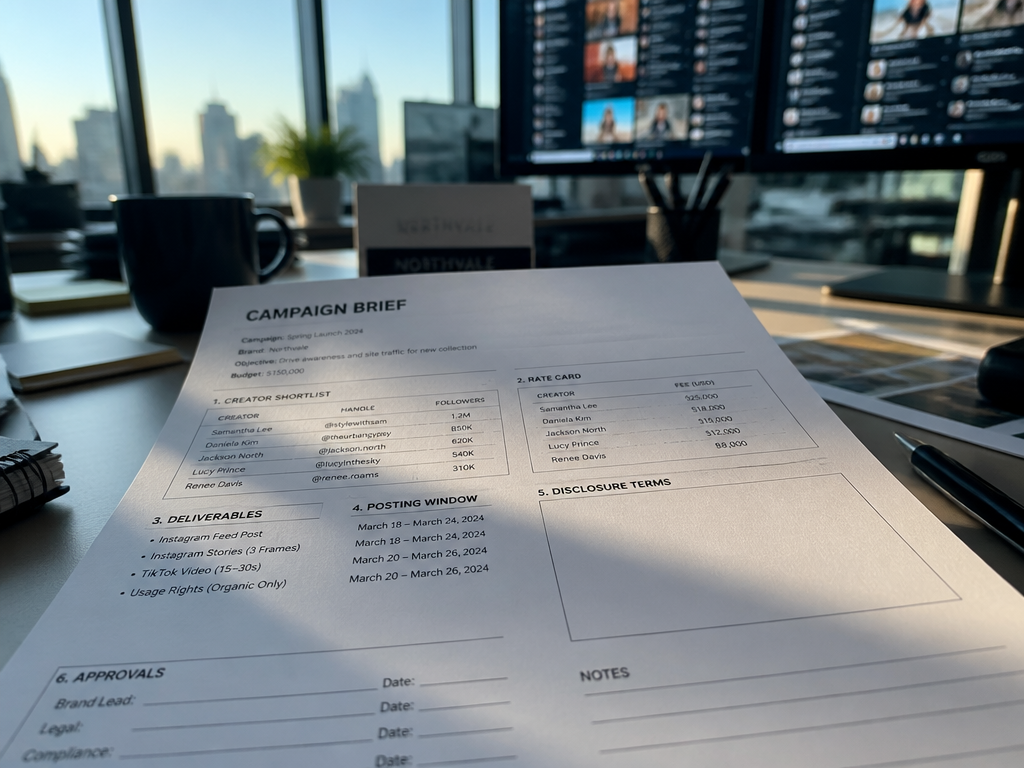
A campaign brief crosses your desk on a Tuesday. Twelve creators, mid-tier followings, each posting a fifteen-second Reel with your artist's new single under a lip-sync or a get-ready-with-me. The rate card runs a few hundred dollars a post, more for the ones with real reach. The deliverable spec is precise about aspect ratio, posting window, and hook timing. It says nothing about disclosure. Nobody on the thread asks. This is normal, and that is the problem.
Here is the verdict up front: undisclosed paid social marketing for music is a widespread industry habit, and the legal exposure it creates does not sit with the influencer alone — it sits with the advertiser, which in most of these deals is your label or your client. If you are running paid promotion and your creators are not disclosing it, you are the deep pocket in the room.
What most people do
The mechanics are boring, which is part of why they escape scrutiny. A label or a marketing agency identifies creators whose audience overlaps with the target demographic. Money changes hands — sometimes a flat fee, sometimes free product, event access, or a promise of future work. The creator receives a brief: use this sound, post in this window, hit this hook in the first three seconds. The song gets embedded in content that reads as organic taste. A dance. A cooking video. A "songs that live in my head rent-free" list where your single is conveniently number four.
What almost never appears is a clear indication that money changed hands. No #ad, no "paid partnership" toggle, no spoken line saying the post is sponsored. The rationale, when anyone bothers to articulate it, runs along these lines: it's music, not a product. The creator would plausibly like the song anyway. Everyone in the space operates the same way, so a disclosure would only make your post look more commercial than the competitor's post that carries no disclosure at all.
There is also a quieter version of this, the one that shows up in reporting on the sector and in candid conversations with creators: campaigns where the instruction to omit disclosure is implicit or explicit. A creator who has been told, directly or through the shape of the brief, that a hashtag would "kill the vibe" is a creator being steered away from compliance by the party paying them. That steering is not neutral. It is the advertiser's decision, and regulators treat it that way.
If you manage these campaigns, none of this is news. The workflow is efficient, the results are measurable, and the disclosure question has simply never been the thing that got a campaign killed. That is exactly the assumption worth pressure-testing.
What the evidence suggests
Start with the rule, because it is less ambiguous than the industry treats it. In the United States, the Federal Trade Commission's endorsement guidance requires that a material connection between an endorser and the brand being promoted be disclosed clearly and conspicuously. A material connection includes payment, free products, and other incentives that an audience would not reasonably expect. A paid Reel featuring your single is, on its face, an endorsement with a material connection. The fact that the endorsement is a song rather than a skincare serum does not remove it from the rule's scope. Regulators in other jurisdictions — the UK's advertising and competition authorities among them — apply comparable principles.
The distinction the industry leans on — it's music, not a purchase — does not survive contact with the actual standard. The rule is not about whether the audience is being asked to buy something in that moment. It is about whether the audience understands that the endorsement was paid for. A stream is a monetized action. A save, a follow, a sound-adoption that fuels an algorithm are all commercial outcomes the label is paying to manufacture. The audience's belief that they are watching an unpaid, genuine preference is precisely the value being purchased, and precisely what disclosure is meant to protect.

The liability question is where music-industry intuition tends to be wrong. The instinct is that if anyone gets caught, it is the influencer who failed to tag the post. Enforcement guidance does not read that way. The advertiser — the party that paid for and directed the endorsement — carries responsibility for the disclosures in campaigns it runs. Regulators have historically pursued brands and agencies, not only the individual endorsers, and have signaled that they expect advertisers to have programs in place to secure compliance from the creators they hire. A label that pays for a hundred undisclosed posts is not a bystander to a hundred individual creators' choices. It is the entity that built the campaign.
Reporting on paid music promotion has repeatedly surfaced the gap between practice and rule: creators describing standard fees for embedding songs, describing that disclosure is rare across the people they know, and in some accounts describing being nudged away from it. When endorsers are willing to say on the record that nobody in their circle discloses, that is not a defense. It is a description of a sector-wide pattern that gives a regulator a clean, well-documented target the day it decides the category is worth attention.
And the category is not exotic. Enforcement bodies have spent years building familiarity with influencer marketing in beauty, fitness, and consumer tech. There is no structural reason music promotion sits outside that competence. The absence of a headline case so far is a function of priority, not of legality. Priorities move.
What I actually do
If I am the person responsible for a paid social campaign, I treat disclosure as a line item in the brief, not an afterthought a creator might add. Concretely:
- The brief specifies the disclosure, not the creator. The deliverable spec that dictates hook timing and posting window also dictates the disclosure: the platform's paid-partnership tool switched on, plus a clear on-screen or spoken indication. If I can mandate the aspect ratio, I can mandate
#ad. - The contract makes it a condition of payment. The agreement states that posts must carry required disclosures and that non-compliant posts are not fulfilled deliverables. This flips the incentive. The creator who thinks a tag hurts reach now has a financial reason to include it.
- Someone checks the live posts. A campaign that pays for a hundred posts and reviews none of them is a campaign that cannot prove it acted reasonably. I keep screenshots or captures of the posts as delivered, with disclosures visible, dated.
- The paper trail runs the other way too. I keep the briefs. A brief that instructs disclosure is evidence of a compliance program. A brief that omits it — or, worse, discourages it — is evidence for the other side.
None of this dents performance in any way I have been able to measure. Audiences have been trained by years of #ad across every other category. A disclosed music post does not read as less authentic than a disclosed makeup post; it reads as a normal piece of paid content, which is what it is.
Who this is for, and who can skip it
This is for anyone signing off on budget for creator-driven promotion — label marketing leads, artist managers running their own campaigns, agencies buying influencer inventory on a client's behalf. If your promotion is entirely organic, or your creators are already on paid-partnership tooling with disclosures baked in, you are in better shape than most and can treat this as confirmation.
If you are outside the US and think this does not touch you, check your local regime before you decide that. The specifics differ; the underlying principle — paid endorsements get disclosed — is close to universal across the markets that matter for a release.
This week, pull the last campaign brief you approved and read it for one thing: does it tell the creator to disclose the payment, in writing. If it doesn't, add the line before the next one goes out.
Not sure which tool to use?
Compare the top AI music and sound tools side by side — honest reviews, real pricing, no sponsorships.