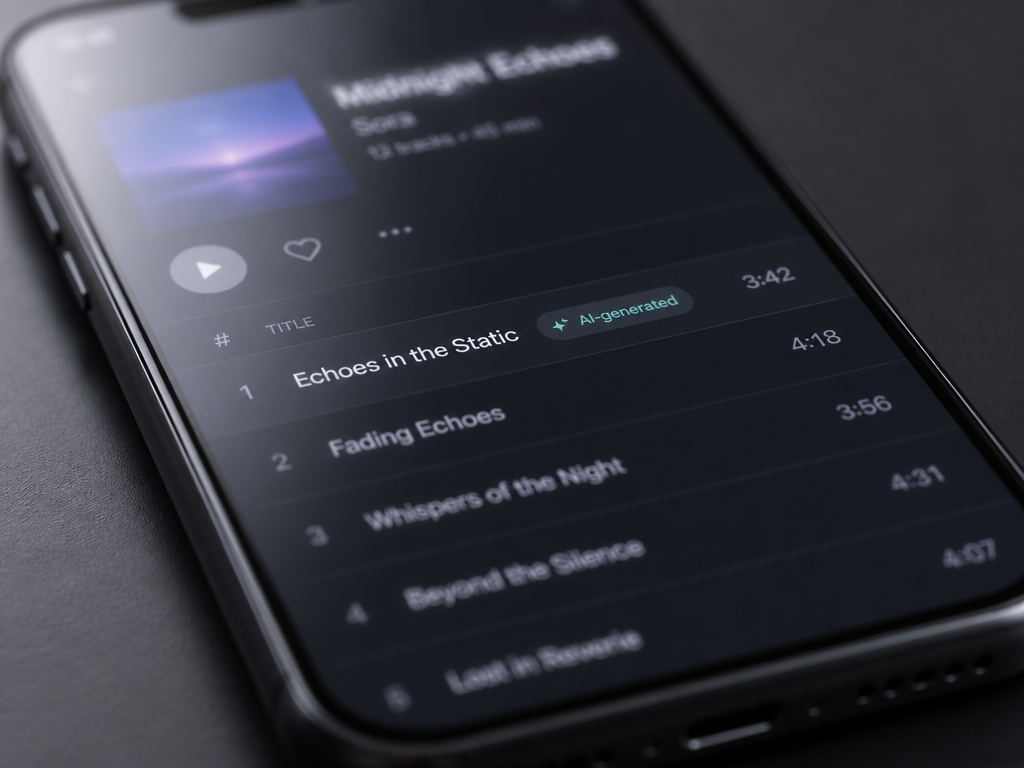
A label that says "AI-generated" on a track doesn't tell a listener whether a machine made the music. It tells them what the uploader chose to declare, in a field most people never look at, using a category with a seam so wide you could drive a tour bus through it.
That is the thing to understand before you spend an afternoon worrying about AI music labeling on your next release, or before you promise a client their podcast bed is "human-made." The label is a disclosure, not a verification. It records an intent, not a fact. And once you see it that way, both jobs — uploading clean and curating honestly — get easier, because you stop expecting the tag to do work it was never built to do.
I want to earn that claim rather than assert it, so let me walk through what the labeling frameworks actually say, what the platforms actually check, and what falls into the gap between the two. That gap is where you live if you make anything.
The metadata field nobody reads until it bites
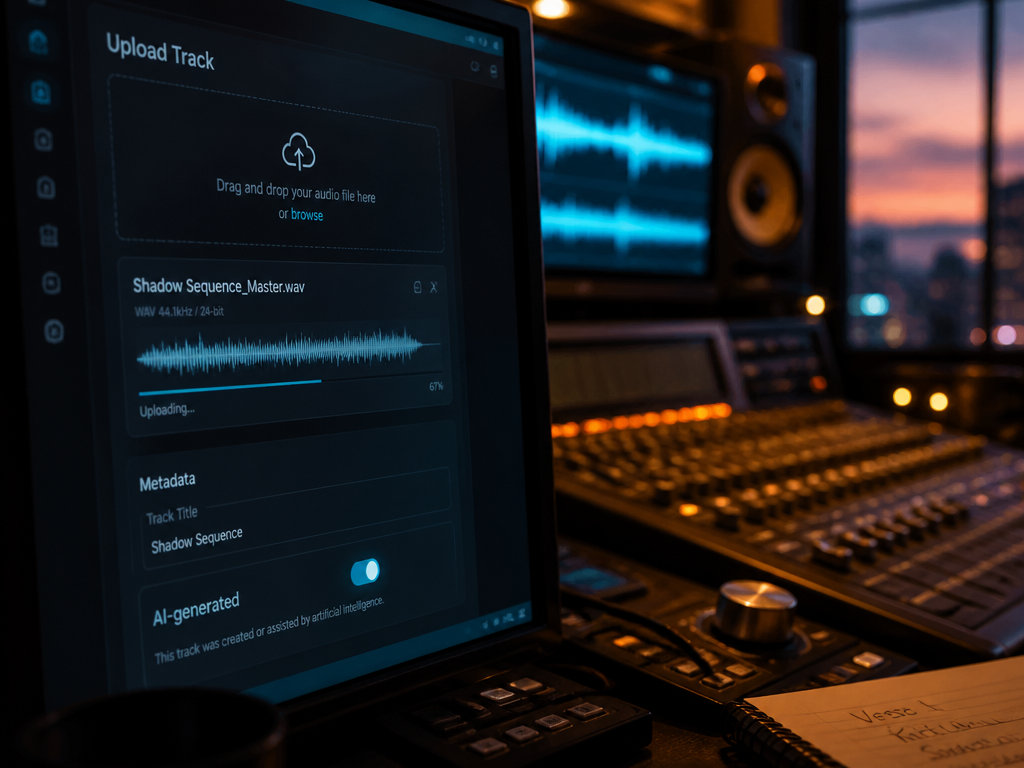
Here is a real shape of the problem. You render a 48kHz WAV, you built the arrangement yourself, you played the bass, but the pad underneath came out of a text-to-audio generator because you needed something wide and you needed it Tuesday. You send it to a distributor. Somewhere in the upload flow there is a checkbox or a dropdown asking whether the track contains AI-generated content. You are honestly not sure which box is true. There is no box for "one texture out of nine."
That single ambiguous moment is the whole story of AI music labeling right now. The industry has agreed, roughly, that disclosure is good. It has not agreed on where the line sits, who checks, or what happens when the checkbox and the audio disagree. So the burden lands on you, at the least convenient point in the process, with the fewest instructions.
Producers tend to treat this as a legal risk. It is closer to a hygiene problem. Get the disclosure wrong in the optimistic direction — claim "all human" when a generator did real work — and you are exposed if a platform's detection flags it later. Get it wrong in the pessimistic direction — over-label a track that used a stock synth preset trained on who-knows-what — and you may sit in a bucket that some curators quietly avoid. Neither outcome is catastrophic. Both are avoidable.
What the frameworks are actually trying to do
Over the past couple of years, industry groups, rights organizations, and the larger streaming services have moved toward a shared idea: songs that involve generative AI should carry a machine-readable signal in their metadata, so platforms and listeners can tell what they are hearing. The framing is transparency, not prohibition. Nobody credible is proposing to ban AI-assisted music from streaming — the volume alone would make that unenforceable, and plenty of legitimate releases use AI tools somewhere in the chain.
The motivation is scale. Some platforms have reported that a large and rising share of daily uploads are fully machine-generated — figures that have been cited in the range of tens of percent of new tracks on certain services, depending on who is counting and when. Whatever the exact number on any given week, the direction is not in dispute: the flood is real, and the platforms would rather sort it than drown in it. Labeling is the sorting mechanism they can agree on without agreeing on anything harder.
So the labels exist to serve three parties at once, and this is where the trouble starts, because those three parties want different things:
- Platforms want a signal they can filter, rank, and defend to rights holders.
- Listeners and curators want to know what they are choosing to hear.
- Rights organizations want a paper trail for royalty and provenance disputes.
A single checkbox can't fully satisfy all three. It tries anyway.
Two categories, and the seam between them
Most frameworks converge on two buckets. There is content that is substantially machine-generated — the melody, arrangement, and production came out of a model with a prompt and light human steering. And there is content that is human-authored but AI-assisted — a person wrote and produced the track, and a tool touched some part of it: a mastering assistant, a stem separator, a generated texture, a pitch-corrected vocal.
The categories are reasonable on paper. The problem is that almost no real session lives cleanly in one of them. Consider what actually happens in a working week:
- You generate a four-bar loop, then rewrite the chords, re-perform the bass, and rearrange the whole thing. Generated or assisted?
- You compose everything by hand, then run the master through an AI loudness-and-EQ tool. Assisted, obviously — but the tool made real decisions about the sound.
- You feed a generator a detailed prompt describing key, BPM, instrumentation, and mood, iterate forty times, and comp the best sections together. You did enormous creative labor. The audio is entirely synthetic.

That last one is the seam. It is genuinely both. The framework asks you to pick a side, and whichever you pick, someone can argue you chose wrong. The honest answer — "a human made the decisions, a machine made the sound" — is exactly the answer the two-category system can't represent.
For your purposes, a useful working rule: if you could not reproduce the released audio without the generator, lean toward disclosing generation. If the AI tool only cleaned up, separated, or corrected something you authored, that is assistance. It is a rule of thumb, not a ruling. When the frameworks get more granular — and they are moving that way, toward fields that describe which elements were AI-involved rather than a single yes/no — this gets easier. As of writing, most upload flows still hand you the blunt version.
How do streaming services detect AI music
They mostly don't detect it in the sense you imagine. As of writing, the primary mechanism is self-disclosure: the uploader states whether the track contains AI-generated content, and that declaration travels in the metadata. On top of that, some platforms run automated detection that analyzes the audio itself for statistical fingerprints of known generative models, and some cross-check against voice-clone and impersonation databases. Detection accuracy is claimed to be high for the specific models a system is trained to recognize and much lower for everything else — new models, heavily post-processed renders, and hybrid human-AI tracks routinely slip past.
So the practical picture is layered:
- The label is what you declared. It is only as accurate as your honesty and your understanding of the categories.
- The detector is what the platform's classifier guessed from the waveform. It catches obvious fully-generated output from models it knows, and misses the rest.
- The mismatch — declared human, detected synthetic, or vice versa — is what actually triggers review, demotion, or a request for clarification.
If you take one thing from this section: the label and the detector are separate systems that occasionally check each other. Neither is the truth. They are two guesses about the truth, and the gap between them is exactly where an over-processed AI track or an under-declared human track can hide, in both directions.
For the uploader: a disclosure checklist that won't come back on you
You want to be the release that never gets a second look. Here is the routine I use before anything leaves the session.
-
Inventory the AI in the chain. List every tool that touched the track and what it did: generation, stem separation, mastering, vocal correction, denoise. Write it down for yourself even if no upload field asks. You will forget by the time a question arrives.
-
Apply the reproducibility test. For each element, ask: could I release this audio without the tool? If a generator produced audio you kept, that is generation, and you disclose it even if you did heavy editing after.
-
Match the disclosure to the platform's actual categories, not your feelings about them. If the upload flow offers only a single AI checkbox and any real AI generation is in the track, check it. Do not talk yourself into "assisted" because it feels more respectable. The detector doesn't care about your pride.
-
Keep your project files and prompt logs. If a dispute lands, the thing that resolves it fastest is showing your work: the DAW session, the stems you performed, the prompt history from the generator. This is the single most protective habit and almost nobody does it.
-
Check the voice-clone line specifically. Synthetic or cloned vocals are the category platforms are most aggressive about, because impersonation is where the legal exposure is real. If your vocal is model-generated, disclose it plainly and be sure you have the rights to the voice you trained or prompted.
-
Read your distributor's terms, not the platform's. Most independent artists upload through a distributor that sits between them and Spotify or Apple Music. The distributor's AI-content policy is the contract you actually signed, and it can be stricter than the platform's. That is the document that gets you dropped.
None of this takes long once. The producers who get burned are not the ones who disclosed AI — they are the ones who claimed a track was fully human when a detector or a listener could tell it wasn't.
For the curator or listener: what a label can and can't verify
If you build playlists or you care what you are streaming, the temptation is to treat an AI label like a nutrition panel — objective, verified, complete. It is none of those. Here is what the tag can and can't stand behind.

| You want to know | Does the label tell you? |
|---|---|
| Whether a machine generated the audio | Sometimes — only if the uploader declared it and understood the category |
| Whether a real human wrote and performed it | No — absence of a label is not proof of human authorship |
| Whether the AI training data was licensed | No — labeling is about output disclosure, not training provenance |
| Whether a voice was cloned without consent | Partially — some platforms flag this separately and enforce it harder |
| Whether the track was auto-generated at spam scale | No directly, but undisclosed-and-detected tracks cluster here |
The uncomfortable takeaway for curators: an unlabeled track is not a verified-human track. It is an undeclared track. The producer may have skipped the box out of confusion, out of the category seam, or because their distributor never surfaced the field. And a labeled track is not necessarily worse — plenty of deliberately AI-generated work is honest, well-made, and exactly what a project needs. The label sorts by disclosure, not by quality and not fully by origin.
If you are trying to build a genuinely human-only playlist, the label alone will not get you there. Verified-artist status, a discernible release history, live performance footage, and credited session players tell you more than a metadata flag ever will. That is slower work. There is no fast version that is also accurate.
The honest limits
Let me be direct about where this system is soft, because pretending otherwise would make this the kind of piece the tag itself is supposed to protect against.
It is voluntary at the seams. The larger platforms and many distributors are building disclosure into their flows, but adoption is uneven and enforcement is thin. A voluntary system depends on the people with the least incentive to comply — high-volume spam uploaders — choosing to comply. They won't. So the label works best on exactly the population that needs it least: honest producers.
Detection is model-specific and beatable. A classifier trained on last year's popular generators is weaker against this year's, and weaker still against a generated track that has been resampled, re-recorded through analog gear, or layered under live instruments. The arms race favors the evader in the short term, the way spam filters always lag spam.
The categories don't fit the workflow. As covered, the generated-versus-assisted split cannot describe the hybrid session, which is now the normal session. Frameworks that move toward element-level disclosure — this stem generated, that vocal corrected — will fit reality better, but they ask more of the uploader, and more friction means less compliance.
Training provenance is a different problem entirely. A label tells you AI produced the output. It says nothing about whether the model was trained on licensed material. For a producer worried about commercial safety, that second question is the one that actually determines your exposure, and no output label answers it. The commercially-safe move is choosing tools whose training data and license terms you can read, not relying on a downstream disclosure tag. This is one reason to prefer generators that state their training and licensing plainly — City of Punk exists partly to sort which ones do — but that decision happens at the tool, long before the label.
None of these limits make disclosure pointless. They make it partial. A partial signal, honestly applied, is still better than no signal and a shrug. The mistake is treating a partial signal as a complete one — which is where I started.
Where this is heading, without a prediction
I am not going to tell you which framework wins or when the fields get standardized, because anyone who claims to know is guessing. What is observable: the direction is toward more granular disclosure, machine-readable metadata that travels with the file, and platforms that treat the declaration and the detector as two inputs to a review rather than one gospel truth. The near-term reality is messier than the announcements suggest and more functional than the cynics claim. Disclosure is becoming table stakes for distribution the way ISRC codes and correct genre tags already are — an unglamorous piece of release hygiene you handle so it never becomes a problem.
The version of this that matters to you is not the industry politics. It is that the metadata field on your next upload is now load-bearing. Treat it like the loudness target or the sample rate: a spec you get right on purpose, not a box you click past.
Try this this week
Before your next upload, open the AI-content disclosure field in your distributor's flow — actually find it, because a lot of people have never located it — and write yourself a two-line note in the release folder stating exactly which elements were generated and which were assisted, using the reproducibility test. If a question ever comes, you will answer it in thirty seconds instead of reconstructing a session from memory, and you will already know which box was true.
Not sure which tool to use?
Compare the top AI music and sound tools side by side — honest reviews, real pricing, no sponsorships.