A number has been doing a lot of work lately. Somewhere between a rights-holder panel and a product roadmap deck, "half of new uploads are AI-generated" became the load-bearing fact of the AI music labeling conversation. It gets cited to justify budgets, staffing, and now a coordinated push toward disclosure standards across the industry. If you run a streaming upload pipeline, sit on a rights team, or manage a catalog, that number is probably already shaping decisions you have not made yet.
So it is worth asking where it came from, what the new labels actually require of your systems, and how thin the ground under the whole thing might be — because the belief has traveled a lot further than the evidence.
The number that built the belief
The figure people repeat lands somewhere between 30 and 50 percent of new uploads on major platforms being AI-generated or AI-assisted. Follow it back and it gets slippery fast. Some versions come from a distributor's internal detection sweep. Some come from a vendor selling the detection. Some are "AI-assisted," which — depending on the definition — could include a producer who used a stock plug-in with a machine-learning mastering stage.
That range matters more than the midpoint. Thirty percent of uploads being fully synthetic is a different world than fifty percent being touched by any automation, and the two get flattened into one headline. The belief that emerged — the flood is here, act now — is durable and repeatable. The measurement underneath it is a collection of different studies counting different things, mostly by parties with a stake in the count being high.
None of this means the trend is fake. Upload volume from generative tools is genuinely climbing, and anyone watching submission queues can feel it. But the field came to believe a specific, tidy number, and that number is being used to move real infrastructure. Keep that gap in mind as the standards arrive, because the standards are being sold with the same certainty.
What the labels are supposed to do
Set the number aside and look at the actual proposal on the table. The disclosure framework taking shape across the industry generally splits into two categories, and the split is the part worth memorizing.
The first category flags content where AI generated the substance of the recording — the composition, the performance, the arrangement, or all three. This is the "made by a model" bucket.
The second category flags content that is fundamentally human but used AI somewhere in production — think a vocal cleaned up by a machine-learning tool, a stem separated algorithmically, a master finished by an automated chain. Human authorship at the core, machine assistance at the edges.
The decision tree is meant to be answerable by whoever uploads the track:
- Did a model generate the melody, lyrics, or performance itself? → first category, full disclosure.
- Did a human write and perform it, with AI tools somewhere in the chain? → second category, assisted disclosure.
- Neither? → no label.
That is clean on a slide. In a real catalog it is not clean at all, and that ambiguity is exactly where your pipeline is going to feel the strain.
Where the label actually lives
For a product manager, the label is a metadata field, and metadata fields have a lifecycle. The question is not "should we support the label" — it is where the field is populated, who is allowed to write to it, and what happens when it is wrong.
A disclosure flag can enter your system at several points:
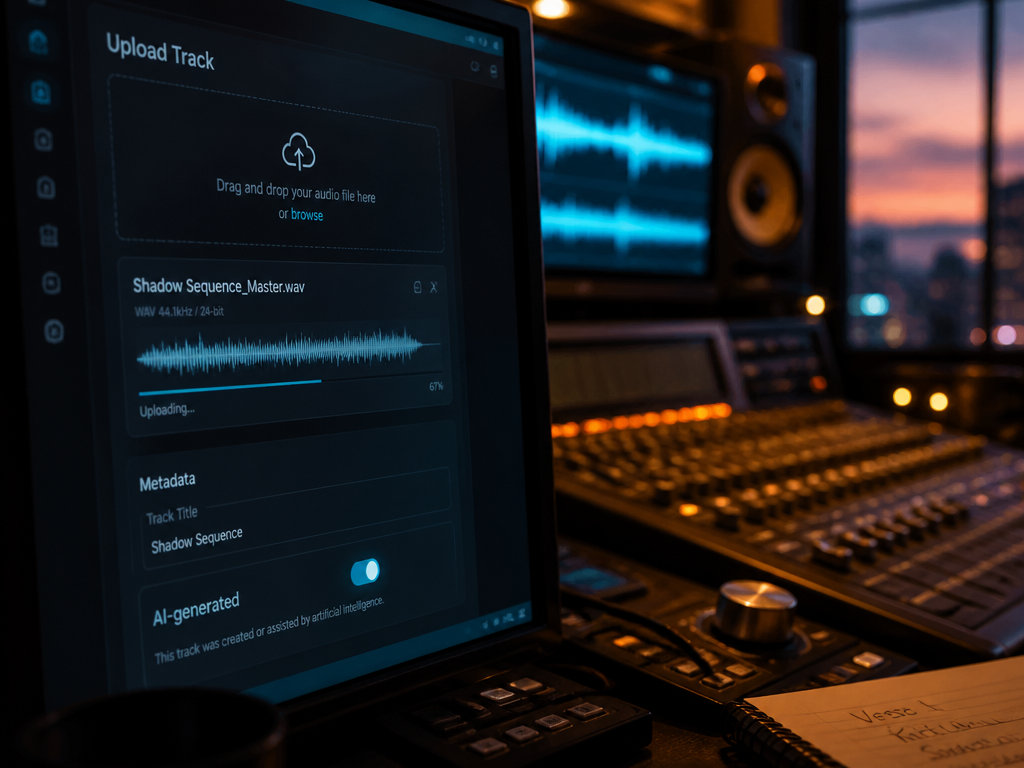
- At submission, declared by the uploader through the distribution form.
- In transit, carried inside the delivery package alongside ISRC, contributor credits, and territory rights.
- After ingestion, appended by a detection pass you run yourself.
Each of these has a failure mode. Uploader-declared data is only as honest as the uploader, and there is a clear incentive to under-declare when a label might affect discovery or payout. Delivery-package metadata assumes every distributor upstream of you implemented the same schema the same way, which they will not. And post-ingestion detection means you are now the party making a claim about someone else's work — a claim you may have to defend.

The industry framing treats the label as a transparency feature for listeners. Operationally it is a data-provenance problem, and provenance problems are governance problems: versioning, dispute handling, audit trails, and a policy for what a mislabeled track costs whoever mislabeled it. If your schema does not already have a place to store who asserted this flag and when, that is the first thing to build.
What the detectors can and cannot see
The other number attached to this movement is a detector accuracy figure — often cited near 99.8 percent. It sounds like a solved problem. It is not, and understanding why protects you from designing a pipeline around a promise the tools cannot keep.
A detection accuracy number is almost always measured against a specific test set: known AI-generated tracks from known models, versus known human recordings, under lab conditions. That is a very different task than judging an arbitrary upload from a model you have never seen, put through post-processing designed to look organic. Accuracy on a curated benchmark tells you little about performance in an adversarial queue, and generative music tools iterate faster than any detector's training data.
There is also the second-category problem. Detectors are built to answer "was this generated," not "was this assisted." A human vocal that passed through an AI de-noiser looks, to most classifiers, entirely human — which is arguably correct, and arguably the exact case the assisted label exists to catch. Detection cannot populate a field that depends on knowing the process, not the output. That part still comes from disclosure, and disclosure comes from trust, and trust is the thing standards are supposed to replace but cannot manufacture.
The gap between a standard and a rule
Here is the detail that tends to get lost in the announcements: a labeling standard is not an enforcement mechanism, and so far the coordinated efforts have been careful about that distinction. Organizations can define categories, publish schemas, and encourage adoption. What has been notably absent is language committing any specific platform to require the labels, reject unlabeled AI content, or penalize misdeclaration.
That silence is not an oversight. Enforcement is where the liability lives — for false positives that suppress legitimate artists, for false negatives that undermine the whole point, for the appeals process when a human musician gets flagged by a detector trained on someone else's model. A voluntary standard lets the industry demonstrate motion without owning the hard consequences of a rule. For your planning, that means the near-term reality is a schema you should support and a compliance regime you should not assume will be uniform, mandatory, or stable.
A readiness checklist for your pipeline
Before you write a line of code, run your intake against these questions:
- Storage: Does your metadata schema have a field for AI disclosure, and a separate field recording who asserted it and when?
- Categories: Can your form capture the two-category distinction, not a single AI/not-AI boolean?
- Ingestion: When a delivery package arrives with a disclosure flag from an upstream distributor, do you trust it, verify it, or overwrite it — and is that policy written down?
- Disputes: Is there a path for an artist to contest a flag your detector applied?
- Display: Where does the label surface to listeners, and does your product spec say what it should mean to them?
- Change management: When the schema revises — and it will — how do you re-label a back catalog without re-deriving claims you cannot support?
Answer those and you are ahead of most of the market, standard or no standard.
Back to the number
Return to where this started: half of new uploads, allegedly, are AI. Whatever the true figure — and it is a range assembled from parties who benefit from it being large — the labeling response is being built as if the number were settled and the tooling were finished. Neither is. What is real is the plumbing you will be asked to lay: a metadata field, a two-part decision tree, a detection pass that works better in a lab than in your queue, and a standard with no teeth yet behind it. Build for the plumbing, stay skeptical of the headline, and you will be ready for the rule whenever it actually arrives — which is a different thing than believing it already has.
Not sure which tool to use?
Compare the top AI music and sound tools side by side — honest reviews, real pricing, no sponsorships.