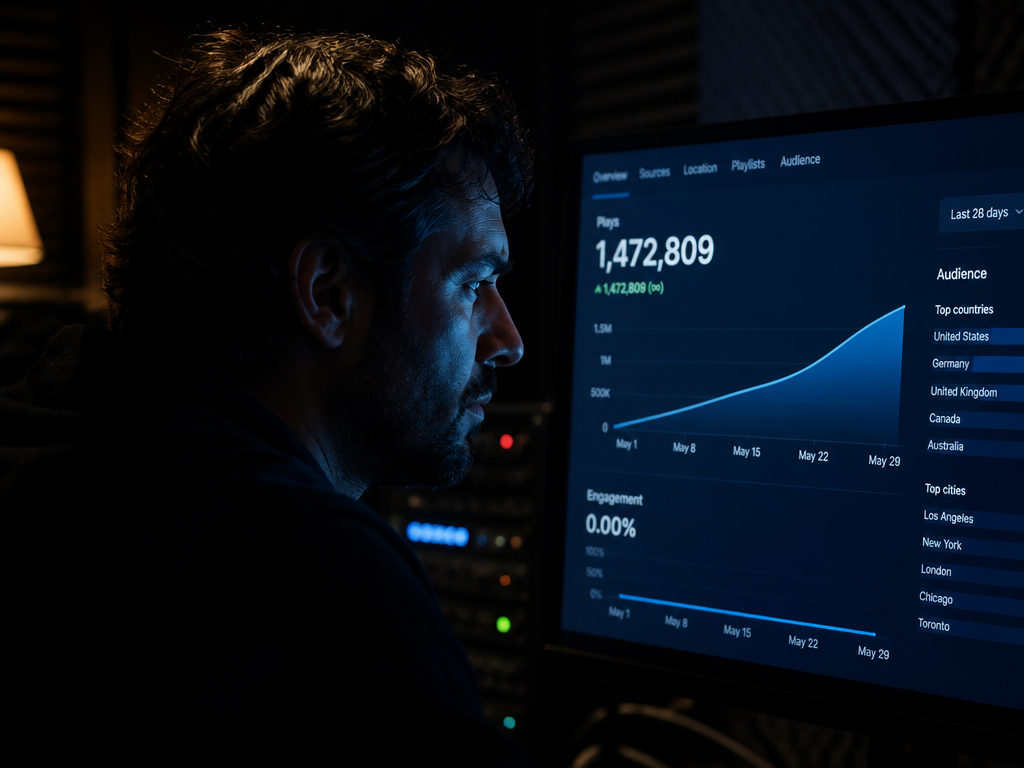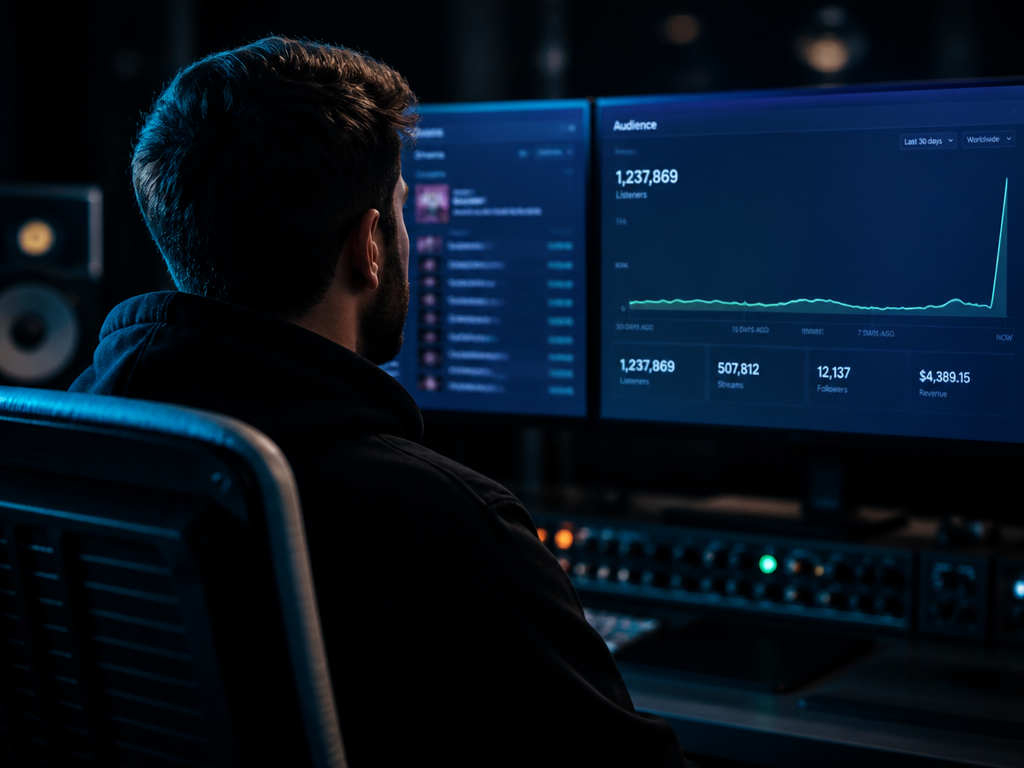
A release strategist I trade notes with sent me a screenshot last spring: a track that had been sitting flat at a few hundred monthly listeners, then a vertical line the day she posted a thirty-second clip of the session on three different platforms at once. The audio numbers moved two days later, not the same day. That lag is the whole game, and almost nobody plans for it.
That gap — between where a listener first hears something and where they end up streaming it on repeat — is what music community platforms are quietly reorganizing around. Spotify direct uploads, the video beta, the slow folding of "watch" and "listen" into one surface: these aren't separate stories. They're the same bet that the discovery moment and the monetization moment now live on different screens, and the platform that owns the handoff wins. If you release music without a label between you and the catalog, this changes how you sequence a drop. Here's what most people get wrong, what the data actually points to, and the order I run a release in now.
What most people do
Most independent artists treat distribution as a spray. One master, one set of metadata, blasted to every store and platform on the same day through a distributor, and then they wait. The logic is reasonable — you can't be everywhere manually, so you automate the everywhere. But it flattens four genuinely different environments into one button, and each of those environments rewards completely different behavior.
The second common move is platform monogamy in reverse: chasing whatever surface got a press cycle this quarter. When Spotify reopened direct upload paths and started testing video, a wave of artists treated it as a mandate — drop everything, get the video up, the algorithm rewards early adopters. Some of that is true at the margins. Most of it is prompt-roulette logic applied to release strategy: keep pulling the lever and hope the new feature pays out.
The third mistake is the quietest and the most expensive. People misread what "direct" means. A direct upload to a platform is not the same as a distribution deal, and it is definitely not the same as the catalog path most of the industry still runs through. Spotify's earlier direct-upload experiment, the one from the late 2010s, got shut down within about a year — the company decided its energy belonged in tools for the people who aggregate and distribute, not in being a distributor itself. When direct paths reopen in any form, they tend to reopen as a feature on top of the existing pipeline, not a replacement for it. If you treat a beta upload tool as your primary distribution rail, you build your release on a surface that can change its terms or close the door, as that history shows it has before.
And then there's the metric problem. Most people watch the wrong number on day one. They refresh the streaming dashboard the morning of release, see nothing dramatic, and decide the track didn't land. But the entire premise of the current platform shift is that the listen is downstream of the watch. You're checking the destination before the traffic has arrived.
What the evidence suggests
Strip the announcement language away and the strategic logic underneath the video push is simple arithmetic. Platforms have noticed that when someone watches a music video — a real performance clip, a session video, even a static visual with the audio under it — that person is measurably more likely to come back and stream the audio version later. Watching feeds listening. The video isn't the product; it's the on-ramp to the royalty-bearing thing, which is the stream.
That's why a streaming service that historically treated video as a side dish would invest in pulling video onto its own turf. The competitive frame writes itself: the biggest music-discovery surface on the planet is a video platform, and a streaming service that can keep the discovery moment inside its own walls — instead of losing it to a search bar somewhere else — gets to own both the first impression and the repeat play. The whole point is to stop the handoff from leaking to a competitor.
For an independent artist, the durable takeaway isn't "upload a video to the new beta." It's that the discovery surface and the monetization surface are diverging, and your release has to be built for both. That's a structural fact that will outlast any specific feature.
Here's how the major surfaces actually differ in what they reward, based on how each one is built rather than on any single quarter's metrics:

| Platform | What it actually rewards | What you're optimizing for |
|---|---|---|
| Spotify | Saves, playlist adds, completion rate, repeat listens | Long-tail streaming royalties, algorithmic playlist entry |
| YouTube | Watch time, click-through, comments, video as the unit | Discovery reach, ad/Content ID revenue, the search-result moment |
| Bandcamp | Direct fan purchase, follows, named support | Higher per-fan revenue, owned audience, no algorithm to please |
| SoundCloud | Reposts, comments-on-the-waveform, early-stage feedback | Producer-community traction, remix/collab discovery |
Read down the "what it rewards" column and the spray-everything-identically strategy falls apart. A track engineered to win a save on Spotify — strong front-load, a hook inside the first fifteen seconds, a reason to hit repeat — is not the same asset as a video built to hold watch time on YouTube, and neither is the same as a release-day post on Bandcamp where the entire transaction is one engaged fan deciding to pay you directly.
What's actually eligible, and what isn't
The constraints on direct video upload tend to be narrower than the marketing suggests, and they matter. Beta video features have generally launched with real technical limits: standard widescreen framing, real video content rather than auto-generated visualizers, and a gradual, invitation-style rollout rather than a flip-the-switch-for-everyone launch. As of writing, access is uneven and the supported-format list is short. If your plan depends on a feature you don't have access to yet, you don't have a plan — you have a waitlist.
There's also the eligibility question underneath the eligibility question. Content that earns royalties on a platform is content that platform can account for, chart, and monetize. A beta upload tool may or may not feed the same royalty and chart machinery as a track delivered through your distributor. Before you route a primary release through any direct-upload path, the thing worth confirming — in that platform's actual terms, not in a blog summary of them — is whether that upload counts the same way a distributed release counts. Those terms vary by platform and they change, so I'm pointing you at them rather than promising you what they say.
The AI-rendered footnote
If your audio is machine-generated — which, given where you're reading this, it might be — there's one extra layer. Original, commercially-safe renders are fine to distribute, but the video on-ramp introduces YouTube's Content ID into the picture, and Content ID matches on audio fingerprints whether a human or a model made the sound. An original render shouldn't trip it. A render that leaned too hard on a recognizable reference can. This isn't a reason to avoid AI sound — it's a reason to keep your generation original enough that the fingerprint is genuinely yours, and to keep the license documentation for anything you didn't make from scratch.
What I actually do
I sequence a release as a relay, not a starting gun. The mistake is firing every platform simultaneously and hoping. What I do instead is decide which surface owns the discovery moment, which owns the conversion, and stagger them so the second one catches the traffic the first one creates.
Here's the order, concretely.
1. Master once, deliver in formats, not in copies. I bounce a 48kHz/24-bit WAV master as the source of truth, then export a separate loudness-targeted version for streaming (around -14 LUFS integrated, true-peak under -1 dB) and keep stems and a clean instrumental on hand. The instrumental matters: it's the bed for a session video, a vertical clip, and a podcast-safe edit, all from one render. When the step works, you have one master and four delivery assets, not four masters drifting out of sync.
2. Send the audio through your distributor first, with lead time. The streaming version goes out through the normal distribution pipeline well ahead of the date — the standard window most distributors ask for is on the order of a couple of weeks, partly so the track is eligible for editorial playlist consideration. This is the rail that actually pays and actually charts. Direct-upload features sit on top of this, not in place of it. When this works, you have a live release date locked and a pitch submitted before anything public happens.
3. Build the video as an on-ramp, not an afterthought. Because the evidence says watching pulls listening, I cut a real video — a performance, a session, a process clip, something with motion that isn't a looping waveform. Standard widescreen, captioned, with the hook landing early. If a direct video-upload path is available to me on the streaming side, the video goes there too, so the discovery moment and the stream can live on one surface. If it isn't available yet, the video lives on the video platform where it always has, and I don't pretend the beta exists for me when it doesn't.
4. Seed the owned channels before the algorithmic ones. A day or two ahead, the people who'll pay directly hear it first — Bandcamp followers, the email list, the small SoundCloud circle who comment on the waveform. These are low-volume, high-conviction surfaces. They don't need an algorithm to find you, and the early saves and purchases from real fans are the signal the algorithmic platforms read as "this has traction." When this works, you've got a base of genuine engagement before the broad release rather than asking a cold algorithm to manufacture it.
5. Release the audio, then post the video on the lag. The track goes live. Then — not the same hour — the video clip drops across the discovery surfaces. The point of the gap is that the watch creates a delayed listen, and you want the audio to already be live and accountable when that delayed listen arrives. Posting the video the moment the track lands wastes the on-ramp on traffic that has nowhere to convert yet.
6. Watch saves and completion, not day-one stream count. The streaming number on release morning tells you almost nothing. What I actually track is save rate, completion rate, and the lag between a video view spike and an audio stream bump. If the video moves and the audio doesn't follow within a few days, the on-ramp is broken — usually the video and the track aren't telling the same story, or the hook isn't in the first fifteen seconds where a saver decides. When this works, you can see the relay handing off: views first, saves and streams trailing behind by a day or two.
The release-prep checklist I actually run
- [ ] 48kHz/24-bit WAV master archived as source
- [ ] Streaming version normalized (~-14 LUFS, true-peak < -1 dB)
- [ ] Clean instrumental and stems exported from the same master
- [ ] Distributor delivery scheduled with editorial lead time
- [ ] Metadata, credits, and ISRC consistent across every surface
- [ ] Video cut in standard widescreen, captioned, hook in first 15s
- [ ] License documentation on file for any sound I didn't make from scratch
- [ ] Owned channels (list, Bandcamp, SoundCloud) primed to seed first
- [ ] A single dashboard view tracking saves and completion, not raw plays
Where the tools fit
The honest version: most of this is sequencing and discipline, not software. Where a foundry like the one publishing this earns its place is upstream — generating the original bed, the alternate intro, the instrumental version, the thirty-second loop for the vertical clip — so that the four delivery assets in step one come from material you own outright and can clear without a sample-clearance headache. That's a genuine use, and it's the only one I'll claim here. The release strategy above works whether your audio came from a model, four broken synthesizers in a closet, or both.
The caveats I won't pretend away
This relay has failure modes, and the data-led optimism around video conversion glosses over them. The video-to-audio lift is real in aggregate, which is not the same as real for your specific track — averages hide the releases where the video did numbers and the audio flatlined because the two weren't the same song emotionally. Beta features close; the late-2010s direct-upload shutdown is the precedent, not an outlier. And the more your release leans on a single platform's tooling, the more exposed you are when that platform changes the deal. The owned channels in step four aren't sentimentality. They're the part of your audience that survives a platform rewriting its terms.
There's also a temptation, once you've read a column like this, to over-engineer. You don't need all six steps firing on every release. A loosie, a quick instrumental, a B-side — those can go out the simple way. The full relay is for the release you actually care about converting.
What to try this week
Pick one track you've already released that underperformed. Cut a real fifteen-to-thirty-second video clip from it — a performance angle, the session, a process shot, anything with motion that isn't a static waveform — caption it, and post it to your strongest discovery surface. Then watch the streaming dashboard for that specific track over the following three days, not the following three hours.
If the audio number moves on the lag, you've found your on-ramp, and you can build your next release around it on purpose. If it doesn't, you've learned something cheaper than a failed launch: the video and the song weren't telling the same story, and that's a fixable problem. Either way, you'll have measured the handoff yourself instead of taking a platform's word for it — which is the only version of this that's actually yours.
Not sure which tool to use?
Compare the top AI music and sound tools side by side — honest reviews, real pricing, no sponsorships.