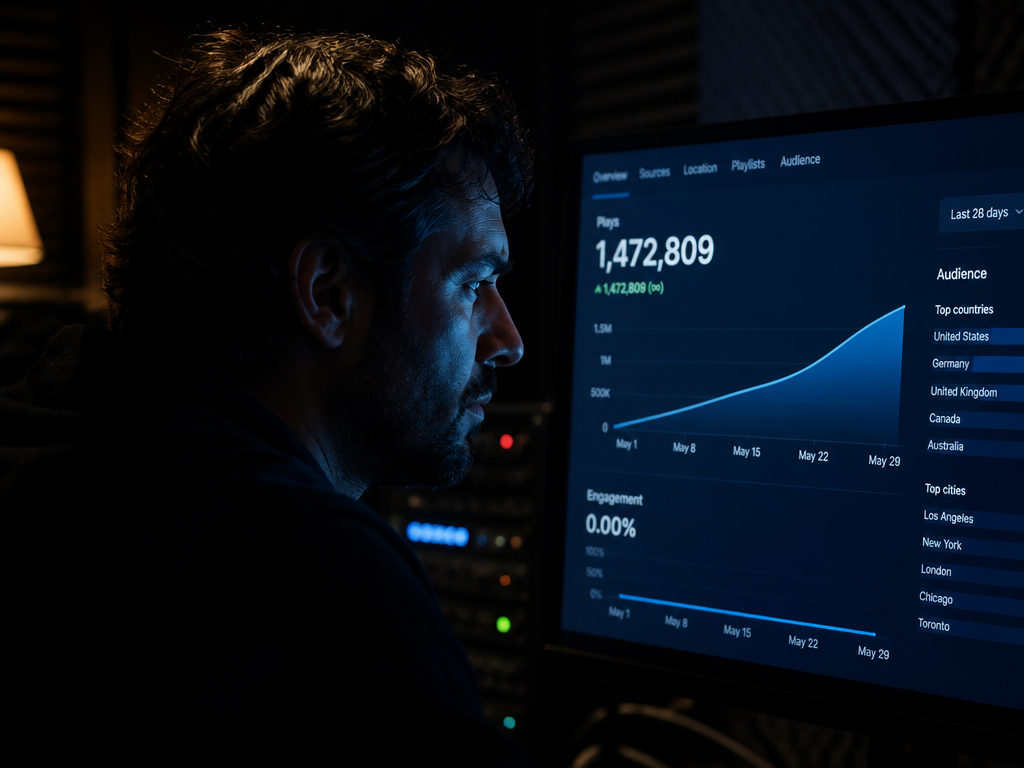
You open SoundCloud on a Tuesday and the track you posted Sunday night has 4,000 plays. You did nothing. No DSP placement, no blog, no post that took off. Just 4,000 plays, sitting there. And under them: zero comments, zero reposts that go anywhere real, a like count that didn't move with the plays. That gap — between the number going up and nothing happening because of it — is the whole story of artist promotion in 2025, and it's the number you should be staring at.
Because the plays are real in the sense that a counter incremented. They are fake in the sense that a play from a server farm in a country you've never released in does not buy you a single thing. It does not turn into a fan, a gig, a sync placement, or a curator who trusts your next link. The drop-off between bought reach and anything downstream of it tends to be near-total. That is the figure to build around. Not how many plays. How many plays that mattered.
What that gap actually measures
A play is the cheapest signal in music. It costs a bot operator a fraction of a cent to manufacture one, which is exactly why it's the metric the fraud economy sells. When someone DMs you "10k plays for $15," they are selling you the one number that is trivially fakeable and almost meaningless on its own.
What's expensive — what can't be cheaply faked at scale — is everything that happens after the play:
- A save to a personal library
- A repost from an account with its own real listeners
- A comment that references a specific second of the track
- A follow that survives a week
- A return listen from the same human three days later
When you measure the distance between your play count and those second-order actions, you're measuring whether anyone was actually there. Real listening leaves a wake. Bot traffic leaves a flat line with a tall number on top of it.
Labels know this. A&Rs know this. The serious playlist curators learned it years ago. When they look at a profile, they are not impressed by 200k plays; they are doing the same subtraction you should be doing, and a profile with 200k plays and forty comments reads as a confession, not a flex.
What it doesn't measure — and where artists get fooled
Here's the trap. The gap I'm describing is a great fraud detector, but it is a bad measure of quality. A track can have honest, modest numbers and slow growth and still be the best thing you've made. Organic engagement tells you people are real. It does not tell you the work is good, and it does not tell you it's good yet.
So don't flip the logic into a new anxiety. Low real engagement on a new release isn't a verdict. It's a starting position. The point of reading the gap is narrow: to know whether the numbers in front of you describe human beings or describe a transaction. Once you know that, you can make decisions. With bought numbers, you can't make any decision at all, because you're reading noise.
Why the bots cost more than they charge
The pitch for fake engagement is that it primes the pump — that a big number attracts a real audience. The mechanism that's supposed to make that work mostly doesn't, and the downside is concrete.
Platforms run fraud detection that's gotten sharper every year. Industry bodies track manipulation across DSPs because manufactured streams distort royalty pools, and the platforms respond by stripping fake plays, suppressing flagged accounts in recommendation systems, and in some cases penalizing the profile. The risk isn't only that you wasted fifteen dollars. It's that the algorithm you were trying to game learns to distrust your account, which is the exact opposite of what you paid for.
Then there's the credibility tax, which is harder to measure and worse. A curator who clocks your profile as inflated doesn't tell you. They just don't reply, and they remember the name.
The slower thing that actually works
The honest alternative is unglamorous and it's reciprocal. Networks built around real artists trading real attention — RepostExchange being the long-running example, founded back in 2017 and folded closer into SoundCloud's own world — work on a simple mechanic: you repost other people's tracks to your followers, you earn the same in return, and the engagement that results comes from accounts that are themselves real artists with real audiences. It's not magic and it's not instant. It's a system where the unit being traded is genuine reach instead of fabricated counts.
That's the category worth your time: anything where the engagement is a byproduct of an actual human relationship. Reciprocal repost networks. Genre-specific Discord and Reddit communities where people share works in progress. Direct collaboration — a feature verse, a remix swap, a co-sign from someone one tier above you. These move slower than a bot order. They also compound, which a bot order never does.
Read your own stats like a skeptic
Before you spend on any promo service, run your existing numbers through this. It's the same subtraction a curator does, and it takes two minutes.
| Signal | Healthy organic pattern | The bot tell |
|---|---|---|
| Plays vs. likes | Likes rise roughly in step with plays | Plays spike, likes flat |
| Reposts | From accounts with their own listeners | From empty or generic profiles |
| Comments | Reference a moment in the track | None, or generic ("nice track") |
| Geography | Matches where you've actually reached | Random countries you've never posted to |
| Timing | Spread out, follows your posting/sharing | A vertical wall in a few hours |
If your real numbers are small, that's fine. Small and real is a foundation. Big and fake is a liability dressed as an asset.
One thing inside your control
You can't control the algorithm and you can't manufacture taste. What you can control is shipping work that's actually yours, cleanly licensed, with no sample-clearance landmine waiting to detonate after a track gains traction. That's the angle behind a foundry like City of Punk — original, commercially-safe sound and stems you can release without a clearance problem undercutting the slow, real growth you're trying to build. The growth is the hard part. Don't let the source of your sound be the thing that takes it down.
Plays are the number anyone can buy. Everything that matters is the number nobody can.
Not sure which tool to use?
Compare the top AI music and sound tools side by side — honest reviews, real pricing, no sponsorships.