Deezer said it out loud before most of its competitors did: on some days, roughly a third of the tracks arriving at its ingestion pipeline are fully machine-generated. Later reporting from the platform pushed that figure higher — north of a quarter, then toward a third and beyond, depending on the week you asked. That single number is doing an enormous amount of work in the current panic about AI music detection, and it deserves a closer read than the headlines gave it. Because the number is real, and it also does not mean what most people in the room think it means.
Start with the number. Then figure out what it counted. Then — this is the part that decides whether your catalog survives the next three years — figure out what it left out.
The number counts uploads, not listens, not dollars
Here is the crucial distinction buried under the scary percentage. The figure describes arrivals, not plays. It measures how many files hit the delivery pipeline and got flagged by an in-house classifier as fully synthetic. It says nothing, directly, about how many times those tracks were streamed, how much revenue they generated, or whether a human being chose to listen to a single second of them.
That gap matters more than the number itself. A pipeline can be 30 percent AI-generated by volume and 1 percent AI-generated by actual listening time. Most of those uploads are the sonic equivalent of link spam — batch-generated ambient loops, lo-fi wallpaper, sleep-and-focus filler uploaded in bulk on the statistical bet that a sliver will get caught by an algorithmic playlist. The detection stat tells you the front door is crowded. It does not tell you what happened once those files were inside the house.
So when a label executive reads "a third of uploads are AI" and hears "a third of my artists' income is gone," that is a leap the data has not yet supported. The number is a symptom worth taking seriously. It is not, on its own, the diagnosis.
What the classifiers are actually detecting
The detection systems making these counts are trained to answer one narrow question: does this audio bear the statistical fingerprints of a known generative model? They listen for artifacts — the particular way certain models handle transient smearing, stereo-field symmetry, the too-clean decay on a reverb tail, the absence of the micro-timing drift a human drummer leaves behind. A track generated end to end by a common model tends to sit inside a recognizable distribution, and that is what gets flagged.
What those systems handle badly is the middle. And the middle is where nearly all of the interesting music is going to live.
Consider four tracks:
- A song written, performed, and mixed by humans, with no AI in the chain.
- A human song where a generative tool cleaned up a noisy vocal or invented a two-bar transition.
- A human topline sung over a fully AI-generated instrumental bed.
- A track generated whole-cloth from a text prompt, untouched.
A classifier can distinguish the first from the fourth with reasonable confidence. The two in the middle are where it gets soft, and where the honest engineers will tell you the false-positive and false-negative rates climb. A producer who runs a legitimate vocal through a modern stem-separation or de-noise tool — standard practice in 2020, let alone now — can trip a naive detector. Meanwhile a generated instrumental with a real voice on top can pass as human because the thing the model is worst at faking, a human larynx, is the thing it was told to leave alone.
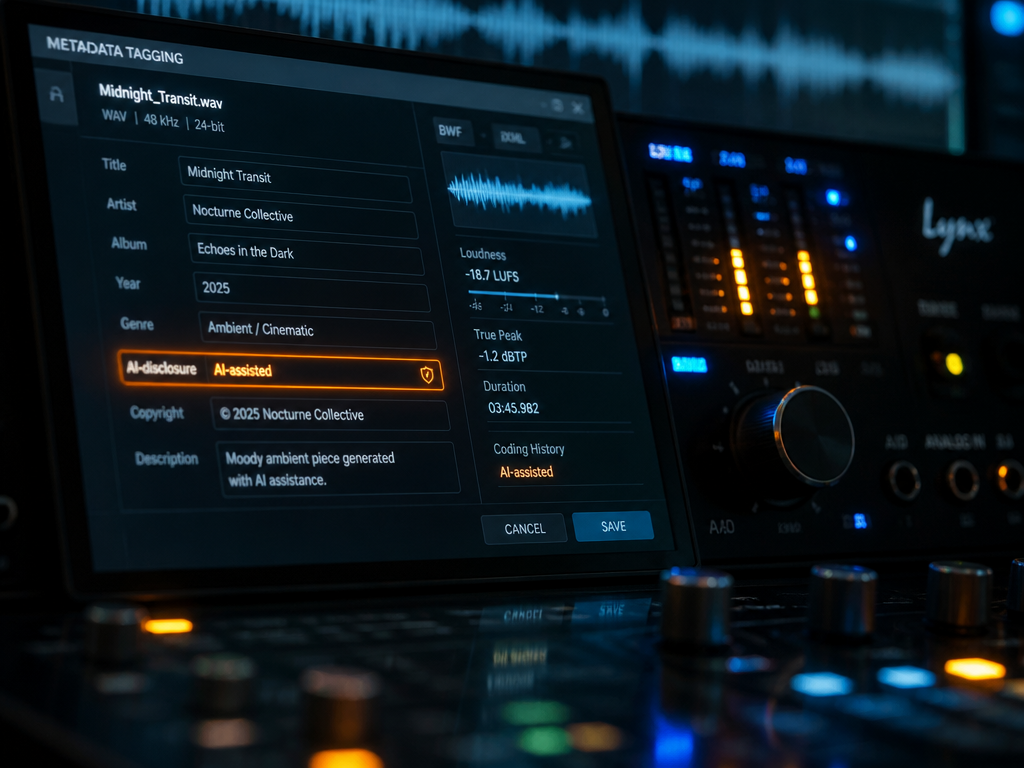
This is why the industry proposal that got the most attention — a two-tier tag distinguishing AI-generated from AI-assisted content — is both sensible and quietly optimistic. It assumes we can reliably sort tracks into those buckets at scale. Detection can do it at the extremes. In the middle, "AI-assisted" is a spectrum that runs from a mastering plugin to a machine that wrote the melody, and no current classifier draws that line cleanly.
What does AI music detection actually check?
AI music detection checks whether a piece of audio matches the statistical signature of a machine-learning model rather than a human recording — it does not check who owns the music, whether it infringes copyright, or whether it was fraudulently uploaded. A detector answers "was this likely generated?" It does not answer "is this legal?", "is this original?", or "should this earn royalties?" Those are separate questions requiring rights metadata, fraud analysis, and — eventually — human or legal judgment. Treating a detection flag as a verdict on any of those is the single most common mistake being made right now.
The distinction is worth holding onto because the loudest arguments conflate three different problems: authenticity (is it AI?), integrity (was it uploaded to game the system?), and rights (does someone else own the training data or the output?). Detection touches the first, glances at the second, and cannot see the third at all.

The royalty pool doesn't care whether you listen
Now to the part that keeps distributors awake, and the reason the upload number frightens people even though it measures uploads.
Most streaming services pay out on a pro-rata model. The subscription and ad money for a period goes into a pool, and each rightsholder is paid a share proportional to their fraction of total streams. The mechanism is the vulnerability. You do not need AI tracks to be popular to dilute the pool — you need them to accumulate streams at all, at scale, and to increase the denominator faster than the pool grows.
Picture it concretely. A month's pool is a fixed pie determined by subscriber revenue. If ten thousand generated ambient tracks each pull a few hundred streams from playlist placement, sleep timers, and looped background use, that is a few million streams siphoned off the top before a single human artist's numbers are counted. The pie did not get bigger. The number of hands reaching into it did. Every legitimate release now represents a slightly thinner slice.
This is the real fear, and it is a structural fear, not a quality fear. It does not require the AI music to be good. It does not require anyone to prefer it. It only requires the payout math to be pro-rata and the marginal cost of generating a track to approach zero. That combination — infinite cheap supply against a fixed pool — is what makes the upload count feel like an emergency even when the listening data looks calm.
Detection is being proposed as the fix. But detection only helps here if it is wired into a policy — demonetize flagged tracks, exclude them from the pool, cap their playlist eligibility. Flagging a track and then paying it anyway accomplishes nothing for the pool. The tag is a prerequisite for the intervention. It is not the intervention.
Every platform is solving a different problem
The industry response has not been unified, and pretending otherwise sets stakeholders up for a nasty surprise when they discover a track behaves differently on each service.
Broadly, three postures have emerged, and they map to different business incentives:
| Posture | What it looks like | Who tends toward it |
|---|---|---|
| Detect and disclose | Flag AI tracks, label them for listeners, keep them monetized | Platforms competing on catalog breadth |
| Detect and gate | Flag AI tracks, exclude from editorial playlists or the pro-rata pool | Platforms positioning on artist trust |
| Detect and remove | Flag and pull fully-generated tracks, especially fraud-linked ones | Platforms already fighting stream fraud |
These are not settled categories, and any given platform may run all three depending on the track and the week. The point is that a track's fate depends on whose pipeline it entered. The same generated file can be labeled and paid on one service, ghosted from playlists on a second, and rejected at ingestion on a third. There is no single answer to "what happens to AI music" because there is no single detector, no single threshold, and no single monetization rule behind them.
For a distributor delivering to dozens of DSPs, this fragmentation is the actual operational problem. You are no longer shipping one file to one standard. You are shipping into a patchwork of detection models with undisclosed thresholds and unpublished consequences, and your artists will ask you why the same catalog earns differently across services. "The detectors disagree" is a true answer that will satisfy no one.
The responsibility gap nobody wants to own
Here is where the announcements go quiet. A tagging standard answers what the labels should be. It is markedly less clear on who applies them, who verifies them, and who is liable when they are wrong.
Walk the chain. The artist or the AI tool knows the truth of how a track was made, but has every incentive to under-disclose if disclosure costs playlist placement or royalty eligibility. The distributor passes files through and could attach metadata, but generally does not have forensic capacity to verify claims at volume. The platform can run detection, but a detector produces a probability, not a fact, and platforms are wary of the liability in either direction — demonetizing a human artist by mistake, or paying a fraud ring by omission.
So the tag exists as a specification, and each link in the chain has a reason to hope the link before it did the work. That is not a standard. That is a hot potato with a schema attached.
The uncomfortable truth is that self-declaration and automated detection are both necessary and both insufficient. Self-declaration is honest until dishonesty pays. Detection is scalable until it is wrong. A durable system needs declaration checked against detection, with a dispute process for the false positives that will absolutely happen — and someone has to fund and staff that process. As of writing, no proposed standard specifies who.

What to actually do this quarter
If you sit anywhere in the value chain, the correct posture is not to wait for the standard to settle. It will not settle soon, and the operational decisions cannot wait for it. Here is a working checklist, grouped by role.
If you run a label or manage rights: - Audit your own catalog against at least one third-party detector before a platform does it for you. Know your false-positive exposure — which of your legitimately human tracks might trip a flag because of heavy processing. - Get disclosure language into your artist and producer agreements now, defining AI-generated versus AI-assisted in your own terms. Do not wait for a universal definition that may never arrive. - Track per-DSP payout behavior on any borderline release. If the same track earns differently across services, that is your early warning that detection thresholds are diverging.
If you distribute: - Decide your disclosure policy before a DSP forces one on you. Passing unverified metadata through is a position, and it is one you may have to defend. - Build the capacity to attach and update AI-status metadata per delivery target, because the standards will not converge and you will be shipping different tags to different platforms. - Keep a paper trail of what each artist declared. When a dispute lands, the declaration is your evidence.
If you're an artist worried about the pool:
- Assume detection is imperfect in both directions and that your fully human track could be misflagged. Keep your session files, stems, and dated project histories. A 48kHz WAV bounce with a version history is worth more than an argument.
- If you use AI tools in your process — cleanup, transitions, stems — document where and how. "AI-assisted" is not an accusation, and being able to describe your chain precisely is your best protection against a bad flag.
None of this uses the word "just." None of it is quick. All of it is cheaper than discovering after the fact that your catalog got swept into a demonetization bucket you never saw coming.
What detection buys you, and what it doesn't
Detection is a genuinely useful instrument. It gives platforms a scalable first filter, it makes bulk-upload fraud more expensive to run, and it creates the metadata layer that any future monetization policy will need to stand on. Those are real gains, and the people building these classifiers are doing serious engineering, not theater.
But be clear about the ceiling. Detection is a probability engine pointed at a moving target. Every improvement in detection is an incentive for the next generation of models to hide their fingerprints better, and generation is currently improving faster than detection is. The classifiers will keep getting harder to trust exactly as they get more important. That is not a reason to abandon them. It is a reason to stop treating the flag as a verdict.
The deeper issue the upload number exposes is not detection at all. It is the payout structure. A pro-rata pool with a fixed size and an effectively infinite supply of cheap content was always going to strain, and AI generation is the thing that made the marginal cost of a new track collapse to nearly nothing. You can label every synthetic track perfectly and still watch the pool dilute if the policy behind the label pays them anyway. Some platforms are experimenting with user-centric or artist-centric payout models that route a listener's subscription to the artists that listener actually played — a change that would blunt the dilution mechanic regardless of how good detection ever gets. That structural conversation matters more than the tagging conversation, and it is getting a fraction of the attention.
Detection tells you what a track probably is. Only policy decides what a track is worth. The industry has spent most of its energy on the first question because it feels tractable and technical, and comparatively little on the second because it is a fight about money and everyone at the table earns from the current arrangement.
The number that started this — a third of uploads, machine-made — is a useful alarm precisely because it is so easy to misread. It measured supply. It did not measure demand, revenue, fraud, or harm. It told you the door is crowded. It is the height of the crowd that made the industry finally build a doorman, and the doorman is a good idea. But a doorman who can count heads and cannot check tickets, backed by a venue that pays everyone who gets in regardless, has not actually solved the problem the crowd represents.
Build the detector. Publish the threshold. Fund the disputes. And then have the harder conversation about the pool, because that is the one that decides who gets paid.
Detection can tell you a machine made the song. It can't tell you a human deserves to be paid — that's still your call, and you're still making it.
Not sure which tool to use?
Compare the top AI music and sound tools side by side — honest reviews, real pricing, no sponsorships.