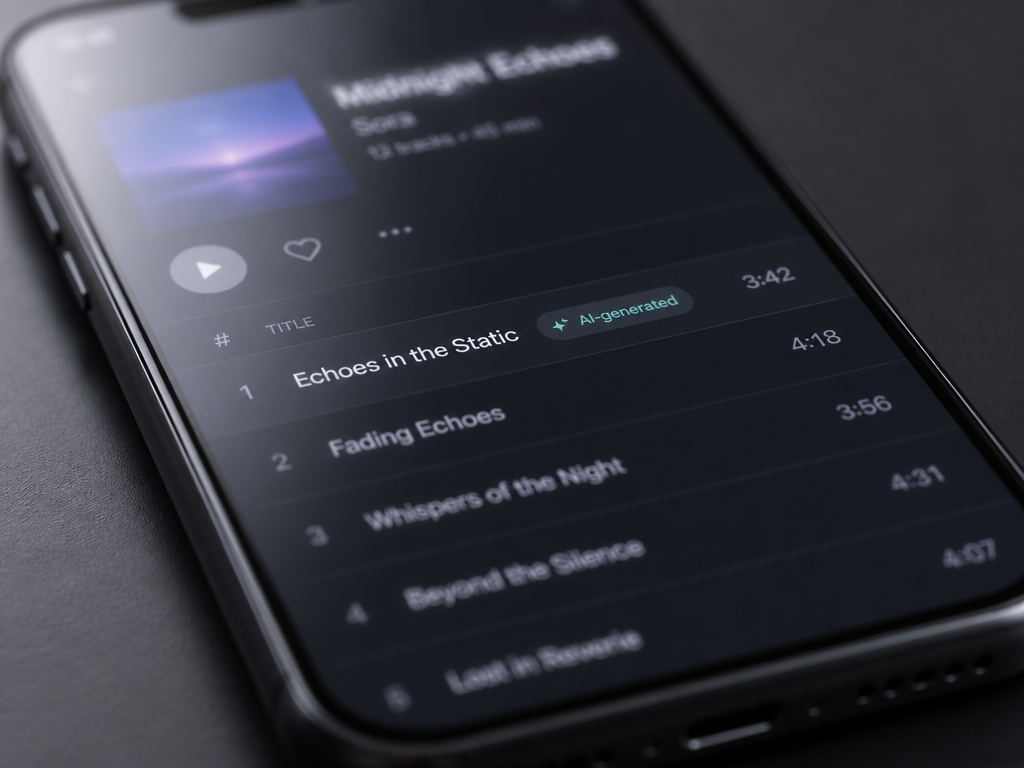
You render a track in your AI tool of choice — an 80 BPM downtempo thing, warm Rhodes-ish keys you played in yourself, a bassline the model generated, your own vocal chop on top. You bounce it to 48kHz WAV, hand it to your distributor, and three weeks later it shows up on a streaming service wearing a badge you never applied: "AI-generated." You wrote the melody. You sang. But somewhere in the pipe, a classifier looked at the spectral fingerprint and made a call about your creative process that you didn't get to weigh in on.
That gap — between how a track was actually made and how a system decides to label it — is the whole story of AI music labeling right now. If you upload, curate, or just want to know what you're listening to, the question isn't whether labels exist. It's who sets them, what they check, and what happens to your track once the tag is on it. Those three things are not decided in the same place, and they don't agree with each other.
What is AI music labeling?
AI music labeling is the practice of tagging a recording with information about whether artificial intelligence was involved in creating it, and to what degree. In its cleanest form it lives in a track's metadata — the same file fields that carry the ISRC, the songwriter credits, and the release date — and travels with the recording from distributor to platform. In its messier form it's a badge a streaming service or a detection tool applies on its own, based on what its model thinks it hears. Both get called "labeling." They are not the same mechanism, and confusing them is how producers get surprised.
Two categories everyone is trying to draw a line between
Most emerging frameworks split AI involvement into two buckets, and the line between them is where all the argument lives.
- AI-generated: a model produced most or all of the audio you hear. You may have typed the prompt and picked the take, but the sound itself came out of the system.
- AI-assisted: a human made the core creative decisions — played parts, wrote the topline, arranged the piece — and used AI for specific tasks like mastering, stem separation, a fill, or a background texture.
On paper this is tidy. In a real session it is not. If you generate a chord progression, replay it on your own keyboard, then run the result through an AI mastering chain, which bucket are you in? The frameworks tend to hinge on where the creative decisions came from rather than which tools touched the file. That's a judgment, and judgments are exactly what automated systems handle worst.
Three ways a label gets applied — and where they diverge
There are three lanes putting labels on music, and they operate on completely different logic. Here's how they stack up against the criteria that actually affect you.
| Criteria | Industry metadata standards | Platform-side rules | Automated detection |
|---|---|---|---|
| Who sets the tag | You / your distributor | The streaming service | A classifier model |
| What it examines | Your declaration of process | Your declaration + their policy | The audio itself |
| Can you appeal it | It's your input | Usually, via support | Rarely, and slowly |
| Main failure mode | People don't fill it in | Policies differ per platform | False positives |
| Travels with the file | Yes, in metadata | No, platform-local | No, platform-local |
Lane 1: Industry metadata standards

This is the version the trade bodies are pushing toward — a standardized field where you, the person who made the thing, declare whether it's AI-generated or AI-assisted, and that declaration rides along in the file. The strength is obvious: nobody knows how your track was made better than you do. The weakness is just as obvious. It's a self-declaration, so it's only as honest and as complete as the person filling it in, and adoption across distributors is uneven. A field that exists but sits empty tells a listener nothing.
Lane 2: Platform-side rules
Individual streaming services have started building their own answers. Some are rolling out disclosure requirements at upload; some display a provenance or verification indicator; some quietly demote content they consider low-effort AI churn. The important detail for you is that these rules are local to each platform and they don't match. A track labeled one way on one service can appear differently — or carry no label at all — on the next, because the tag lives on the platform, not in your file. As of writing, the specifics shift often enough that you should read each destination's current policy before you release, not after.
Lane 3: Automated detection
This is the lane that flags a track without asking anyone. A classifier analyzes the audio and estimates how likely it is to be machine-generated. It's the only method that doesn't depend on honesty, which is its appeal. It's also the one that mislabeled the producer in the opening — because these models learn the statistical texture of AI output, and a heavily processed human recording, a hyper-clean master, or a genre that already leans synthetic can trip the same wire. Detection accuracy varies by tool and by genre, and vocals, ironically, are among the hardest cases to call. A false positive here doesn't stay a technicality; it can attach a label to your work that you can't easily remove.
If you upload: a pre-release check
- Fill in the AI field even when it's optional. An empty declaration invites a classifier to decide for you.
- Match your claim to your process. If a human made the core creative calls, that's AI-assisted; don't over-declare out of caution.
- Keep your project files and stems. If detection flags you, session evidence and dated stems are the closest thing you have to an appeal.
- Read each platform's current policy per release. They diverge and they change.
- Know your tool's license. Labeling is about disclosure; commercial use is a separate question your generator's terms govern.
If you curate or listen: what the badge tells you
A label answers one question — roughly how the track was made — and no others. It does not tell you whether the song is any good, whether the artist is real, or whether a human sang the hook. An "AI-assisted" tag might sit on a track that's 95 percent a human band with one generated pad. An unlabeled track might be pure model output that slipped through because the field was blank and the classifier didn't catch it. Treat the badge as provenance, not as a quality rating and not as proof.
The verdict that's forming
Line the three lanes up and a pattern shows. Metadata standards get provenance right but depend on people telling the truth. Platform rules capture intent but don't agree with each other and don't follow your file. Detection is the only honest-proof method and the one most likely to be wrong about you specifically. None of them, alone, does the job — which is why the labels you'll actually see are a patchwork of all three, applied by different hands with different stakes.
For now, the tag on your track describes how it was made. It doesn't decide whether it was worth making. That's still your call, and the label was never built to take it from you.
Not sure which tool to use?
Compare the top AI music and sound tools side by side — honest reviews, real pricing, no sponsorships.