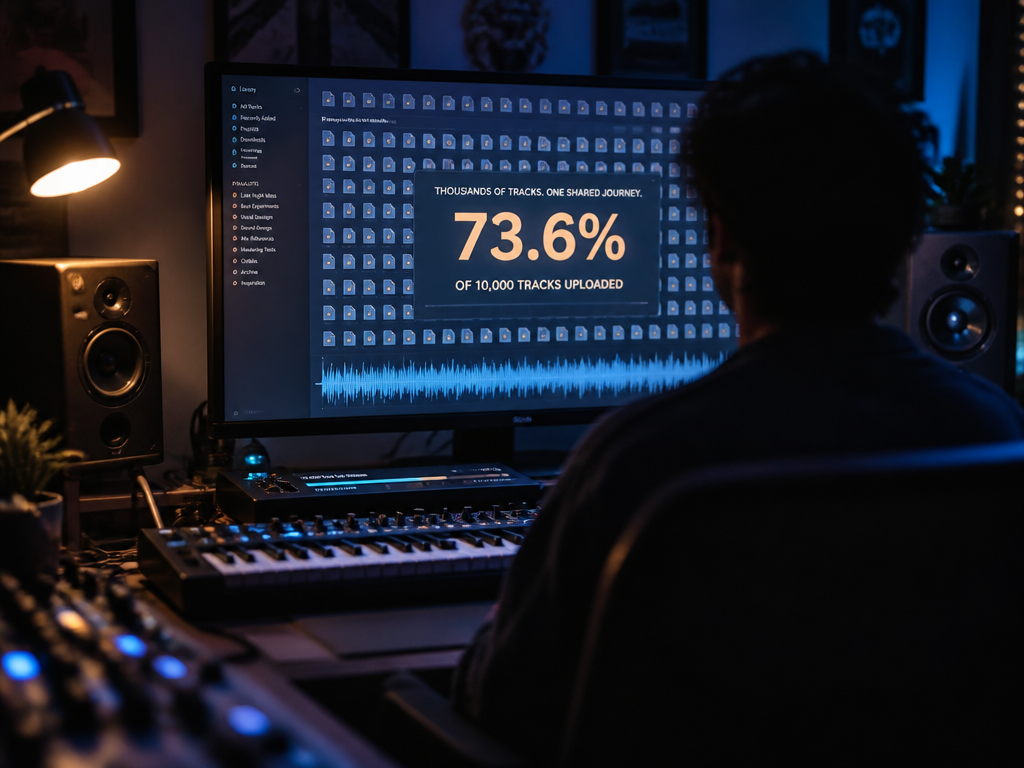
There's a number that's been doing the rounds in label Slacks and producer Discords, and it goes something like this: somewhere around 40-something percent of tracks uploaded to streaming platforms in a given day are AI-generated. The exact figure shifts depending on who's counting and when — I've seen it quoted as 18 percent, as 28, as "nearly half" — but the shape of it is always the same. A big fraction. Rising. Stated with a kind of flat dread, the way you'd report a flood line on a bridge.
If you make music for a living, that number lands in your stomach. AI music generation has gone from a novelty to a firehose in about two years, and the natural conclusion is that the firehose is pointed at your rent. I want to slow down on that number, because I think it's measuring something real and then getting used to scare you about something else entirely.
(Disclosure up front, because you'd find it anyway: City of Punk builds AI music tools. I score indie games and short films, I've shipped tracks made the slow way and the fast way, and I'm not going to pretend the upload counter doesn't have my name adjacent to it. The point of this piece is to be straight about what the panic gets right and what it gets wrong.)
The number, and where it came from
Take the headline figure at face value for a second. As of writing, multiple platforms and detection vendors have floated stats in the same neighborhood: a large and growing share of daily uploads are flagged as machine-generated. Some platforms have said it out loud in their own filings and blog posts. The figure travels well because it's clean, it's alarming, and it confirms what every working musician already feels — that the channel they upload to is getting crowded with stuff that didn't cost anyone a session.
Here's the thing about a clean number. It's almost always hiding three or four messy ones.
What it actually measured
"Uploads flagged as AI-generated" is doing a lot of quiet labor in that sentence.
First: uploads, not plays. A platform can ingest fifty thousand AI tracks a day and have almost none of them surface to a listener. Upload volume is the cheapest thing in the world to inflate — it costs a prompt and a render. The number tells you how much is being poured in, not how much is being poured out to ears. Those are wildly different quantities, and the gap between them is where your actual income lives or dies.
Second: detection is fuzzy. The tools that flag AI audio are looking for statistical fingerprints — artifacts in the high end, suspiciously clean phase relationships, the particular way a mushy render handles a vocal sibilant or a cymbal decay. They get fooled in both directions. A bedroom producer's overcompressed lo-fi loop can trip the same wire as a generated one. A clean, well-prompted instrumental run through a real analog chain can sail through undetected. Any percentage built on that foundation has an error bar nobody prints next to it.
Third: the number conflates things that aren't the same thing. A fully generated four-minute song competing for a playlist slot is one category. A 90-second ambient bed for a meditation channel is another. A functional drum loop at 120 BPM destined for a content farm is a third. Lumping them into one scary fraction is like reporting "vehicles on the road" without separating ambulances from go-karts. Most of that upload flood is functional audio — texture, filler, background — not songs anyone was going to fall in love with.
What it doesn't measure at all
Now the part that should actually keep you up.
The upload number measures supply. It says nothing about the system deciding whose supply gets heard. And that system — the recommendation engine, the playlist editorial logic, the algorithmic radio that decides what plays after the song someone actually chose — is the thing quietly sorting your career.
This is the move I want you to make: stop watching the firehose, start watching the valve.
A streaming platform doesn't pay out based on how many tracks exist. It pays based on which tracks get streamed, and an enormous share of streams come from algorithmic placement, not search. If the system optimizes for "retention" — keep the session going, don't make anyone reach for the skip — then cheap, inoffensive, infinitely available instrumental audio is structurally favored. Not because a person decided AI should win. Because the metric rewards the thing AI is best at producing: pleasant, frictionless, endless wallpaper that nobody complains about and nobody seeks out.
That's the threat. Not a robot writing a better song than you. A payout pool that's fixed in size, an allocation system tuned for retention over intention, and a near-zero-cost way to manufacture retention-friendly filler at industrial scale. Your detuned analog bassline under a broken 808 isn't losing to a machine on quality. It's losing to a machine on margin, inside a sorting mechanism that was never built to care about the difference.
The contradiction is the system, not a betrayal
You've watched a platform warn listeners about AI slop one week and announce an AI-generation feature or a catalog licensing deal the next. It reads as hypocrisy, and it is, but it's more useful to read it as honesty by accident.
A streaming platform's incentive is to maximize hours streamed at minimum royalty cost per hour. Human-made music with a devoted audience drives subscriptions — that's the marketing value, the thing they put in the warning post. Cheap functional audio drives margin — that's the thing they put in the product roadmap. There's no contradiction inside the spreadsheet. The platform wants the prestige of your artistry and the unit economics of a render farm, and it will say whichever one suits the audience in the room. Expecting it to pick a side is expecting it to act against its own structure.
So when the mixed signals confuse you, that confusion is accurate. You're reading a machine that genuinely wants both.
How I'd decide where to put your energy and money
If you're an indie artist or a small label trying to figure out where AI fits — as a tool you use, a threat you fight, or noise you ignore — here's the frame I'd use instead of the upload stat.
- Where does your money actually go, and what's the license? Any AI tool you adopt should give you commercial-use terms in plain language, not buried in a footnote, and ideally stems and a clean export (48kHz WAV, not a lossy bounce). If you can't tell who owns the output, that's the answer.
- What does the platform you depend on optimize for? If it's pure retention, functional audio will outcompete you there structurally. Don't fight the algorithm on its turf; build the relationship it can't manufacture.
- What's the 12-month cost — in dollars and attention? A subscription that saves you ten hours of tedious bed-music work is worth it. One that pulls you into prompt-roulette, chasing a usable render that never quite arrives, is a tax on your real catalog.
- Who is this wrong for? Anyone whose value is the human fingerprint — the voice, the story, the live room. AI generation can't fake the thing your audience showed up for. Using it to chase the filler market is competing for the one race you're built to lose.
Who should worry, who shouldn't
If your income comes from licensing functional audio — corporate beds, hold music, generic underscore — the supply flood is aimed squarely at you, and the margins are about to get ugly. That's real, and I won't soften it.
If your income comes from people who chose you — a fanbase, a sync relationship built on a recognizable voice, a live draw — the upload number is mostly weather. The system isn't built to surface you anyway; you were always going to win through relationship, not algorithmic luck. AI as a tool in your chain — sketching ideas, generating textures you then mangle, killing the tedious parts — is leverage. AI as a competitor for your audience's attention barely registers, because that attention was never allocated by upload volume.
What this didn't answer
I haven't told you whether disclosure labels will get enforced, because nobody knows yet — voluntary tagging is easy to dodge and the standards aren't settled. I haven't told you whether per-stream economics will shift to protect human work, because that's a fight between platforms, rights organizations, and regulators that hasn't resolved as of writing.
What I can tell you is to stop reading the upload counter as your fate. The number to watch isn't how much AI gets poured in — it's the payout terms, the metadata rules, and what the recommendation system is tuned to reward. The firehose is loud. The valve is quiet, and the valve is where your rent is decided.
Not sure which tool to use?
Compare the top AI music and sound tools side by side — honest reviews, real pricing, no sponsorships.