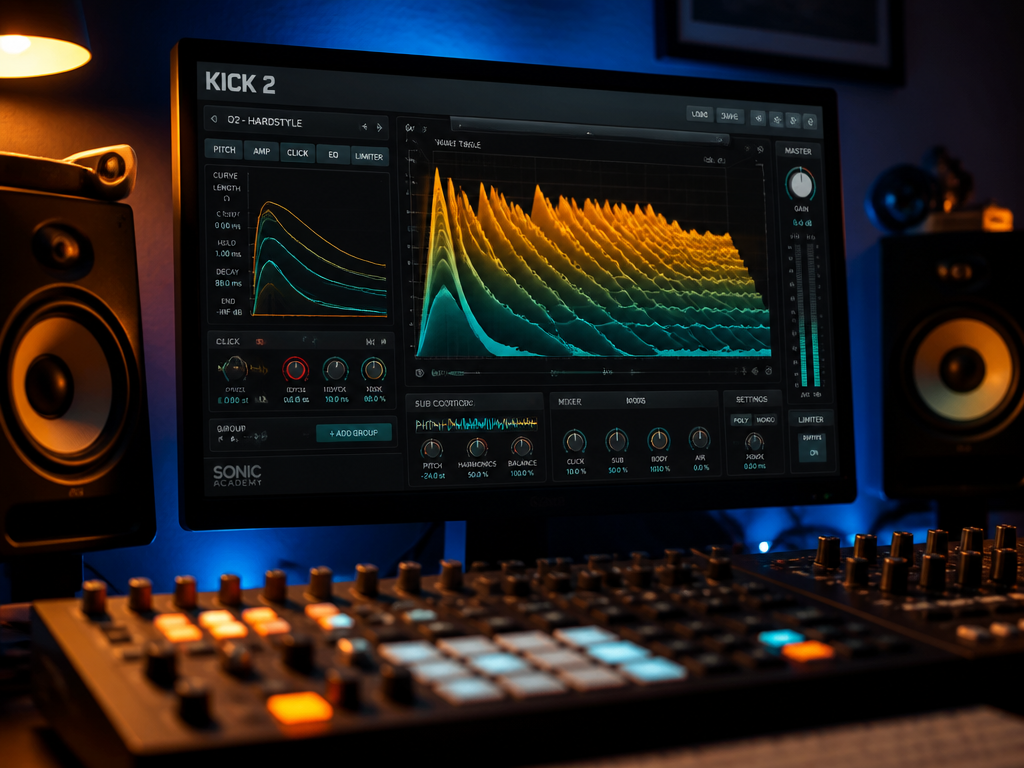
Last Tuesday I had a bass idea — a detuned, slightly seasick sub around 55 Hz, the kind that wobbles a quarter-tone flat and back like it's deciding whether to commit. I opened a well-respected software synthesizer to chase it, clicked into the oscillator page, then the mod-matrix page, then the page where you assign the LFO to the thing you assigned on the other page. By the time I'd found the routing, the idea was gone. Not the synth's fault, exactly. But a virtual synthesizer that makes you remember where everything lives is a synth that punishes the half-formed thought, and the half-formed thought is the whole job.
So this is a comparison between two ways of escaping that. Quick disclosure first: City of Punk builds a generative audio tool, which makes these two its cousins, not its enemies. I'm going to be honest about all of it anyway, because the day this publication starts grading on a curve is the day you stop trusting the BPMs.
The two camps
On one side: the physics-sandbox synth. Think of a 3D space where you place masses, springs, mallets and exciters, then strike or pluck the structure and listen to it ring. You're not editing parameters so much as building a contraption and watching what falls out of it. Anukari is the obvious flagbearer here, and the appeal is that you discover sounds the way you'd discover them banging on a radiator — by accident, then on purpose.
On the other side: the patch-cable modular synth. VCV Rack is the free, sprawling reference point; Vital sits nearby as a more conventional but deeply modulatable softsynth. You're still building, but you're building signal flow: oscillator into filter into VCA, an envelope here, a sequencer there, cables you can trace with your eyes. It rewards understanding rather than rummaging.
I'll keep a third thing in the corner as a control: a stock rompler-style synth with presets and a search bar. That's the thing you reach for when the edit is due in an hour. We're measuring the other two against the question of when you'd ever leave it.
How I'd decide
Here are the criteria I actually used, in the order they matter to a working session.
- Discovery vs. recall — does it generate sounds you didn't ask for, or reproduce sounds you specify?
- Output quality — what comes out at 48kHz, and does it survive a busy mix?
- CPU and export reality — can you run it live, and how do you get audio out?
- DAW integration and stems — does it play nice with your session, or live on an island?
- License clarity — can you ship the result commercially without a footnote ambush?
- Who it's wrong for — the honest disqualifier.
Discovery vs. recall
This is the whole ballgame, and the two camps split clean.
The physics-sandbox is a discovery machine. You build a lattice of springs, tap it, and get a metallic, decaying tone you'd never have dialed by hand — something between a prepared piano and a struck oil drum, with overtones that drift as the structure settles. Move a mass two pixels and the timbre lurches. You stumble onto a 90 BPM percussion bed made of glass and regret, and you keep it because you couldn't have planned it.
The modular synth is a recall machine that fakes discovery. You can patch chaos — feed a noise source into a sample-and-hold into pitch and let it wander — but you're choosing to wander. Left alone, it does exactly what your cables say. For a sub that wobbles a quarter-tone flat in A, modular gets you there precisely and repeatably. The physics-sandbox gets you somewhere stranger and refuses to do it twice the same way.
Output quality
Both can sound genuinely good, and both can sound mushy. Physics models smear in the low end — that seasick sub came out cleaner in Vital, where I had a real filter and could carve the mud. The sandbox excelled at the inharmonic stuff: bells, mallets, scrapes, textures with a physical logic the modular world has to fake with FM and ring mod. If your track needs a clean four-on-the-floor bass, modular. If it needs a 70 BPM ambient bed that sounds like a building breathing, the sandbox, every time.
CPU and export reality
Here's where the romance meets the meter. Physics simulation is hungry — complex structures can chew CPU fast, and you may end up rendering to audio rather than running live. Modular varies wildly by patch; a small VCV rack is light, a maximalist one is not. Both camps generally let you bounce to WAV; whether either runs as a plugin inside your DAW versus standalone is the thing to check before you commit a session to it, because that detail changes month to month and tool to tool.
DAW integration and stems
The control romper wins this on points — it's a plugin, it's in your session, done. The modular world has matured here; VCV Rack and Vital both offer ways into a DAW, and you can often split outputs to stems. The physics-sandbox is the most likely to feel like an island you visit, build in, and export from. If your pipeline is "everything lives in the project file," factor in the round-trip.
License clarity
This is where stock libraries have burned you, so read carefully and read it yourself. Open-source modular (VCV Rack core) is permissive, but individual third-party modules carry their own terms — the gotcha is always the add-on, not the host. Commercial softsynths like Vital let you use the audio you make freely; you're licensing the instrument, not the output. Physics-sandbox tools are newer, so confirm the current terms at the source before you ship. As a rule: the sound you generate is yours, the instrument is rented, and the footnote that bites is always in the marketplace add-on.
Who it's for, who should skip
Reach for the physics-sandbox if you score film, games, or ambient work and you want a texture nobody else has — if "I don't know what this is but I need it" is a sentence you say weekly. Skip it if you need the same bass tomorrow as today, or your CPU is already maxed.
Reach for the modular synth if you want to understand your sound and rebuild it on command, and you've got the patience to patch. Skip it if menus already exhaust you; modular is more freedom, which is more rope.
There's no single winner, because they answer different questions. The sandbox is better at surprising you; the modular is better at obeying you. For adaptive game loops where I need controlled variations, modular. For the one weird hit that defines a cue, the sandbox.
These days the physics-sandbox patch I built last month — a sprung metal frame tuned loosely around D, struck softly — lives open on my second monitor while I score. I don't always record it. I tap it between takes the way you'd flick a wind chime, and about once a session it says something I write down.
Not sure which tool to use?
Compare the top AI music and sound tools side by side — honest reviews, real pricing, no sponsorships.