Open a session, load a kick synth, and count the layers it gives you before you play a single note. On a lot of the modular kick tools that defined the last decade, the answer was three: a sub oscillator, a transient or click generator, and a sample slot to bolt real weight on top. Three stacked engines under one amplitude envelope. That number — three — is what most people mean when they talk about deep kick drum synthesis in a plug-in. It is also, as it turns out, the least interesting thing about whether you should pay to upgrade.
Short verdict: if you already own PunchBox V1 and you build kicks by editing envelopes rather than clicking presets, V2 is worth the upgrade for the advanced editor and wavetable layer alone; if you mostly load a preset and tune it to your track, V1 already does that and your money is better spent elsewhere.
I have been running V2 alongside my V1 sessions for a couple of weeks, and I want to be honest about the bias up front: this family of plug-ins has been my default kick machine for years, and I went in wanting to like it. So let me try to earn your skepticism back by starting with the marketing number and taking it apart.
What the layer count actually measures
The pitch for tools in this class has always leaned on the stacked-engine architecture. You get a sub layer for the body — a sine or triangle you pitch-envelope down from something like 120 Hz to a resting 40–50 Hz over a few dozen milliseconds. You get a click/transient layer for the attack, the 2–5 kHz snap that makes a kick cut through a busy mix on laptop speakers. And you get a sample layer, where you drop in a 909 tail or a distorted 808 or a recording of a cardboard box, and blend it under the synthesized parts.
That three-way split is real and it matters. It is the difference between a kick that is one sound and a kick that is three sounds glued so tightly you hear them as one. When you A/B a synthesized-only kick against a layered one, the layered version survives translation — it still reads as a kick on a phone, in a club, through a cheap Bluetooth puck. The number is measuring how many independent bodies you can tune against each other, and that is a legitimate spec.
V2's headline addition is that the synth layers can now run as wavetables rather than fixed waveforms. On paper that is not a fourth layer — the count is technically the same. In practice it changes what each layer can be. A wavetable sub can move from a clean sine at the fundamental to something with harmonic grit as the envelope sweeps, so your kick's timbre evolves inside a single hit instead of staying static. That is where a lot of the "more modern" character comes from: the layer count did not grow, the layers got smarter.
What the number doesn't measure
Here is the trap. Layer count tells you how many sound sources you can stack. It tells you nothing about how precisely you can shape each one, and shaping is the entire job.
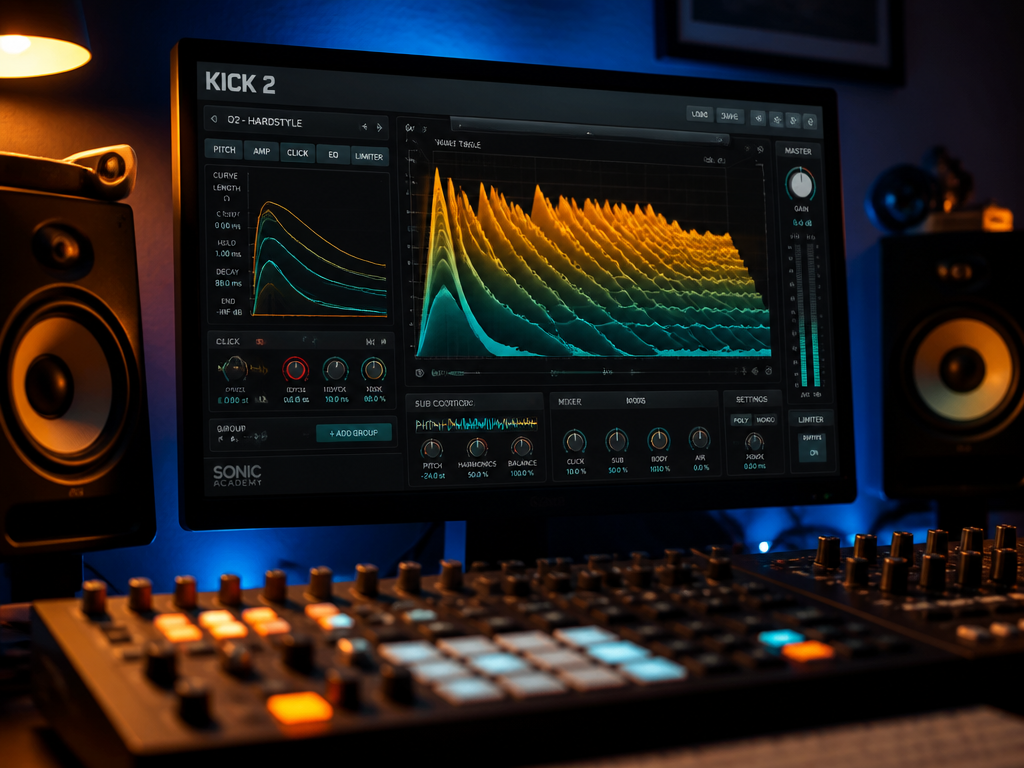
A kick lives or dies on its envelopes, and the resolution of those envelopes is the thing the spec sheet never advertises. V1 gave you decent control, but you were often stuck with a pitch envelope that was more of a preset curve than a drawable shape. V2's advanced editor is the real reason to open your wallet. You can draw multi-stage envelopes with adjustable curve tension per segment, which means you can put a fast initial pitch drop for the click, a slower second-stage descent for the body, and a tiny plateau at the bottom so the fundamental actually sustains instead of dying. That is a techno kick versus a trap kick versus a hardstyle kick — all from the same layer, defined entirely by curve shape rather than by which sample you loaded.
None of that shows up when you count engines. Two plug-ins can both say "three layers" and be a decade apart in what you can actually sculpt. So when you are auditioning a new kick workflow, ignore the layer number and audition the envelope editor first. Draw a pitch curve. See how many stages it allows, whether you can adjust curve tension, whether you can modulate a filter or the wavetable position from the same envelope. That is the spec that separates a tweakable instrument from a fancy sample player.
How I'd decide
- Output quality. Both render clean at the sub end. V2's wavetable layers give you more usable variation before you reach for external distortion; V1 gets there but leans harder on the sample slot and outboard saturation. Neither sounds mushy on a well-tuned patch — mush in a synthesized kick is almost always your envelope, not the engine.
- Tweak depth vs immediacy. V1 wins on speed-to-preset. V2 keeps that immediacy on the main panel and hides the depth in the advanced editor, so you are not punished for wanting to move fast. This is the balance that matters if you switch between "kick due in ten minutes" and "kick I will obsess over for an afternoon."
- Export and integration. You can render the kick to audio for committing to a track, and both drop cleanly into any DAW as an instrument. If your workflow is exporting one-shots to a sampler or a game-audio middleware bank, confirm the bit depth and sample rate on export match your project before you commit a whole kit.
- Price over 12 months. These are perpetual-license plug-ins, not subscriptions, so the honest math is upgrade-cost-once versus nothing. Check the crossgrade price for existing owners as of your purchase date — it varies with sales, and D16 runs them often enough that patience is a real strategy.
- Who it's wrong for. If you make kicks by dragging in a sample and EQing it, none of the synthesis depth helps you, and V1 already covered you.
The rest of V2 is honest nice-to-haves. The browser is cleaner and faster to search, which you will appreciate on hit number four hundred. The randomizer is fun and occasionally lands something you would not have drawn yourself, though I still want it to reach more parameters. The patchbay and expanded effects are genuinely useful for finishing a sound in the box, but they are not why you upgrade — they are why you stay.
Who this is for, who should skip it
Buy V2 if you are the person who draws pitch envelopes by hand, layers a wavetable sub under a distorted 808, and cares about curve tension. Skip it — for now — if V1 already lives on your master bus doing preset-and-tune duty, because the layer count you are paying attention to did not change.
Which brings us back to three. Three layers was never the reason to upgrade, and it was never the reason V1 was good. The number tells you how many sounds you can stack; the envelope editor tells you whether any of them will be yours. V2 finally made the second number the one worth counting.
Not sure which tool to use?
Compare the top AI music and sound tools side by side — honest reviews, real pricing, no sponsorships.