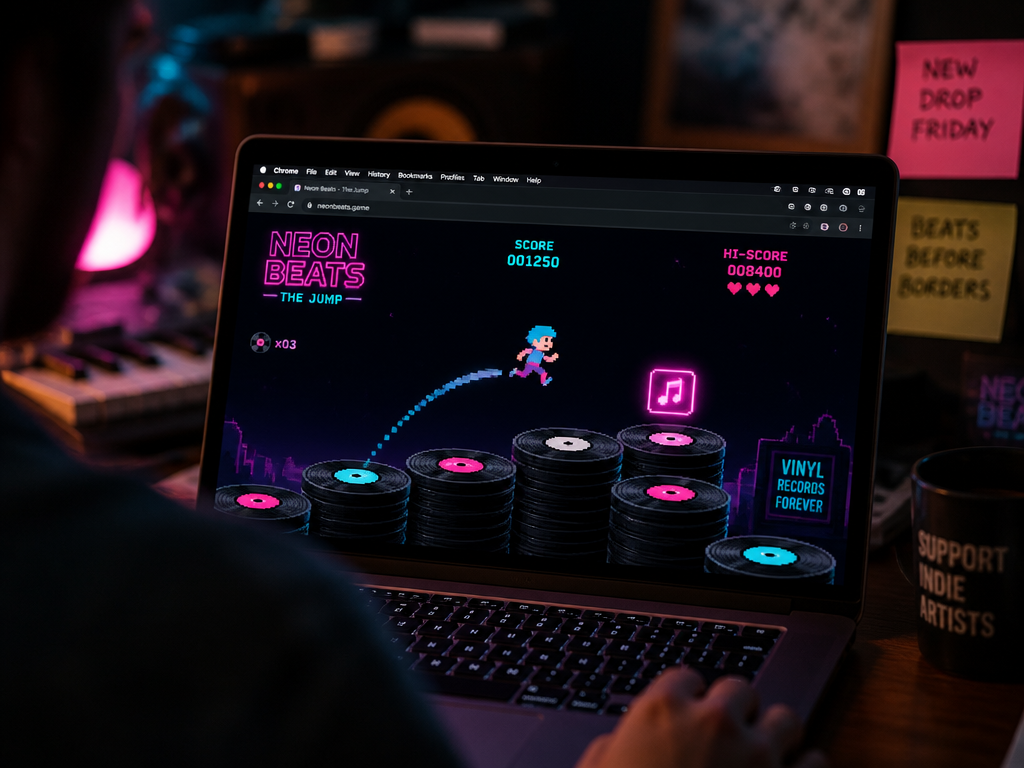
A playable browser game that loops your single as its soundtrack will pull more fan attention this month than another cold pitch to a playlist curator who owes you nothing. That is the claim. It sounds like the kind of thing a tool vendor says right before they charge you a subscription, so the rest of this is me trying to earn it.
The thing making that claim plausible is vibe coding — the practice of describing a piece of software in plain language and letting a model write the code. Until recently that was a niche hobby for developers who wanted to skip boilerplate. Now the barrier has dropped far enough that a musician's marketing person, someone who has never opened a terminal, can type "a runner game where the character jumps over records to the beat" and get something playable back. Meta's Pocket app is the version of this that pushed it toward the mainstream, but it is not the only door in, and it will not be the last.
What vibe coding actually is, minus the mystique
Here is the plain-language version for the featured-snippet crowd: vibe coding is building software by describing what you want in ordinary sentences, then refining it through conversation, instead of writing code line by line. The AI handles syntax; you handle taste and direction. For a game, that means you describe the mechanic ("collect the falling coins, lose a life if you miss three"), the look ("neon on black, glitchy"), and the feel, and iterate from what comes back.
The register shift matters. A year ago, shipping a branded mini-game meant hiring a developer, which meant a budget line, which meant it did not happen for anyone below a certain revenue tier. The floor is lower now. You can prototype an idea in an afternoon, and the cost of a bad idea is an afternoon.
What you should not expect: polish for free. The first render is usually the loosest. Physics feel floaty. The difficulty curve is wrong — either trivially easy or unwinnable by the third screen. Prompt-roulette is real; you will type roughly the same request three times and get three different games, one of which is close. Treat the AI like a session player who nails the take on the fourth pass, not the first.
The two tactics that hold up
Not every game idea survives contact with a real campaign. Two do, consistently.
The gizmo. A small, single-mechanic toy tied to your release — an infinite runner, a rhythm-tap, a clicker — that runs your track underneath and lives at a link you control. It is not meant to be Hades. It is a landing page that happens to be playable. The song is the point; the game is the reason someone stays past the eight-second mark. When someone plays for ninety seconds, they have heard your hook loop three times, which is more than a passive stream gives you and far more than a scroll-past.
The fan contest. Once the tools let anyone describe a game, you can hand the mechanic to your audience. Post the prompt you used, ask fans to remix it into their own version scored to a track off the record, and feature the best ones. This turns the release into user-generated content without asking fans to be animators or coders. The ceiling on quality is low and that is fine — the value is participation, not production value.
Both work because they convert a passive listen into an active minute. Neither works if the game is boring on its own terms, and no AI fixes boring.
The audio trap nobody warns you about

Here is where a sound person gets nervous. When you tell a vibe-coding tool "add background music" or "add a coin sound," it may pull audio from wherever its training or its asset library points, and the licensing on that audio is often unstated. If your game is a marketing asset — and it is, the moment it promotes a paid release — you are on shakier ground than a hobbyist posting to friends.
Two clean fixes:
- Use your own track. This is the whole point anyway. Export your song, or a loop from it, as a 48kHz WAV or a compressed MP3 the platform accepts, and drop it in as the soundtrack. You own it, so the game's audio is clear.
- Generate the SFX cleanly. The blips, coin-grabs, and menu clicks want original sound too. A short original bleep — think a 200ms square-wave ping around C5 with a fast decay — reads as "coin" to any player, and you can make it in any generator that gives you commercial rights and downloadable stems. This is the boring case where a tool like City of Punk earns its keep: you need a handful of royalty-clear one-shots for the interactions, not a symphony.
The general rule: assume nothing in a template is cleared for commercial use until the terms say so in writing, and replace anything you cannot verify. Read the license the day you export, not the day you get the takedown.
Build checklist and a starting prompt
If you are going to test this before the next release, work in this order:
- Pick one mechanic. Runner, tap-to-beat, or catch-the-falling-thing. One. You should be able to explain it in a sentence.
- Have the audio ready first. Bounce a 15–30 second loop of your track. Game loops are short; pick the section with the hook.
- Prompt the shell, then refine. Get something playable, then fix difficulty, then fix the look. In that order.
- Swap in your audio and original SFX. Confirm nothing borrowed remains.
- Test the loop point. You should hear the track restart without a click or a gap — that is the tell that it is set up right.
- Publish to a link you own and put that link everywhere the release goes.
A starting prompt that tends to survive the first pass:
Make a simple one-button rhythm game for mobile web.
Tapping makes a character jump over obstacles that
approach on the beat. Neon-on-black art, glitchy.
Score counts successful jumps. Game over on one miss,
with a restart button. Leave the soundtrack empty —
I will add my own audio file.
The reasoning: one input (tap) keeps it playable on a phone, "on the beat" ties motion to your track, and telling it to leave the audio empty avoids the licensing trap before it starts.
What this does not fix
Be honest about the ceiling. A mini-game gets you a spike, not a habit — retention on a marketing toy falls off fast, and it should; nobody is meant to play your runner for a week. You are also building inside someone else's platform much of the time, which means the rules and the algorithm are theirs to change. And ownership of AI-generated code and assets is genuinely unsettled terrain — save your source track, your original SFX, and your prompts, so the parts that are clearly yours stay clearly yours.
Which leaves the question I cannot answer for you, because nobody has the numbers yet: does a played minute actually convert to a saved song, a followed artist, a bought ticket — or is it a warmer, more expensive version of a like that ends when the tab closes? Test it against your own release and tell me what you find. I am still watching.
Not sure which tool to use?
Compare the top AI music and sound tools side by side — honest reviews, real pricing, no sponsorships.