There's a number that gets quoted in artist Discords until it loses its edges, and it's worth slowing down on. Depending on the year and the platform, the organic reach of a post to your own followers — the people who chose you, hit follow, asked to hear from you — sits somewhere south of 40%, and on a bad day a long way south of it. The exact figure moves around and every platform guards its real math, so treat that 40% as a weather pattern, not a measurement. But the direction is not in dispute. You post a clip of the track you've been sweating for three weeks, and most of the people who asked to hear it never see it.
That gap is the whole reason a category of tools now exists for work-in-progress sharing, and it's the reason this platform review exists too. Before anything else, the disclosure: City of Punk makes a competing product in the broad neighborhood of AI music tools. So read this as a producer who has skin in the game telling you what the WIP-sharing category actually does, where it leaks, and when you'd be smarter keeping your money. I'll name the friction. If I don't, I haven't reviewed anything.
The verdict, up front
If your problem is that your finished releases vanish into a feed, a work-in-progress sharing platform is worth setting up — but only if you already have, or are willing to slowly build, a small list of people who reply to you, because these tools amplify a relationship you have rather than manufacture one you don't.
That's the snippet. The rest of this is why, and the conditions under which it's wrong.
What the number actually measured
Go back to that sub-40% reach figure and look at what it counts. It counts impressions against follower count on a social feed over some window. It's a delivery statistic. It tells you that the pipe between you and people who opted into hearing from you is narrow, throttled by a ranking system that has its own priorities — watch time, session length, ad inventory — none of which are your release date.
Here's the part producers skip. That number measured a feed, not a fan. A follower on a legacy platform is a number that lives in a database the platform owns. You can't email them. You can't see who they are. When the platform changes its ranking — and it will, quarterly, forever — your "audience" is revalued without your consent and without a heads-up. The 40% isn't a fixed tax. It's a variable one, set by a party that doesn't return your calls.
So what the figure genuinely measures is dependency. You built a thing that looks like an audience, and you don't control the connection to it. That's the honest reading, and it's the reading that makes WIP platforms make sense. Substack made the same argument for writers years ago: own the email list, and the algorithm stops being the landlord. The sound world is running the same play now, slower, and with the extra wrinkle that audio is harder to host, harder to gate, and far easier to rip.
What the number doesn't measure
Now the part that matters more, because this is where the WIP angle separates from the general "own your audience" sermon.
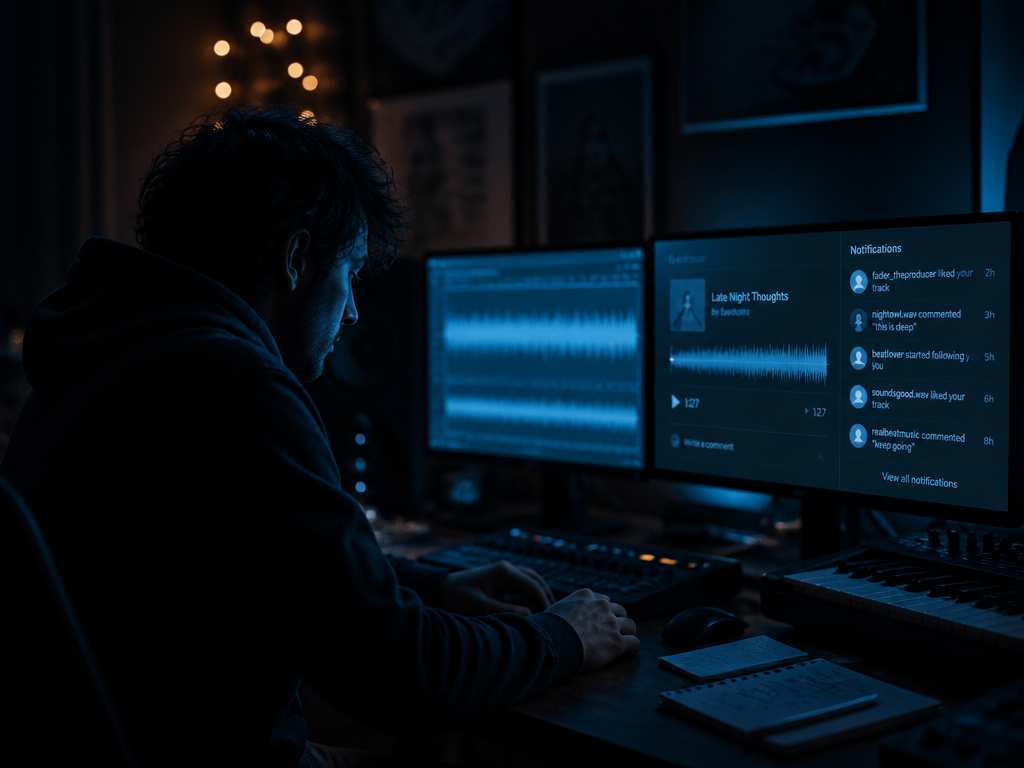
That reach number tells you nothing about response. It counts whether a clip was delivered. It cannot tell you whether the person who heard your unfinished second verse was the one who'd have told you the snare is masking the vocal in the 2–4kHz range, or that the drop lands a bar late, or that they'd happily pay for the stems. The signal you actually lose to the algorithm isn't reach. It's the feedback loop — the specific, timestamped, craft-level response from someone who cares about the track enough to scrub back to 1:14 and tell you the reverb tail is swallowing the hat.
I'll be concrete, because this publication lives on concrete. Say you've got a 124 BPM house cut in A minor, and the breakdown isn't landing — the filter sweep feels limp and you can't tell if it's the automation curve or the fact that you cut the kick too early. On a feed, you post the clip, get fourteen fire emojis and a comment that says "vibes," and you've learned nothing. On a tool built for WIP sharing, twelve people who've followed your process can leave a comment pinned to 0:48 — "kick drop too soon, hold it one more bar" — and three of them disagree, and now you have an actual decision to make instead of a guess. That exchange is the thing the 40% number was never built to measure, and it's the thing worth paying for.
How I'd decide between these tools
I don't trust a review that grades on vibes, so here are the criteria I'd run any work-in-progress platform through before it gets a recurring charge on my card.
Feedback fidelity
Can listeners comment at a timestamp, or only on the track as a whole? Timestamped comments are the difference between "I like it" and "the transition at 1:52 is rough." SoundCloud pioneered timestamped comments years ago, and any WIP-focused tool that doesn't match that is behind before it starts. Look further: can you stack versions of the same track so feedback on v3 doesn't get orphaned when you upload v4? Can collaborators leave private notes versus public ones? The whole value proposition collapses if the feedback is as shallow as a feed's.
License and ownership clarity
This is where these tools burn people, and it's the first place I read the fine print. Two questions, both non-negotiable. One: when you upload a work-in-progress, who can download it, and in what format? If anyone with the link can pull a full-quality WAV of your unreleased track, you've handed your unprotected master to strangers. Two: what rights does the platform claim over what you post? Some terms grant the platform a broad license to use, display, or promote your uploads. That might be fine for a finished single you're marketing; it's a problem for an unreleased work you intend to sell or license later. Read whether the grant is limited to "operating the service" or whether it's broader, and whether it survives you deleting the file. If a platform's terms aren't clear on this, that's not a neutral fact — it's a reason to keep looking.
Stems and export formats
You're a producer, not a content creator, so the export side matters. Can you share stems for a collaborator to pull into their DAW, or only a stereo bounce? Does the platform transcode your 48kHz/24-bit upload down to a lossy stream, and if so, can a trusted collaborator still get the original? For pure fan-facing WIP sharing, a streamed preview is fine and arguably safer. For collaboration, you need real file delivery — WAV or AIFF stems, ideally with a way to share without making them permanently downloadable by the public.
Price over twelve months
Ignore the monthly number on the pricing page and multiply by twelve, then ask what you actually get for it. The pattern across this category, as of writing, splits roughly three ways: a free tier with caps on uploads or audience size, a creator tier in the rough range you'd expect for a working tool, and revenue-share or fan-monetization layers where the platform takes a cut of what your supporters pay you. The number that matters isn't the subscription — it's the take rate on money your fans send you, because that's the line that grows as you succeed. A flat subscription you outgrow is cheap. A 10–15% cut of a growing supporter base is not. Prices and cuts vary by platform and change often, so verify both at the source before committing.
Audience portability
The single question that separates an owned audience from a rented one: if this platform raises its take rate or shuts down, do you leave with your fans' contact details, or with nothing? Can you export an email list? Does the relationship persist off-platform? If the answer is that your community lives and dies inside the app, you've rebuilt the dependency you were trying to escape, with a friendlier interface. The whole point of leaving the 40% behind is to stop being a tenant. Don't sign a new lease that reads like the old one.
Who it's wrong for
A criterion most reviews skip. These tools are wrong for the producer who has no audience yet and thinks the platform will supply one. They won't. They're wrong for the artist whose entire identity is reach — if you measure success in follower counts and viral clips, a small room of engaged listeners will feel like a demotion. And they're wrong for anyone who hates posting. WIP sharing is a habit, not a feature; if you don't have the temperament to show unfinished work on a rhythm, you're paying for a gym membership you'll never use.
The category, walked through
Strip away the branding and a work-in-progress platform is a small, owned room where you do three things a feed actively fights you on.
You share the unfinished thing. Not the polished single with the release-day push, but the loop, the rough mix, the two competing choruses. The premise is that the people who like you most want the process, not the product — and that showing the process is itself the marketing, because people who watched a track get built will be there when it lands.
You collect structured feedback. Timestamped, version-aware, attributable to people whose ears you've learned to weight. This is the part that earns the subscription. A comment thread on a feed is noise; a comment pinned to the bar where your arrangement sags is craft.

You gate the drop. When the track is done, the people in that room hear it first, or get the stems, or get a price they won't find on the streaming services. The relationship has a shape — it's not a number in someone else's database, it's a list of people you can reach without asking permission. That's the asset. Everything else is interface.
It's the same architectural idea that's shown up across the industry as artists got tired of feed roulette — listening sessions, supporter clubs, vaults of unreleased work. The names change. The bet underneath them is constant: that a curator and the small room they've gathered are worth more than a large audience you can't talk to.
The friction nobody puts on the pricing page
Here's where I keep the review honest.
The cold-start problem is real and it's brutal. A WIP platform is a megaphone, not a crowd. If you arrive with no one, you'll spend your first months posting into a quiet room and wondering if the tool is broken. It isn't. The tool assumes you bring the relationship; it only makes the relationship better. Anyone selling you a WIP platform as a discovery engine is selling you something the category doesn't do.
Platform fatigue is a genuine cost. This is the con that the polite reviews name and then wave away, and I won't wave it away. Adding a WIP room to your week is one more place to check, one more inbox, one more set of notifications competing with the seven feeds you already maintain. The honest math: this only works if it replaces something, not if it stacks on top. If you're using it to post the same clips you post everywhere else, you've added work and subtracted nothing. The artists who make it pay are the ones who move their core relationship there and let the feeds become billboards that point home.
Feedback can be flattery wearing a lab coat. A small, loyal room is supportive by nature, and supportive rooms tell you the track is great. That's pleasant and useless. The fidelity of the feedback depends entirely on whether you've cultivated people who'll tell you the truth, and most communities drift toward applause if you let them. The tool can timestamp a comment; it can't make the comment honest. That's on you, and it's harder than the software makes it look.
And rip risk is permanent. Any audio you put into the world in a downloadable form can leak. WIP sharing means exposing unreleased material earlier in its life than a release schedule normally would. The better platforms mitigate this with stream-only previews and access controls, but no setting makes a determined screen-recorder go away. Decide what you're comfortable exposing before the breakdown's even finished.
Who this is for, who should skip it
Set one up if: you have a finished body of work and a trickle of people who actually reply to you; you're sick of release days dying in the feed; you want craft-level feedback on tracks in progress; or you're building toward selling directly to supporters and want to own the connection. The math works when the room is small and warm, not large and cold.
Skip it if: you're starting from zero followers and hoping the platform will find you an audience; your work is genuinely solo and you don't want feedback before release; you already can't keep up with the channels you have; or you're not willing to read the licensing terms closely enough to know who can download your unreleased files. That last one isn't optional. The artists who get burned in this category are the ones who skimmed the rights grant.
If I had to call a single workflow winner: for a producer with a few hundred genuinely engaged listeners who wants to tighten tracks before release and sell to supporters after, a dedicated WIP-and-monetization room beats trying to bend a general social feed to the same job. The feed will fight you. The dedicated tool won't. Verify the take rate and the export-your-list question before you commit, and the trade is sound.
What this looks like in my own room
I'll close with evidence rather than advice. Last month I posted a 96 BPM loop — detuned Rhodes, a broken 808 sliding under it, the kind of thing I'd normally sit on for weeks because I couldn't tell if the detune was characterful or just out of tune. Eleven people heard it in a room I'd built slowly over a couple of years. Four said leave it. Three said the Rhodes was fighting the 808 in the low-mids, pin a comment to 0:22. One sent me back a re-pitched version of my own loop to show me what they meant, which is a thing a feed has never once done for me.
I took the low-mid note, kept the detune, finished the track in two days instead of three weeks of second-guessing. None of those eleven people would have seen that loop on a feed, and I know that because of a number that told me so. The room didn't replace my taste. It gave my taste something to argue with.
Not sure which tool to use?
Compare the top AI music and sound tools side by side — honest reviews, real pricing, no sponsorships.