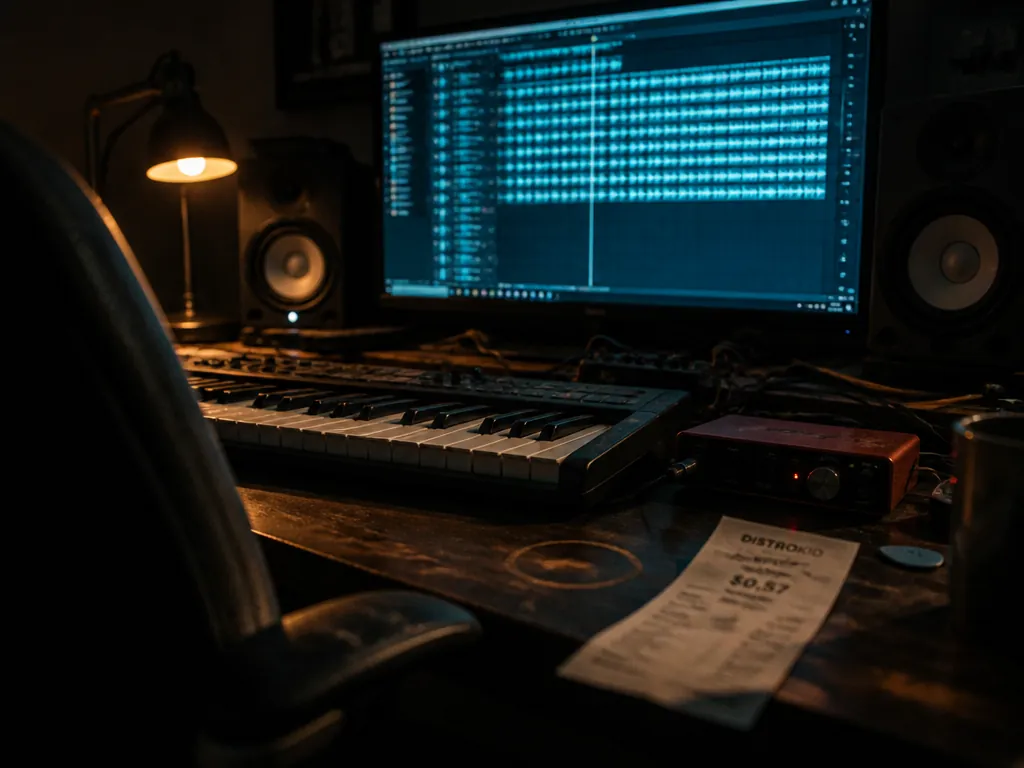
I ran the experiment because I was tired of arguing about it in comment threads.
Last winter I generated a batch of lo-fi keys-and-tape-hiss instrumentals — 82 BPM, F minor, the kind of thing that sits on a focus playlist between two other tracks nobody can name. I edited out the worst of the mush, replaced two smeared transients with samples from my own kit, mastered them at a conservative -14 LUFS, and released four of them through a standard distributor under a name that isn't mine. No pitching, no promotion, no socials. I wanted one uncontaminated reading of AI-generated music economics from the supply side: what does a competent, unremarkable, machine-assisted track earn when nobody is pushing it?
One quarter later: roughly 5,300 streams across all platforms, and a payout that landed just under twenty dollars before the distributor's cut. That is not a study. It is one uploader, one genre, one quarter, and you should treat it as a single data point rather than a rate card.
But the payout was never the interesting number. The interesting number was on my side of the ledger: about forty minutes of my time per finished track, most of it spent re-rendering prompts and fixing a hi-hat that sounded like a crushed can. Twenty dollars against under three hours of skilled labour is a bad wage and a remarkable unit cost. That gap is the whole story, and it is the part that most of the investment conversation skips.
Can you actually make money from AI-generated tracks?
Yes, but almost nobody does it one track at a time. Per-stream rates are a fraction of a cent and vary by platform, market and distribution deal, so a single track needs tens of thousands of plays to clear the cost of a coffee. The money in this corner of the market comes from volume — hundreds or thousands of releases feeding functional playlists — or from placement, where one cue in one ad or one game pays more than a year of passive streaming. Anyone selling you a story about a single AI-fronted act as a business is selling you a lottery ticket with a nice waveform on it.
The headline figures support that reading, if you read them carefully. A third-party analysis circulated this year estimated that the ten biggest AI-fronted acts had pulled in something on the order of six million dollars across Spotify and YouTube. As of writing that is the most-quoted number in the space. Split across ten acts and their full runs, it is roughly what one mid-tier festival act clears in a good year. The top of a long tail is the least informative part of it.
The informative part is upload volume, and platforms have started disclosing it. Deezer has repeatedly put a number on the share of tracks delivered to it each day that are fully machine-generated, and each time the company is asked, the figure has climbed — it passed a quarter of daily deliveries some time ago. Nobody uploading at that scale is doing it for twenty dollars a quarter. They are doing it because the marginal cost of the next track has fallen to near zero, and because they only need a small fraction of those tracks to catch a playlist.
The pool does not grow when the supply does
This is the mechanic that matters for anyone holding catalog, and it gets lost in arguments about artistry. On most subscription services, royalties are paid out of a pro-rata pool: subscription and ad revenue for a market gets aggregated, and rights-holders are paid a share proportional to their share of qualifying streams. A million new tracks arriving in a month does not add a cent to that pool. Whether they matter depends entirely on whether they capture streams that would otherwise have gone somewhere else.
So the risk to existing catalog is not that listeners will prefer machine-made music. It is dilution by substitution in the places where listeners were never expressing a preference to begin with. That distinction is where the actual exposure lives.
Platforms have noticed, which is why the policy response has been about the plumbing rather than about taste: minimum-stream and minimum-duration thresholds before a track earns anything, spam filters aimed at mass uploads and artificially short tracks, impersonation rules covering cloned voices, and industry-standard credits fields where a distributor can declare that AI was involved in a recording. All of that reduces the yield on the cheapest strategies. None of it reduces supply.
Where the displacement is actually landing
| Revenue line | Exposure to cheap supply | Why |
|---|---|---|
| Production/library music, low-budget sync | High, already happening | The buyer needs a cue that fits a 34-second cut, not an artist they love. Substitution is nearly frictionless. |
| Lean-back functional playlists (focus, sleep, ambience) | High | The listener has no artist preference and often no memory of what played. |
| Catalog in crowded, low-identity genres | Medium | Discovery is playlist-mediated and the marginal listener is not loyal. |
| Fandom-driven artists, touring acts | Low | The product is the person. Tickets, merch and attachment do not substitute. |
| Publishing on known compositions | Low, but litigation-exposed | Value sits in the composition, not the render. |
I can speak to the top row from the wrong side of it. The steadiest money in my decade of scoring indie games and short films was never a hit; it was library cues, licensed over and over for corporate video and background beds. That line of work started thinning before most people had heard of prompt-based generation, and it has thinned faster since. Nothing about that is a verdict on whether the machine cues sound good. They sound adequate, and adequate was always what that market was buying.
What platforms can verify, and what they cannot
This is where the responsibility debate gets stuck. Platforms are genuinely good at detecting fraud patterns: bot streams, farmed accounts, upload floods from one delivery pipe. They are increasingly good at policing voice impersonation, because a claim gets filed by a human with lawyers.
Provenance is a different problem. There is no reliable way, at the scale of hundreds of thousands of daily deliveries, to determine from the audio alone whether a stem was generated, whether a session was assisted, or whether the training data behind it was licensed. Disclosure standards exist, and they are the right move, but disclosure is a claim made by the uploader. A creator who describes their process as remixing on hardware will be recorded as having remixed on hardware. The metadata records what was declared, not what happened.
Which is why the paperwork on the tool side has become a real differentiator rather than a marketing line: platforms like ours are increasingly expected to ship a commercial licence, an indemnity position and machine-readable disclosure fields alongside the WAV, because that is the only part of the chain anyone downstream can actually inspect.
If you are underwriting an AI-music revenue claim, ask for these five things:
- Streams broken out by market, not a global total — payout per stream varies enormously between them.
- Payout net of distribution and any per-release fees, per quarter, not gross.
- The split between editorial or algorithmic playlist streams and owned audience. Playlist-dependent revenue can vanish in a single refresh.
- Declared AI-involvement status in delivery metadata, and who signed off on it.
- Chain of title covering the training data and any vocal likeness, in writing.
My four tracks are still up. Last quarter they earned about six dollars, and I will probably leave them there as a running instrument reading. What actually changed in my income had nothing to do with that pseudonym and everything to do with a library that stopped calling.
Music supply went effectively infinite this decade. The pool it gets paid from did not.
Not sure which tool to use?
Compare the top AI music and sound tools side by side — honest reviews, real pricing, no sponsorships.