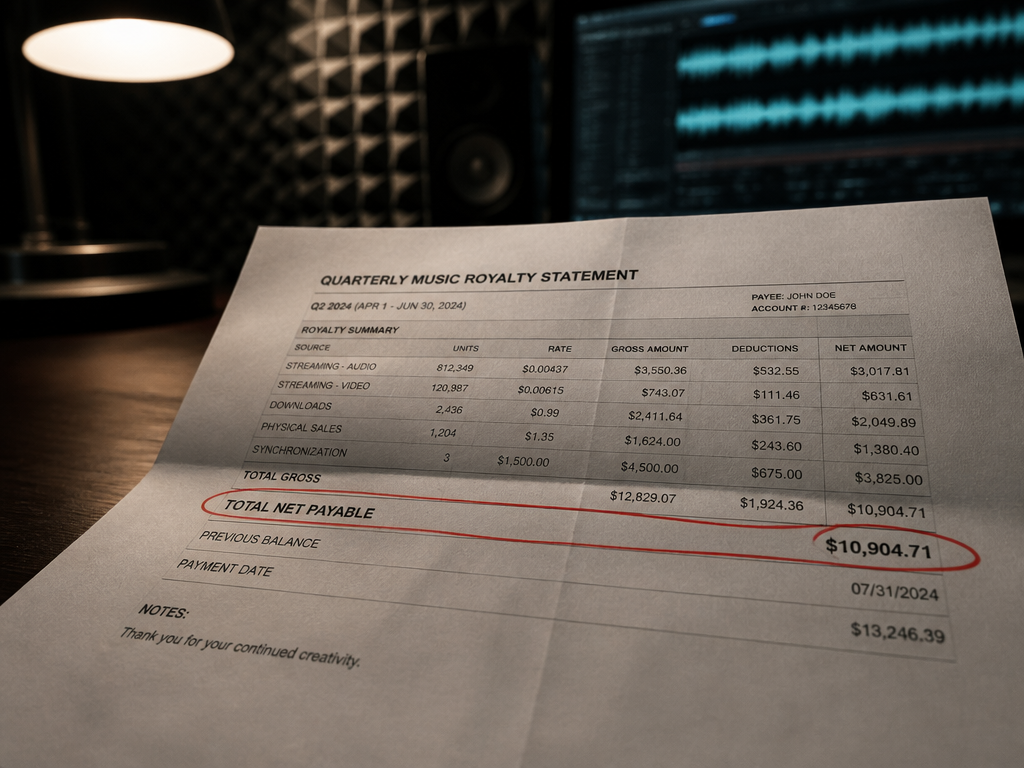
A 92 BPM loop I built for a puzzle game in 2018 — detuned Rhodes, brushed kit, tape hiss I never bothered to clean up — is still in rotation somewhere. Last statement, roughly the same volume of plays paid about a third of what it paid five years earlier. The track didn't change. The room it was standing in got more crowded. That's the least dramatic honest summary of the AI music generation impact on royalties: mostly arithmetic, partly theft, and the two get confused constantly.
The confusion matters because it drives what artists do next, which is usually to spend money on marketing that makes their position worse. So: the mechanism first, then the evidence, then what I actually do with my own releases.
How your streams turn into money
Most major services pay pro rata. The platform collects subscription and advertising revenue for the month, keeps its share, and puts the rest into a royalty pool. That pool is divided by every qualifying stream on the service that month, which produces a per-stream rate. Your streams are multiplied by that rate, then split between the recording side and the publishing side, then passed through your distributor, label, and whatever collaborator splits you signed — or didn't.
Two details in that chain do most of the work.
First, qualifying is carrying weight. A play generally has to clear a minimum duration to count at all — 30 seconds is the common bar — and platforms have added eligibility floors on top, such as Spotify's requirement that a track clear an annual stream minimum before it generates recording royalties. Check the current terms with your distributor; these numbers move.
Second, the pool is fixed before anyone counts the streams. More listening on the service in a given month does not mean more money to distribute. It means the same money, cut finer. That design was written for an era when putting a record into distribution cost time, money, and a studio booking.
Does AI-generated music actually lower your per-stream rate?
Yes — and the honest version has two parts, only one of which is anyone's fault. Generated tracks add releases and plays to a pool that doesn't grow in response, which shaves the rate for everyone, including whoever uploaded the generated track. That's dilution: legal, ordinary, and irritating. Separately there is fraud — catalogs uploaded with no intention that a human ever hear them, streamed by bot farms to convert fake plays into real payouts. Fraud doesn't thin the pool so much as reroute it, taking money already allocated to music people chose to hear.
Dilution costs you fractions of a cent per stream, compounding quietly. Fraud costs the system enough that platforms now police it with financial penalties — and those penalties are the part most likely to land on you by accident.
What most people do
Watch the payout line fall, then buy promotion.
The market that grew around that impulse sells the exact thing a thinning pool makes scarce: plays. Paid playlist placement, "organic growth" packages, stream guarantees, follower campaigns priced per thousand. Some of it is legitimate — real curator pitching, ad campaigns you can inspect in a dashboard, a publicist who answers the phone. A meaningful slice of it is bot traffic wearing a playlist as a costume.
From your side, both look identical: a spike, a chart in the app, a number that finally moves. From the platform's side they don't look alike at all. Fraud detection isn't reading your intent. It's reading listening patterns — sessions that never skip, accounts that only ever play one playlist, device fingerprints repeating across thousands of "listeners," plays clustered in territories where you have no audience and no ad spend.
When a release trips that detection, the consequences don't stop at the promo seller, who has already been paid and has no relationship with your distributor. As of writing, Spotify charges labels and distributors a per-track fee for flagged artificial streams; distributors pass that cost down, withhold the affected royalties, and in some cases pull the release. Artists have paid for a campaign, lost the royalties it generated, and been billed for the privilege — all without believing they did anything wrong.
What the evidence suggests
The scale numbers are worth knowing, with the caveat that every one of them is a snapshot. Deezer, which built its own detector and began tagging fully AI-generated uploads, has reported figures in the range of 90,000 such tracks arriving per day, a share of daily uploads that has climbed steeply rather than plateaued. Apple has reported blocking fake streams in the billions. Neither company published those numbers to reassure anyone; they published them while announcing enforcement.
That's the actual signal in the data. Platform behavior is moving in one direction: detect generated uploads, tag them, keep them out of algorithmic and editorial recommendation, and raise the cost of manipulated streams for whoever delivered them. None of it is retroactive, and none of it restores a per-stream rate to what it was in 2018.
It's worth being precise about which problem is eating which part of your income, because the defenses are different:
| What's happening | What it does to you | Can you act on it |
|---|---|---|
| Volume dilution — more tracks and streams sharing a fixed pool | Slow decline in per-stream rate across your whole catalog | Not directly; only by shifting revenue mix |
| Stream manipulation — bot traffic monetized as real plays | Diverts pool money, and can penalize your release if it touches your campaign | Yes — vet every promotion you buy |
| Misattribution — unregistered works, missing splits, bad metadata | Royalties collected and never routed to you | Yes, and this is usually the biggest single recoverable amount |
That third row is the unglamorous one. Money lost to paperwork looks nothing like a crisis and adds up faster than dilution does.
What I actually do
A working checklist, in the order I do it:
- Register both sides before release. ISRC on every master, the composition registered with my PRO, and the publishing administered. A recording earning money with no registered composition behind it is money sitting in a suspense account.
- Sign splits in writing before anyone touches the session file. Percentages, legal names, PRO affiliations. Verbal splits become disputes at exactly the moment a track starts earning.
- Audit one statement per quarter properly. Not the summary — the raw CSV. Sort by territory, then by service, then look at the tail: countries with no campaign, playlists I can't find, a track earning in a market where nothing else of mine does.
- Buy only marketing I can verify. Ad platforms with impression data, curators who publish contact details and reply as humans, sync libraries. Anyone guaranteeing stream counts is guaranteeing traffic they control, which is the definition of the thing detection systems are hunting.
- Keep generation tools on the paid side of the fence. I use them for briefs and commissioned work — a client's adaptive loop, a bed under a podcast intro — where the fee is agreed in advance and the license is written down. Reviews and licensing breakdowns of those tools are most of what we publish here at City of Punk. What I don't do is push generated catalog into DSPs and hope the pro-rata pool notices.
- Diversify away from per-stream income. Sync, library placements, commissions, direct sales. Not as a growth strategy — as insurance against a rate I have no vote on.
This week, do step 3 with a single statement. Pull the last quarter's raw data, sort by territory, and find the rows you can't explain. If everything reconciles, you've bought yourself a baseline. If it doesn't, you've found real money before the pool gets any thinner — and unlike the per-stream rate, that part is yours to fix.
Not sure which tool to use?
Compare the top AI music and sound tools side by side — honest reviews, real pricing, no sponsorships.