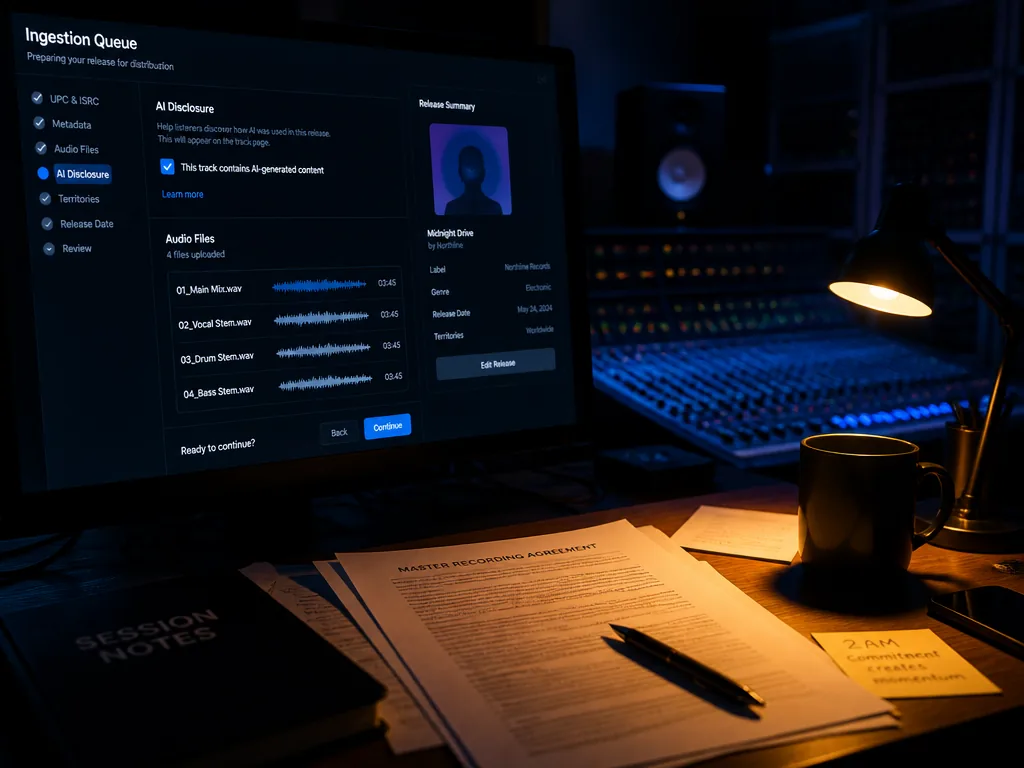
You upload a track through your distributor on a Tuesday. Wednesday it's "in review." Friday you get an email: the release is held pending "clarification of the tools used in production." You didn't lie on the form. You checked the box that said AI was involved because it was — a generated pad, a stem you cleaned up, a bassline you kept. Now your Friday release date is a Monday maybe.
That gap — between a platform saying it "welcomes AI-assisted work" and your track actually going live and earning — is the whole story. Every major streaming service and most distributors now have an AI music policy of some kind. Read them side by side and the marketing language is nearly identical: everyone is against fraud, everyone claims to support real artists, everyone wants transparency. What differs is the machinery underneath, and the machinery is what decides whether you get paid.
This is not a piece about which platform "likes" AI. Platforms don't like anything. It's about three mechanical questions that determine your royalty exposure, and how the major services answer them differently.
The three things that actually decide your payout
Strip away the press releases and every platform policy reduces to three moving parts:
- Gatekeeping and labeling — will the track go live at all, and does it get a visible "AI" tag that changes how listeners and algorithms treat it?
- Fraud enforcement — how aggressively does the platform sweep for spam and fake streams, and how often does legitimate AI-assisted work get caught in that net?
- Royalty structure — does your AI track draw from the same royalty pool as everyone else, or is it pushed toward a separate, smaller, or deprioritized bucket?
The first two decide whether you're on the platform. The third decides what being on it is worth. Most coverage stops at the first. The money is in the third.
Does streaming even allow AI music?
Short answer: yes, on every major platform, as of writing. None of the big services ban AI-assisted or fully AI-generated music outright. What they ban is deception (passing AI vocals off as a named artist), impersonation, and fraud (bot farms streaming garbage tracks to skim the royalty pool). If your track is your own composition, cleared of those three problems, it can be distributed and monetized on Spotify, Apple Music, Amazon, YouTube Music, Deezer, Tidal, and the rest.
The catch is that "allowed" and "treated equally" are not the same thing. A track can be permitted, live, and streaming while still being labeled, deprioritized in recommendation, or — the part that matters — paid differently. So the real question isn't can I put AI music on Spotify. It's what happens to it once it's there.
Keep one distinction in your head throughout, because platforms use it constantly:
- AI-assisted — you generated elements (a pad, a drum loop, a texture) and built a human-arranged track around them. Most policies treat this as ordinary production, closer to using a soft synth than to anything new.
- Fully AI-generated — prompt in, finished track out, minimal human arrangement. This is where disclosure requirements, labeling, and fraud scrutiny concentrate.
Where you sit on that line changes which policy clauses apply to you. A lot of working producers are AI-assisted and don't realize the fully-generated rules are the ones getting quoted at them in scary blog posts.
Criterion one: detection and labeling
This is the part platforms talk about most, because it's the most visible and the least expensive to implement.
Deezer has been the loudest here. The company has publicly reported detecting AI-generated tracks at enormous scale — tens of millions of fully AI tracks flowing through its system — and it applies a tagging system that flags fully AI-generated content and, per its stated policy, excludes flagged tracks from algorithmic recommendations and editorial playlists. The detection is aimed at fully generated material; the point is not to remove it but to keep it from crowding the recommendation surface that everyone else competes for.
Spotify has focused its public messaging on fraud and impersonation rather than a blanket AI label. The company has talked about removing tens of millions of spam tracks and tightening its policy against AI voice clones of real artists. As of writing, Spotify has signaled support for disclosure — surfacing information about AI involvement in credits — rather than an automatic penalty on every AI track. The emphasis is: tell the truth about how it was made, don't impersonate anyone, don't game the stream counts.
YouTube sits in its own category because Content ID and its synthetic-media disclosure requirements were built for video first. If your track lives on YouTube (or gets used in other people's uploads), you're dealing with two overlapping systems: Content ID matching against copyrighted recordings, and a separate requirement to disclose realistic synthetic content. Neither was designed for a producer distributing an instrumental album, and the mismatch shows.
The pattern across all three: detection is aimed at fully AI-generated tracks and at impersonation, not at AI-assisted production. If you built a track with human arrangement around generated elements, you are mostly not the target of detection systems — but you may still be asked to disclose, and disclosure is not the thing that costs you money. Labeling can.
Here's the honest limit: detection is imperfect in both directions. Systems miss fully generated tracks, and they occasionally flag human work as synthetic. If you're relying on "they'll never know," you're planning badly. If you're afraid your legitimate hybrid track will get auto-nuked, that fear is mostly larger than the reality — for now.
Criterion two: fraud sweeps and who gets caught in them
The fraud problem is real and the numbers platforms cite are large: millions of tracks removed, streaming-manipulation networks shut down, whole catalogs delisted. The intent is clean — kill the bot farms uploading thousands of near-identical AI tracks to siphon fractions of a cent per fake stream until it adds up.
The problem for you is collateral damage. Fraud-detection heuristics look for patterns: many tracks uploaded fast, very short durations, near-duplicate audio, low engagement paired with sudden stream spikes, tracks that never get saved or added to playlists. A legitimate AI-assisted producer releasing a large ambient or lo-fi catalog can trip several of those flags without doing anything wrong. High-volume instrumental release is a legitimate business model. It also looks, statistically, a little like fraud.
The producers who get caught in sweeps tend to share a few traits:
- Dumping dozens of tracks at once with identical or auto-generated titles.
- Very short track lengths clustered right around the minimum payable stream duration.
- Buying playlist placement or streams from services that turn out to be bot networks (this is the fast way to get an entire distributor account frozen).
- Tracks with near-zero organic saves suddenly showing high play counts.
None of that is about the audio being AI. It's about behavior that pattern-matches to manipulation. The defense is behavioral, not technical: real titles, real cover art, varied track lengths, no purchased streams, and a release cadence that looks like a person made choices rather than a script.
The uncomfortable truth is that the platforms with the most aggressive fraud enforcement are also the ones most likely to catch you by accident, and their appeals processes are slow. That is a cost you weigh, not a reason to avoid distribution.
Criterion three: royalties, where the money actually moves
The first two criteria are about access. This one is about value, and it's where the platforms genuinely diverge.
The old model, still the default on most services, is a shared pool: total subscription and ad revenue goes into a pot, and each stream draws its per-stream share regardless of who or what made the track. Under that model, an AI-assisted track and a human band track earn identically per stream. Access is the only question; a stream is a stream.
The newer question — the one that changes your exposure — is whether a platform ring-fences AI music or the royalty pool it draws from. A few positions have emerged, and it's worth attributing them to their moment because this area is moving fast:
- Some services have signaled that fully AI-generated tracks should not draw from the same pool on the same terms as human recordings, or should be excluded from the highest-value surfaces (editorial playlists, algorithmic radio) that drive the streams that pay. Deezer's exclusion of flagged tracks from recommendation is effectively a royalty decision dressed as a labeling decision — if the algorithm won't surface it, it won't earn much, whatever the per-stream rate says.
- Others, most notably Tidal, have gone further in publicly tying their AI policy to how royalties are handled — treating the origin of a track as relevant to payment, not only to labeling. As of writing, this positions Tidal apart from platforms that treat a stream as a stream regardless of origin.
- Most major services, in practice, still pay AI-assisted tracks from the same pool at the same per-stream rate today, because the detection and administrative machinery to do otherwise at scale doesn't fully exist yet.
The takeaway for a working artist: the per-stream rate is rarely the lever. Surfacing is the lever. A platform that pays you the same per stream but never puts your track in front of anyone has effectively cut your royalty to near zero without changing a single published number. When you evaluate a platform's AI policy, read the labeling and recommendation clauses as royalty clauses, because that's what they are.
The three platforms on three criteria
Here's the comparison in one view. This is a snapshot of stated positions and observed behavior as of writing — policies in this area change quarterly, so treat it as a way to read any platform's terms, not as permanent fact.
| Criterion | Deezer | Spotify | Tidal |
|---|---|---|---|
| Detection & labeling | Aggressive detection of fully AI tracks; flagged content tagged and excluded from recommendation/editorial | Focus on impersonation and disclosure; supports surfacing AI involvement in credits rather than blanket penalty | Policy explicitly addresses AI origin; disclosure-oriented |
| Fraud enforcement | Active; flagged AI + spam removed from surfaces | Very active; large-scale spam and fake-stream removals, voice-clone bans | Active; smaller catalog scale means less public sweep data |
| Royalty treatment | Effective demotion via recommendation exclusion — a payout decision in labeling clothing | Same-pool per-stream for legitimate tracks today; fraud removed from the pool | Positions AI origin as relevant to how royalties are handled, further than most |
| Who this hurts | High-volume fully-AI catalogs | Anyone buying streams or cloning voices; light touch on assisted work | Fully-generated tracks seeking equal-terms payout |
| Who this barely affects | Human-arranged AI-assisted tracks | AI-assisted producers disclosing honestly | Assisted work presented transparently |
Read down the "royalty treatment" row twice. That row is your actual exposure. The rest is context.
Before you distribute an AI-assisted track: a pre-release check
Run this before you hit submit at your distributor. It's ordered by how likely each item is to cost you a release date or a payout.
- Confirm you own or have licensed every element. Read your AI tool's output license in full. Some grant full commercial ownership of generated audio; some retain rights or restrict resale of stems. If your generated bassline isn't cleared for commercial distribution, nothing downstream matters. You should see explicit commercial-use and ownership language, not a vague "you can use it."
- Disclose accurately on the distributor form. If there's an AI-involvement field, answer it honestly. A held release you can clarify is recoverable; an account flagged for false declarations is much worse. Honest disclosure is cheap insurance.
- Kill the fraud-pattern flags. Give tracks real, distinct titles and original cover art. Vary your track lengths. Don't cluster everything at the minimum payable duration. Space out a large catalog rather than dumping it in one upload.
- Never buy streams or playlist placement from anyone who can't name their sources. This is the single fastest way to get an entire distributor account frozen, and it takes your legitimate releases down with it. The bot network gets you banned, not just the promoted track.
- Check whether your key platforms label or demote flagged AI content, and decide if that matters for where your listeners actually are. If your audience lives on one service, its recommendation policy is your business plan.
- Register your composition and metadata correctly. AI involvement doesn't change the need for accurate songwriter/publisher metadata if you want mechanical and performance royalties to route to you. Missing metadata loses money quietly, for years.
If you want the release-hygiene part handled before it reaches a distributor — commercially cleared stems, clean 48kHz WAVs, exportable metadata — that's the reason a foundry like City of Punk exists: original audio you own outright, so step one is answered before you start. But the checklist above holds no matter where your audio comes from.
The verdict that emerges
There's a temptation to end this with "distribute to Platform X, it's the most AI-friendly." That's the wrong frame, and it dates badly, because the friendliest policy this quarter can tighten next quarter when a fraud scandal makes the news.
Line the platforms up against the three criteria and the real pattern is this: detection and labeling are converging, fraud enforcement is universal and occasionally clumsy, and royalty treatment is the only place platforms are genuinely making different bets. Deezer's approach demotes fully AI tracks through the recommendation door while keeping the published rate intact. Spotify polices fraud and impersonation hard but pays legitimate assisted tracks from the ordinary pool today. Tidal has staked out a position where a track's origin is allowed to touch how royalties work at all — a different bet from everyone treating a stream as a stream.
So the decision isn't "which platform likes AI." It's two questions you already know the answer to: Where do your listeners actually stream? and How clean is your disclosure and release hygiene? Nail the second, distribute wide, and the platform-by-platform policy differences shrink to the size they deserve — real, worth reading, but not the thing standing between you and a payout.
The producers who get burned aren't the ones using AI. They're the ones who lied on the form or bought fake streams to look bigger than they were. Everyone else is mostly fine, and "mostly fine" across every major platform is a better position than the panic suggests.
Distribute honestly and the policy is a footnote; distribute dishonestly and no policy will save you.
Not sure which tool to use?
Compare the top AI music and sound tools side by side — honest reviews, real pricing, no sponsorships.