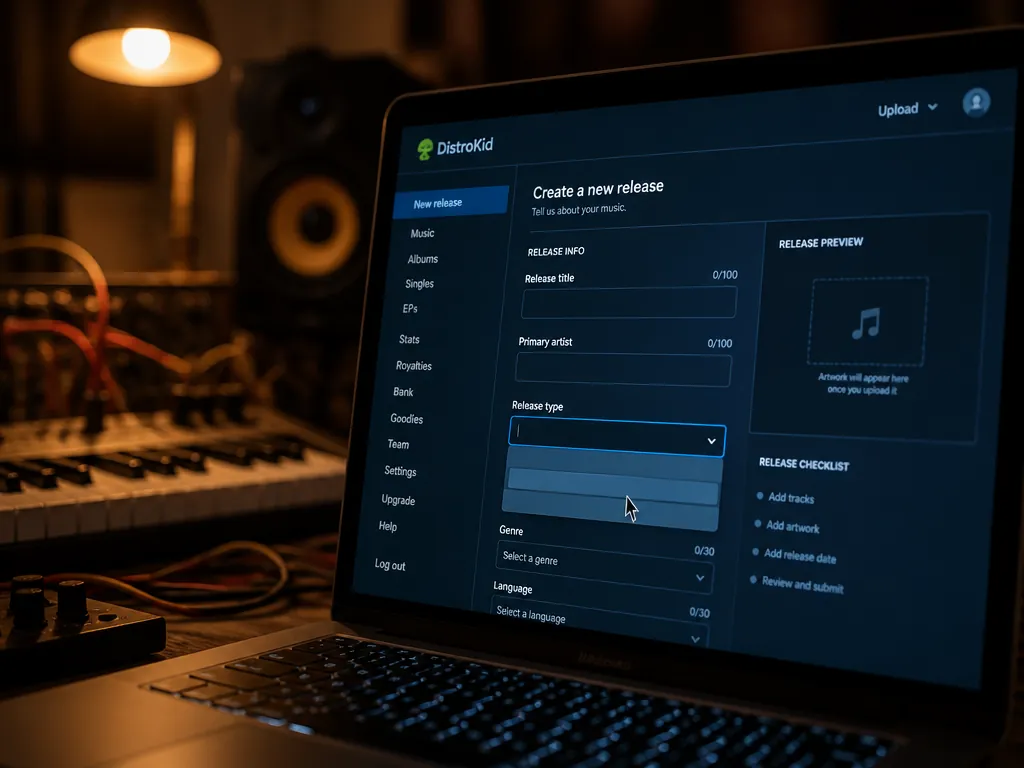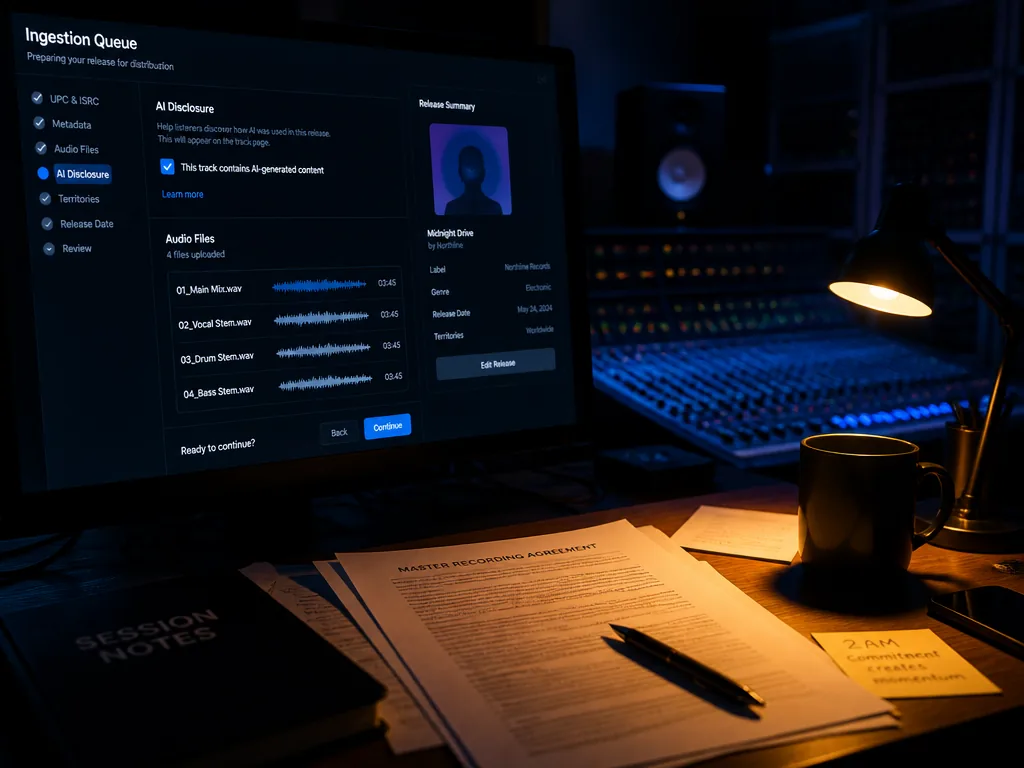
A track lands in a distributor's ingestion queue at 2 a.m. — a moody downtempo instrumental, 82 BPM, F minor, delivered as a 48kHz WAV with stems. Two years ago the only questions the pipeline asked were format, ISRC, and release date. Now there's a checkbox that wasn't there before: was any part of this created with generative AI, and if so, which parts. Somebody has to answer it. Whoever clicks that box is signing something, whether they realize it or not.
That is the quiet shift worth tracking. AI-generated music policy has stopped being a hosting-and-labeling question and become an economic governance question — the fight is no longer whether a platform will carry the track, but whether the track enters the royalty pool, and who carries the liability for the disclosure that decides it. For a rights holder or a distribution strategist, the operative change is in the plumbing between "available to stream" and "eligible to be paid."
Disclosure up front: City of Punk builds a generative music product, so we have a horse in the wider race. That is exactly why this piece stays on the compliance mechanics rather than cheerleading — the parts below cut against tools like ours as often as they favor them.
Why the axis moved
The early phase of this argument was cultural: is AI music "real," should platforms allow it at all. That debate is functionally over, because the volume settled it. When platforms report AI-tagged uploads arriving at scale — Deezer has publicly described tens of thousands of fully AI-generated tracks per day, a large share of daily new deliveries — a ban is not an operational option. You cannot manually adjudicate that flow, and you cannot pretend it isn't happening.
So the industry did what industries do when they can't stop a supply: it moved the control point downstream, from the door to the cash register. TIDAL's framing, articulated by figures like Tony Gervino, is instructive precisely because of what it declines to claim. It is not a ban on AI tools. It is not a verdict on whether AI music has artistic worth. It is a decision about payment — the platform can host a thing and still decline to route royalties to it. Once availability and payment are separated, the whole compliance surface changes shape, and every actor in the supply chain inherits a piece of it.
Follow the track through the pipeline and you can see where the obligations now attach.
Stage one: ingestion, where the disclosure is captured
The first thing that happens is metadata capture, and this is where distributors have already changed their forms. Delivery specs now increasingly include an AI-disclosure field — sometimes a binary flag, sometimes a tiered declaration (no AI, AI-assisted, wholly AI-generated). The important detail is legal, not technical: that field is usually backed by a representation and warranty in the distribution agreement. When the uploader affirms it, they are indemnifying the distributor and, downstream, the platform.
For a label, that means the disclosure decision has moved to the moment of delivery, and it is binding. You are no longer describing a creative process; you are making a contractual statement that a platform may act on financially and that a third party may later challenge. The cost of a careless click lands months later.
Stage two: classification, and the definition nobody has nailed
Next the track has to be sorted, and this is the genuinely unsolved part. "Wholly AI-generated" versus "AI-assisted" is not a settled line. Is a human-written topline over an AI-generated instrumental bed AI-assisted or human? What about a human composition run through an AI mastering chain, or a vocal cleaned with a generative de-noiser? A producer who programmed a detuned analog bassline by hand and then used a model to fill a percussion layer sits in a gray zone that no current policy defines crisply.
The platforms have not published detailed thresholds for where assistance becomes generation, and that ambiguity is not a footnote — it is the liability. Because the disclosure is a warranty, the person who guessed wrong at ingestion owns the consequence. Right now the industry is asking rights holders to certify a category the industry itself has not rigorously defined.
Stage three: detection and labeling, which run in parallel
While classification depends on what the uploader declared, platforms are also running their own detection — audio-fingerprint and model-signature analysis meant to catch undisclosed AI or synthetic-voice impersonation. Treat detection as an audit layer, not a truth machine. It produces flags and confidence scores, and it will generate both false positives (a heavily processed human vocal reading as synthetic) and false negatives (well-laundered AI passing as human).
The output is often a consumer-facing or metadata label. Understand what that label is for: fraud and impersonation control first, consumer information second. It is not, on its own, a payment decision. Which is why the next stage matters more than the tag.
Stage four: the monetization gate
Here the two paths — the uploader's disclosure and the platform's detection — converge on the decision that actually moves money. A track can be fully available to listeners and still be excluded from, or discounted within, the royalty pool. That is the mechanism doing the real work.
Consider why platforms want it. In a fixed royalty pool paid per-stream, every fraudulent or spammed AI stream dilutes what legitimate rights holders receive. Gate the pool and you protect the pool without policing the catalog. For strategists this reframes the question from "will AI music be allowed" to "what share of pool-eligible plays does human-attributed or verified catalog retain." That is a market-share question wearing a policy costume.
Stage five: attribution and clawback
The last thing that happens is the part most people don't plan for. When money has flowed and a disclosure is later found to be wrong — a track declared human that detection or a dispute exposes as generative — the recovery mechanism activates. Distribution agreements increasingly carry clawback and chargeback provisions that let a platform recoup paid royalties, and the distributor pass that recovery back to the account that made the representation.
So the causal chain closes where it opened: the checkbox at ingestion determines who eats the loss at the end. Everything between is process. The disclosure is the liability anchor.
What actually changed, by role
For the distributor: you are now a compliance intermediary, not a pipe. You captured the warranty, so you sit between the platform's clawback right and the uploader's indemnity. Practically, you need auditable disclosure records, tiered AI fields in your delivery spec, and terms that let you pass recovery upstream.
For the indie label: your delivery workflow needs an internal classification step before anything reaches a distributor, because the label — not the individual producer — usually signs the distribution agreement. If your producers use generative tools and nobody logs it, you are certifying blind. The fix is boring: a per-track process note recording tools used and human contribution, kept on file.
For the solo artist using AI tools: disclosing honestly is the cheaper path. Availability is not the risk; a false human-attribution claim that triggers a clawback is. Declare AI-assisted work as such and keep your session files as evidence of human authorship where it exists.
Who needs to act now, who can wait
If you sign distribution agreements, hold sync catalog, or manage a roster that touches generative tools, this is a this-quarter contract review, because the warranty and clawback language is being rewritten around you. If you are a listener-facing brand or a licensee buying finished tracks with clear paper, you can watch rather than move — your exposure is a supplier's problem until your contracts say otherwise.
What this piece did not settle
It did not answer the definitional question, and neither has anyone else: there is still no shared, testable threshold for "wholly AI-generated," which means the warranty every distributor now collects rests on a category the market hasn't fixed. Nor did it resolve whether these platform-by-platform gates converge into a cross-platform standard or stay a patchwork that arbitrage will exploit. Watch two documents for the answer: the AI-disclosure clauses in your next distribution contract, and how the PROs and collective management organizations decide to treat AI-tagged works in their own pool accounting. When those two align on a definition, the guessing stops — until then, whoever clicks the box is the one holding the risk.
Not sure which tool to use?
Compare the top AI music and sound tools side by side — honest reviews, real pricing, no sponsorships.