Zero.
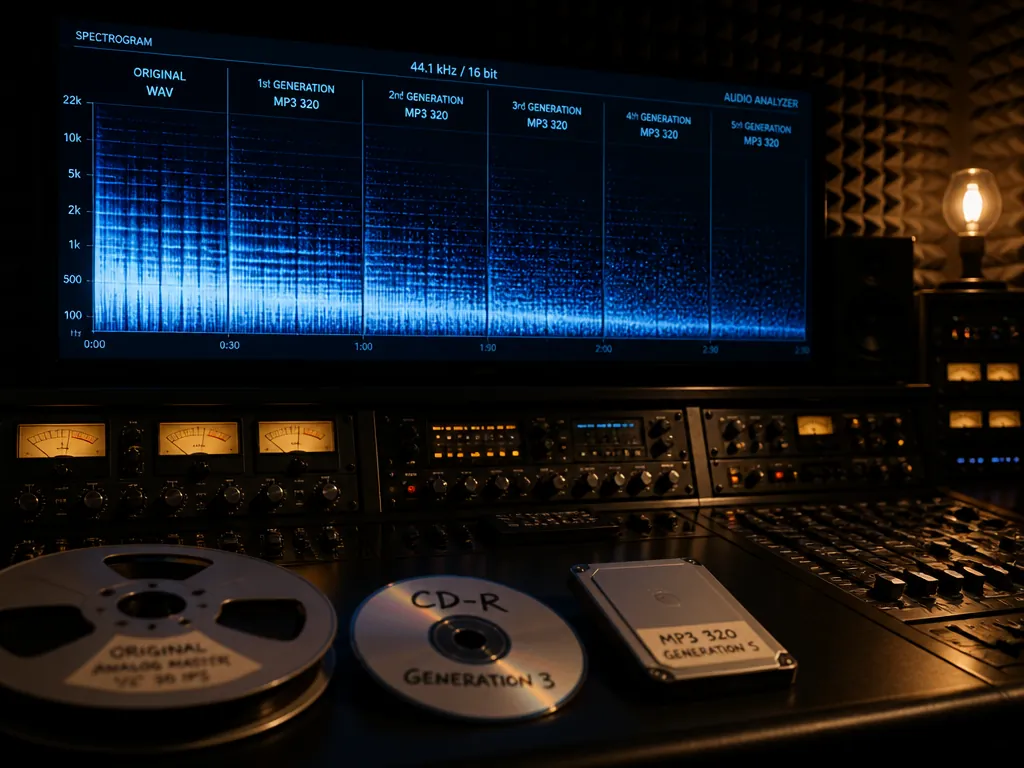
That is the number of independent, published audits I have been able to put in front of someone who asked me a reasonable question: does a commercial audio watermark actually survive a real release chain? Not a lab transform — a chain. A 48 kHz WAV render, a mastering pass with a few dB of makeup gain, a 128 kbps MP3 for the client, a platform's own re-encode, and a +2% pitch nudge from someone building a DJ set. The vendors have internal numbers. The AI music generation companies now shipping watermarking and fingerprinting cite those numbers. As of writing, I have not found a third party who reproduced them.
That gap would be an academic complaint if the industry were still arguing about it. It is not. Detection is being written into platform policy, label settlements, and statute, on the shared understanding that the technology works. It is worth tracing how the field arrived at that understanding, because the belief has a source, and the source is thinner than the belief.
Can platforms actually detect AI-generated music?
Partly, and mostly in one direction. Three different technologies get collapsed into the single word "detection," and they answer three different questions. A watermark is a signal embedded in the audio at generation time; a detector that finds it can say this came from that generator. A fingerprint is a compact hash of a finished recording held in a reference database; a match says this is a copy of a recording we already have. A classifier guesses from the audio alone whether a model or a person made it — and that is the one most people picture when they say "AI detection," and the one with the weakest public track record.
The asymmetry is the load-bearing part. A positive watermark hit is real evidence of origin. A negative result is close to no evidence at all: the track may come from a generator that does not mark its output, from a render made before marking shipped, from a stem that was resynthesized, or from a file that lost the mark somewhere between export and upload. Enforcement built on the presence of a signal is defensible. Enforcement built on its absence is built on nothing.
Where the belief came from
The intellectual source is a run of mid-1990s papers on digital watermarking — spread-spectrum embedding in the perceptually significant regions of a signal, data hiding in audio at the MIT Media Lab, a wave of work that established you could bury a payload under the masking threshold of a recording and pull it back out after ordinary handling.
Read those papers now and the claims are careful. They are scoped to specific transforms, specific payload sizes, specific quality targets, and they are explicit that robustness is defined relative to an attacker model. Within a decade the shorthand had dropped the qualifiers. "Audio watermarks are robust" became a thing people said in meetings. The scope conditions — robust to what, against whom, at what payload — did not travel with the sentence.
The one large public test, and how it ended
In 2000, the Secure Digital Music Initiative ran an open challenge on a set of candidate technologies, four of which were watermarking schemes. A team led by Edward Felten at Princeton reported defeating all four inside the three-week window while, by their account, preserving audio quality. SDMI disputed the interpretation. When the team moved to publish, they were threatened with litigation under the DMCA, withdrew the paper from an information-hiding workshop, and presented it at USENIX Security later that year.
That is, as far as public record goes, the largest adversarial test audio watermarking has faced. It ended with the watermarks broken and the researchers under legal threat, and the field has largely not run it again.
There is a fair counterargument, and operators should hold it: the threat model has changed. SDMI needed marks that survived motivated, skilled attackers with time. A provenance system for generative audio mostly needs to survive an indifferent uploader running bulk exports. Raising the cost of laundering at scale is a real goal and a much easier one. But that reframing has to be stated out loud, because "raises the cost for casual abuse" and "reliably identifies AI-generated recordings" are different products, and policy language keeps reaching for the second while vendors are shipping the first.
How fingerprinting borrowed Content ID's credibility
The other half of the belief comes from a technology that genuinely delivered. Robust audio hashing from the early 2000s, the Shazam-style landmark approach, Audible Magic's commercial deployments, and eventually Content ID operating at platform scale — these work, at volumes nobody in 1997 would have credited.
They work on a closed problem: is this candidate audio a copy of a reference recording we hold? Origin detection is a different question, and the trust transferred without the evidence transferring with it. A fingerprint match on a Suno-registered render tells you that specific render was reused. It says nothing once someone regenerates the stems, re-records the melody through a room mic, changes the arrangement, or drops the vocal and keeps the chords. Those are not exotic evasions. They are Tuesday in a normal production workflow, which means a fingerprint system will produce misses that look identical to innocence.
Then the rules arrived and assumed the tooling worked
The policy layer landed on top of all this rather than after testing it. Transparency provisions in the EU's AI Act require machine-readable marking of synthetic content, with the durability standard gestured at rather than specified. Collecting societies in Europe have gone to court over training and output. At least one major streaming service has said publicly that it tags fully AI-generated uploads in its catalog. Label settlements have pushed attribution and opt-out plumbing into commercial terms.
None of that is unreasonable. But note the loop: regulation describes an outcome and delegates the method to "state of the art"; vendors supply a method and cite the regulation as validation of it. Neither step includes an independent measurement, and Suno's own announcement, by the company's framing, is a roadmap with staged controls rather than a shipped, benchmarked detector.
Questions worth asking before you write a detector into policy
| Ask the vendor | A weak answer sounds like |
|---|---|
| What transform chain was survival measured against, in order? | "It's robust to common processing." |
| What is the false-positive rate on a human-made corpus of comparable size? | A detection rate quoted with no paired FP figure. |
| Who ran the test, and can we re-run it on our own catalog? | Internal only, under NDA, no sample set. |
| What does a negative result mean in your documentation? | Anything that implies absence of a mark indicates human origin. |
| What happens to the mark after stem separation and resynthesis? | Silence, or "that's out of scope." |
If the answers are thin, the honest policy position is that you have a provenance signal, not a detector, and you write your terms of service to match.
If you are the one making the tracks
A watermark in your file is a statement about which tool rendered it. It is not a license, not an accusation, and not a takedown. Your rights come from the platform's terms — which is the document to actually read, and the reason City of Punk keeps tool licensing side by side on its compare pages — not from what a scanner finds in the waveform.
Keep your own provenance anyway: prompts, seeds, session files, dated WAV masters. If a claim ever lands on a cue you delivered, your export history is stronger evidence than anyone's detector.
Back to zero
Zero independent audits is not a verdict. The watermarks may well hold up; the engineering behind them is serious, and the people building them are not making claims they know to be false. But zero is a measurement of something — the distance between what the field has tested and what it has decided to believe. Right now that distance is being written into contracts and statutes, and faith is a strange thing to put in a compliance policy.
Not sure which tool to use?
Compare the top AI music and sound tools side by side — honest reviews, real pricing, no sponsorships.