A distributor I know got a takedown-adjacent question from a platform last quarter: prove this catalog of 400 tracks is human-made. Not "confirm you hold the rights" — that they could do. Prove the audio itself wasn't machine-generated. There is no button for that. There is no report you can pull. The distributor spent a week emailing producers asking them to swear, in writing, that they played the parts.
That gap — between what an AI music labeling scheme promises and what any tool can actually verify — is the thing most transparency proposals quietly step over. The labels are coming, and some version of them is worth having. But if you are the person tasked with implementing one, you need to know what the label is standing on. Right now, in most cases, it is standing on a declaration, not a detection.
The myth worth naming
The myth is reasonable, which is why smart people hold it: AI-generated music can be detected the way copyrighted audio is detected. Content ID and its cousins already scan billions of uploads and match them against a reference database. So the intuition goes — surely we can point the same machinery at the question of whether a track was made by a model, flag the synthetic ones, and populate the label automatically.
It is a clean mental model. It is also wrong about the core mechanic, and the difference matters for every policy built on top of it.
What the evidence actually shows
Start with what audio fingerprinting does. A system like Content ID matches a specific recording against a specific reference. It answers "is this the same sound as that sound." It is very good at that, because it is comparing waveforms to a known catalog. It does not, and cannot, look at a novel track and tell you how it was made.
AI detection is a fundamentally different task. You are not matching against a reference — the whole point of a generated track is that it is new. You are asking a classifier to guess, from the audio alone, whether the fingerprints of a generative process are present. That is a probability, not a match. And the ground under it shifts constantly, because every new model release changes what "generated audio" sounds like. A classifier trained on last year's diffusion artifacts starts missing this year's.
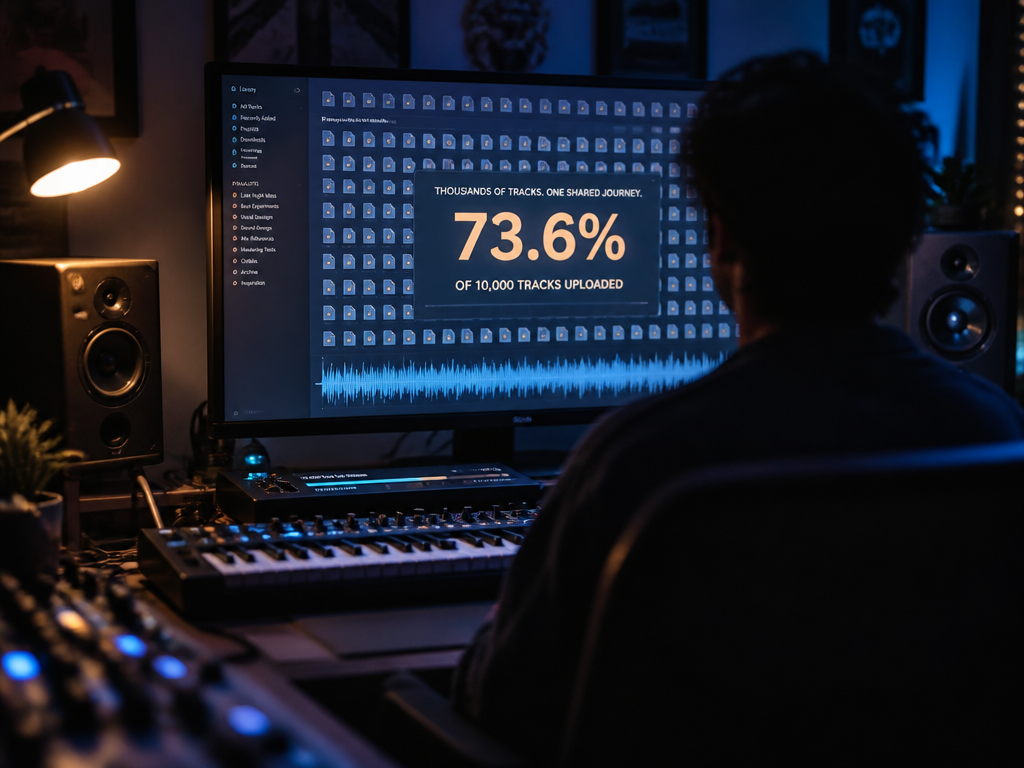
The proliferation numbers are why platforms feel urgency: on some services, a large and growing share of new daily uploads are already fully AI-generated — Deezer has publicly cited figures in the tens of percent, and other platforms report similar direction of travel. But volume is exactly what defeats a probabilistic classifier. At scale, even a small false-positive rate means human musicians get flagged as machines, and a small false-negative rate means the flood you were trying to label sails through unmarked. Neither error is acceptable to the party on the wrong end of it.
There is also the gray zone that no waveform reveals. A producer who generates a drum loop, resamples it, plays a bassline over it, and mixes it by hand has made an AI-assisted track. A producer who prompts a model for a full arrangement and exports the stereo file has made an AI-generated one. Those two files can measure nearly identically to a classifier. The distinction that policy cares about lives in the process, and the process is not in the audio.
How the label actually gets populated

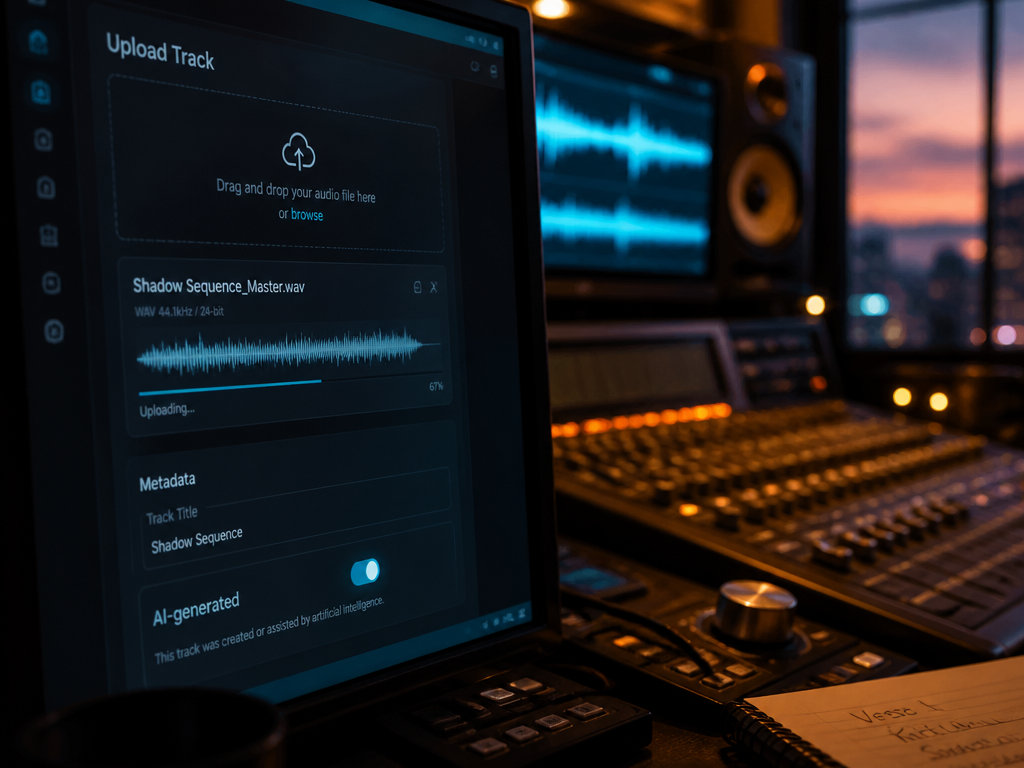
This is where the IFPI-style two-tier approach — one category for AI-generated, another for AI-assisted — is smarter than the detection myth gives it credit for. It is not pretending to be forensic. It is a disclosure regime. The uploader declares which bucket the track belongs in, the metadata carries that declaration downstream, and platforms surface it.
Read that sentence again, because it changes your whole implementation plan. The label's integrity comes from the truthfulness of the person uploading, backstopped by contractual terms and the threat of enforcement — not from a scanner confirming the claim. That is closer to how the industry already handles songwriter splits or sample clearances than it is to how it handles copyright matching. It is an honor system with teeth, and the teeth are legal, not technological.
Which raises the question every executive in this chain should be asking: what happens when someone declares wrong? Two failure modes, opposite directions:
- Under-declaration. A fully generated track gets uploaded as human-made, or with no AI flag at all. Detection can't reliably catch it, so the deterrent has to be the terms of service and the consequence of getting caught by other means — a whistleblower, a model provider's own logs, a producer who reused a recognizable generated hook.
- Over-caution. Legitimate producers who used a single AI-assisted tool start blanket-labeling everything as AI to stay safe, which floods the "AI-assisted" tier until it means nothing. If the label carries a discovery or payout penalty, you have just taxed honesty.
Detection tools still have a role here — as a triage signal, not a verdict. A classifier that returns "high probability of full generation" on a track declared human-made is a useful flag for human review. It is a reason to look, not a finding. Anyone selling you a detector as a compliance guarantee is selling you a lawsuit.
The honest takeaway
If you are implementing an AI-content standard, build it as a metadata and disclosure system first, and treat detection as an audit tool that samples and escalates — never as the source of truth. The label answers "what did the uploader tell us," and the value of that answer is exactly as good as your enforcement and your terms make it. That is not a weakness to hide. It is the actual shape of the thing, and policies written as if detection were solved will break the first time a producer disputes a false positive in public.
The two-tier structure is the right instinct because it admits the middle exists. The mistake is downstream: assuming the tiers will be filled by a machine reading the audio. They will be filled by people, and your job is to make honest filling easier than dishonest filling — clear definitions, no payout penalty for accurate disclosure, and a review path for the disputes that will come.
Something to try this week
Take ten tracks from your own catalog or platform and try to fill the label yourself, using only what is in the file — the audio and whatever metadata came attached. Do not ask the artist. Just decide: generated, assisted, or human, from the evidence in front of you. You will find a handful you genuinely can't call. Those are your gray zone, and their proportion is the real number your policy has to survive — not the detection vendor's accuracy claim, but how often your own trained ears can't tell.
The label you ship will only ever be as trustworthy as the honesty it asks for and the disputes it's built to handle.
Not sure which tool to use?
Compare the top AI music and sound tools side by side — honest reviews, real pricing, no sponsorships.