The email lands on a Tuesday, three days after the show. A guitarist who played second on a five-band bill has worked out that the act above them — 22-minute set, stereo bounce off a USB stick, no gear to load in, no soundcheck to speak of — was generated. Not assisted. Generated. They want to know whether you knew. They want to know what you're going to do about it. They have already posted.
Every argument about AI in live music runs on adjectives. Soulless. Inevitable. Lazy. Useful. Venue managers don't book adjectives. You book slots. So start with the only number in this fight that anyone can verify, and it isn't from a study — it's from your own calendar.
The number is 624
Take a 150-cap room running four ticketed nights a week, three acts a night, fifty-two weeks a year. Four times three times fifty-two is 624. That's the supply of stage time your building produces in a year, at full tilt, before anything gets subtracted.
Then subtract. Two weeks dark over the holidays. The private hires. The six nights a touring package takes the whole bill and brings its own support. The Tuesdays you stopped programming because they lost money. Run that on your own room and the real figure lands somewhere well under 500, and it will be smaller than you assumed when you started counting.
That's the number. Not a survey of audience attitudes, not a percentage of listeners who say they'd pay less for machine-made music. A count of how many times a year your venue can put a name on a poster.
What 624 actually measures
It measures scarcity, and it measures it precisely. Stage time is the one input in your building that can't be scaled. You can add a bar, extend the licence, move the sound desk, print more tickets for a bigger room. You cannot manufacture a Friday.
It also measures rivalry. Two acts cannot occupy the same slot. Every allocation is a denial — that's not a moral claim, it's arithmetic, and it's the actual engine under the guitarist's email. They are not writing to you about aesthetics. They are writing to you about a slot that existed once and is gone.
And it measures your leverage. Whatever policy you write gets enforced roughly 624 times a year, in public, in front of the people whose opinion determines whether your room is where the scene plays or where the scene used to play. Venue policy on AI artists isn't a press statement. It's a decision you make hundreds of times, on a form, at speed.
What 624 doesn't measure
This is where most venue policies fall apart, because the number is blunt and the situation isn't.
It doesn't measure how much AI. One slot is one slot whether the act mastered their record with an assistive plugin, used stem separation to build a remix, layered a generated pad under a live cello, or rendered the entire 30 minutes in a browser tab. Your calendar treats those identically. Your local scene does not.
It doesn't measure who's on stage. A human triggering generated stems, playing over them, sweating, is a fundamentally different room than a laptop running a rendered set to a click nobody's following. Audiences read that difference in about ninety seconds.
It doesn't measure draw. If the act in question sold 40 advance tickets and the band complaining sold 12, your booker already knows why the slot went where it went. That fact doesn't settle the argument, but leaving it out of your own internal accounting is how venues end up making a promise they'll break in six weeks.
It doesn't measure what the audience was told. Nearly every one of these blowups is a disclosure failure before it's an ideological one. People who would have bought a ticket to a billed AI act are furious about an unbilled one.
It doesn't measure rights. Who owns the master coming out of the PA, what the output licence permits for public performance, what goes on the setlist sheet you send to your PRO, whether the act can produce a name to report at all. These terms vary by platform and change; read the specific licence rather than assuming the category. A venue that never asks is a venue that finds out later.
And it doesn't measure reputational cost, which is asymmetric. Nobody posts about the night the policy worked.
What counts as an AI act, exactly
There's no industry-standard definition, so the venues handling this well write their own and publish it. In practice three different things get flattened into one phrase: AI-assisted production, where a human writes and performs and the tools help with mixing, mastering, or sound design; AI-generated material performed live, where a person on stage plays or triggers machine-made audio; and fully synthetic acts, where no human performs and a rendered set is played back, sometimes behind a fictional artist persona. Almost all of the conflict comes from collapsing those three into one word and then arguing about the word.
| Tier | What it is | What the room sees | Reasonable handling |
|---|---|---|---|
| Assisted | Human writes and performs; AI in mixing, mastering, stem separation, sound design | A band | No disclosure needed; this is production, and it's already everywhere |
| Generated-with-performer | Machine-made beds, stems, or vocals; a human plays, sings, or triggers live | A hybrid set | Disclose on the event page in one line; book on merit |
| Fully synthetic | No live performer; rendered set, sometimes a fictional persona | Playback | Bill it plainly, or don't book it — the middle path is what burns you |
We spend a lot of time at City of Punk pulling these tools apart, and the honest finding is that the line between tiers is blurrier inside the software than it will ever be in a policy document. That's an argument for asking the question, not for skipping it.
The tech rider already told you
Before the booking form, the advance. An act that needs one 3.5mm cable, no monitors, no DI, and declines a line check is telling you what the set is. So is a rider that asks for a 48kHz WAV playback slot and nothing else. So is a stereo bounce arriving where you'd expect stems.
None of that is disqualifying — plenty of respected electronic acts run playback and always have. But your production manager usually knows the shape of a show a week before your booker does, and in most venues those two people never compare notes. Make them. The cheapest AI policy in the building is a production manager with permission to flag an advance.
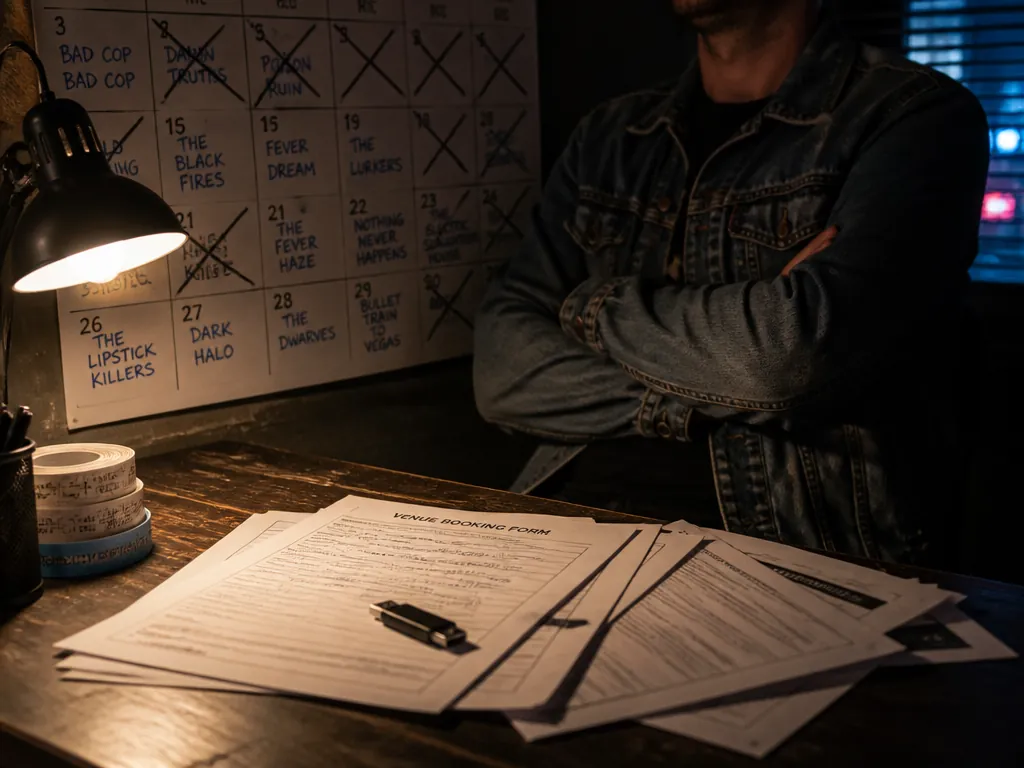
The one question to add to your booking form
Does any part of your set use generative AI?
[ ] No
[ ] Yes — production tools only (mixing, mastering, stem separation, sound design)
[ ] Yes — generated music or vocals are part of the performance
[ ] Yes — fully AI-generated; no live performer

If you ticked either of the last two: in one line, what does a
person do on stage?
Four boxes and a free-text line. The boxes exist because a yes/no question gets a defensible "no" from anyone who used a mastering assistant, which makes your own data worthless. The free-text line does the real work — it's answerable in five seconds by an act with a live show and it's visibly awkward for an act without one. You are not auditing anybody. You're recording what you were told, which is the difference between a mistake and a cover-up when someone asks later.
Then put the answer on the event page. One clause next to the set time. Not a warning label, not an asterisk — the same register you'd use for "DJ set" or "seated show." Audiences accept an enormous amount when they're told first.
The shape of the backlash
These incidents resolve in a recognisable sequence, and it's worth knowing the parts because each one has a legitimate case.
The local musician's grievance is about allocation and about being surprised: they've spent years working up to a slot, and the slot went to something that didn't queue for it. The AI-using artist's defence is usually that they wrote, arranged, curated, and paid for the tools, and that the objection is really to a workflow rather than to a result — which is a serious argument, not a dodge. The venue's position is that it booked in good faith off information nobody asked for. The booking agency's position tends to be similar, one degree removed.
The resolution is nearly always the same three moves: an acknowledgement, a change to the booking form, and something restitutive aimed at local musicians. What's striking is how often the policy change is precisely the question above. The venue didn't need a philosophy. It needed a field on a form.
A policy you could publish this week
- Define your tiers in your own words, on your own site, in under 150 words.
- Ask the disclosure question at booking and keep the answer on file.
- Bill tier two and tier three on the event page, in neutral language.
- Give your production manager standing permission to flag an advance.
- Decide in advance what share of your slots go to acts based within a set radius, and publish that too — it's the concern underneath most AI complaints anyway.
- Ask who to report to your PRO before the show, not after.
- Write down what you'll do if you get it wrong, while nobody's angry.
None of this settles whether AI on stage is good. It settles whether your room is the one that told people. Those are different questions and only one of them is yours to answer.
Stage time is the one thing in your building you can't generate more of.
Not sure which tool to use?
Compare the top AI music and sound tools side by side — honest reviews, real pricing, no sponsorships.