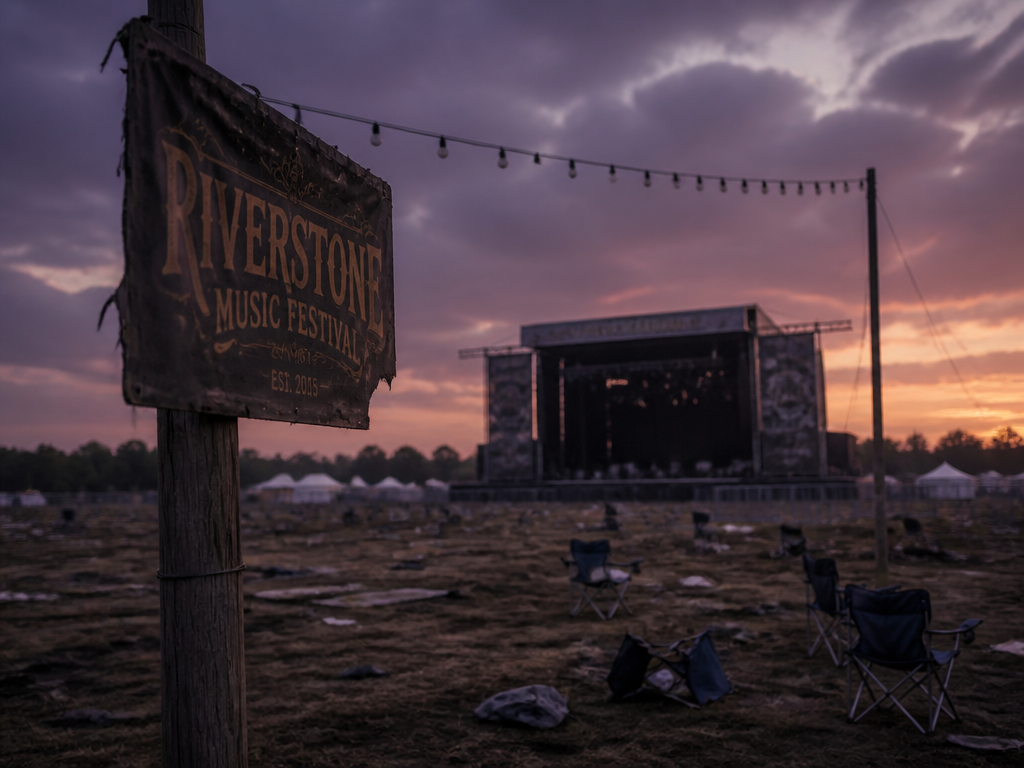
Start with the number the trade press kept repeating last cycle: dozens of UK festivals gone in a single year. The Association of Independent Festivals has tracked this figure for a while now, and the shape of it does not flatter anyone. In one recent reporting window the count of independent UK festivals that folded ran into the dozens — a step up on the year before, which was itself a step up on the year before that. If you want a clean summary of the festival industry crisis, that trend line is it: not a spike, a slope.
But a number that gets quoted this often stops being read. So let me do the unglamorous thing and take it apart, because what the figure counts — and what it quietly leaves out — tells you more about the state of the sector than the headline ever will.
What the number counts
The AIF figure counts festivals that did not happen and are not coming back. That sounds obvious until you try to draw the line. A festival that announces a lineup, sells tickets, then pulls the plug three months out is a cancellation. A festival that quietly does not open bookings for next summer and never issues a statement is a closure. Both remove an event from the calendar. Only one of them makes the news.
The tracked number leans on the visible cases: the ones with a headline act attached, a refund process, a statement that uses words like "heartbreaking" and "no longer viable." Those are the failures with a paper trail. They are real, and each one represents a promoter who ran the maths on load-in costs, artist fees, insurance, security, and toilets, and could not make the far side add up.
So the number is honest as far as it goes. It measures events that had enough momentum to fail publicly. Hold that thought.
What the number actually measured
Here is the part the headline flattens. That count measured discontinuation, not distress. A festival that survives is scored as a survivor — full stop — regardless of what it had to amputate to get there.
And amputation is the real story of the survivors. Talk to anyone programming a 10,000-capacity event and you hear the same set of cuts: the second stage that quietly became a marquee, then a tent, then a rumour. The Saturday headliner budget that used to book a name and now books "a name people will accept." Production spend trimmed until the PA is hired for two days instead of three. Ticket prices nudged up past the point where a family of four can go without a conversation about it first.
None of that registers in a closure count. A festival can lose half its soul and still be marked present. The number measures death. It does not measure the ones dying with the lights on.
What the number doesn't measure at all
Three things escape the figure entirely, and each one matters more than the last.
First, the pre-emptive quitters. Promoters who ran a small event for eight years and simply did not attempt year nine. No cancellation, because nothing was announced. No refund, because no tickets went on sale. These people do not phone the trade press to report that they thought about it and decided the risk was insane. They are absent from the data by design.
Second, the supply chain. A mid-tier festival is a temporary employer of stage crew, riggers, local security firms, catering, portable-loo hire, fencing contractors, and the pub down the road that does three months of trade in one weekend. When the event goes, that spend does not migrate to a bigger festival elsewhere — the bigger festival brings its own contracted suppliers. The money leaves the ecosystem. The closure count records one line item and misses the dozen livelihoods hanging off it.
Third, diversity of programming. The events most exposed are rarely the ones booking the safe, insured, festival-circuit headliner. They are the folk weekender, the jazz-and-heritage bill, the regional dance event, the small genre-specific gathering that a multinational operator would never green-light because the margins are thin and the audience is loyal rather than large. Those go first. The count treats them as interchangeable units. The culture does not.
The mechanics underneath
Why is the squeeze landing hardest in the middle? Because the middle has the worst of both ends.
Large operators — the ones with festival portfolios owned inside global live-entertainment groups — negotiate artist fees, insurance, and supplier rates across dozens of events. A rate that would sink a single independent is a rounding error across a portfolio. They can also cross-subsidise a soft-selling year with a strong one elsewhere. An independent has one throw of the dice per summer and no reserves to absorb a rain-soaked Saturday.
Meanwhile input costs have run ahead of ticket prices for several years, and audiences booking later than ever leaves promoters committing to non-refundable deposits against ticket revenue that may not arrive until weeks before the gates open. That is not a business model. That is a nerve-holding exercise.
Who is most exposed
If you run something between roughly 5,000 and 30,000 capacity, independently owned, one event a year, no portfolio to lean on — you are the demographic this trend is describing. Too big to run lean off goodwill and a field, too small to command the rates and reserves that make the numbers behave. The very-small can survive on volunteers and a shoestring. The very-large can survive on scale. The middle survives on nerve, and nerve is not collateral.
The number, then, is not wrong. It is just modest. Every public closure it records sits on top of a wider seabed it cannot see: the quiet non-starters, the hollowed-out survivors, the suppliers left without a season.
Count the festivals that died if you like. The sector's real condition is written in the ones that lived and came back smaller.
Not sure which tool to use?
Compare the top AI music and sound tools side by side — honest reviews, real pricing, no sponsorships.