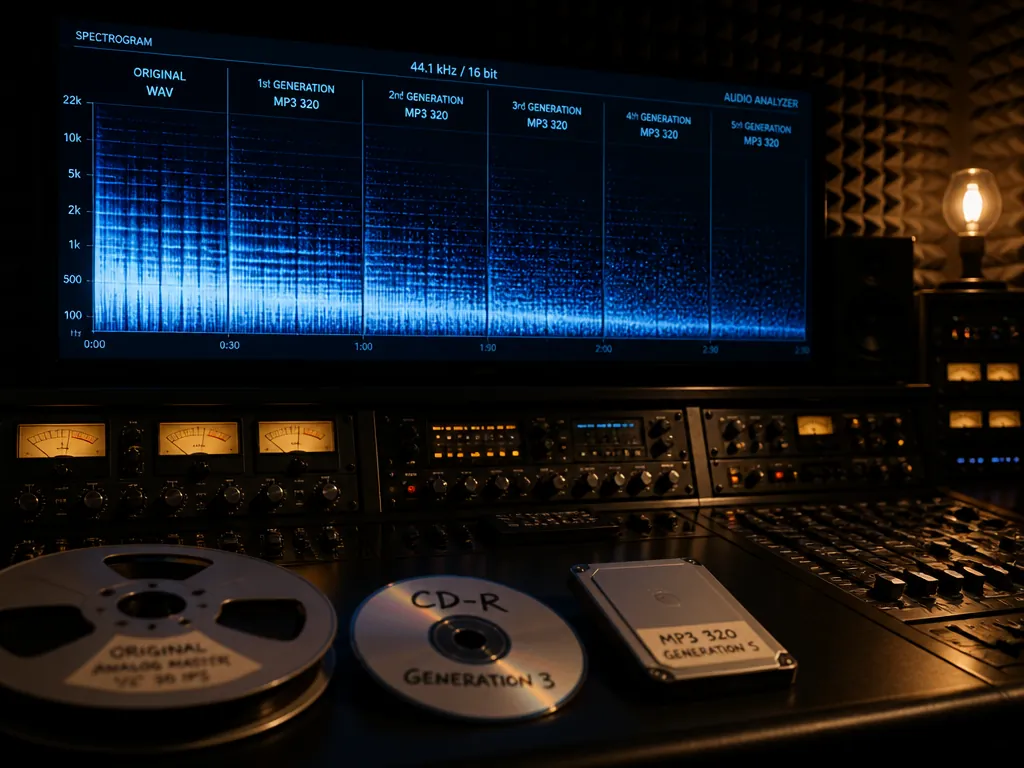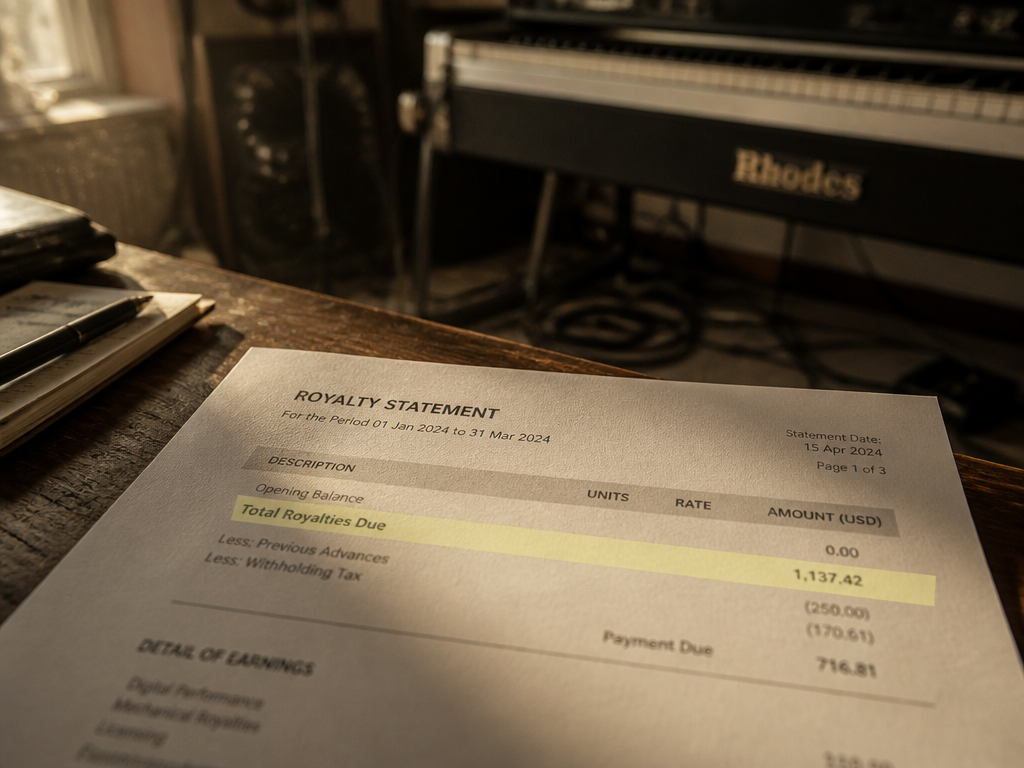
Last month I ran a small test, mostly out of suspicion. I took a bassline I know cold — a detuned analog walk in F minor, the kind of line that sits under a thousand library cues — and I described it to a music generator without naming the song it came from. Tempo, key, the swung sixteenth feel, the slight pitch drift on the root. I asked for "warm analog bass, melancholic, late-night." Then I ran it eight times and listened for how close the renders drifted toward the source.
Six came back generic. Two came back close enough that I sat up. Not a copy — no lawyer would call it a copy — but the contour, the drift, the spacing between notes landed in the same neighborhood. That's the whole problem with the current debate over AI copyright regulation in one render: the question isn't whether a machine plagiarizes a file. It's what happens when the inputs were never licensed and the outputs are close enough to make a rights manager flinch but slippery enough to dodge a takedown. The companies building these tools have a tidy story about why that's fine. It's worth taking that story apart slowly, because it's the story that's going to be told to your legislators.
What is the tech industry's main argument for training AI on copyrighted music?
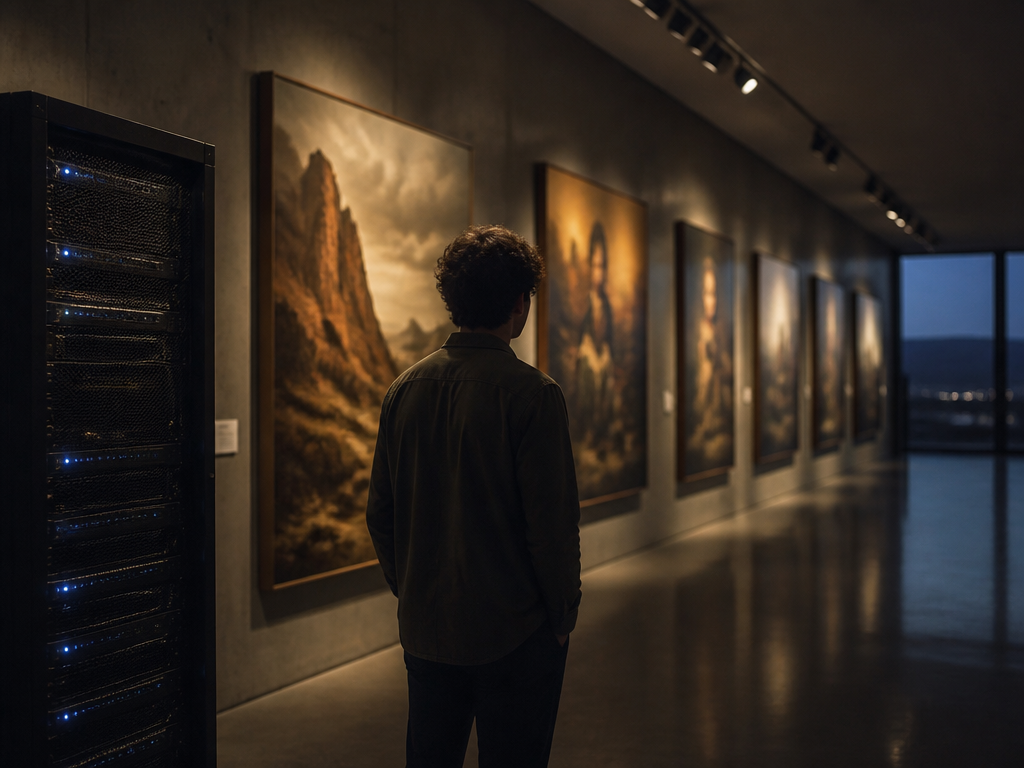
The core argument is that training a model on copyrighted recordings is fair use — that the model studies the work without reproducing it, the way a human artist learns by absorbing other art. The most common framing compares an AI system to an art student walking through a gallery, looking at paintings, and developing their own style from what they see. No one charges the student for learning. So, the argument goes, no one should charge the model.
It's a clean analogy. It's also doing far more work than it can bear.
Start with the gallery itself. Someone bought those paintings, or borrowed them under terms, or the artist consented to the hanging. The gallery often charges admission. The student who later sells work in that style sells one canvas at a time, at human speed, with a human's finite output and a career's worth of accountability. None of those conditions survive the jump to a model trained on millions of recordings scraped without a licensing conversation, then deployed to generate at industrial volume on demand.
The analogy smuggles in three things that don't transfer: payment for access, permission to be in the room, and the natural ceiling on what one learner can produce. Strip those out and "it's like an art student" becomes "it's like a factory that read every book in the library through the wall and now prints novels." Same verb — learning — wildly different machine around it.
The "we'll pay for the data" concession, and what it quietly relocates
A more recent and more sophisticated position concedes some ground: fine, there should be a market for training data. Companies suggest they're willing to pay for access to catalogs, strike licensing deals, build a data economy that compensates rights holders for the material that goes in.
Take the concession seriously, because it's progress over "everything is fair use." But notice what it does to the battlefield. It relocates the entire fight to the input side — what goes into training — and frames the solution as a negotiated price for catalogs. If you're a rights advocate, that sounds like a win, and partly it is. The trap is that an input-licensing regime can be presented as the whole answer. Pay for the corpus, and the output question — what the model spits out, who it resembles, who gets paid when a generated track competes with a human one in the same playlist — gets treated as solved by association. It isn't.
Input licensing is a revenue line. Output similarity is a competitive and attribution problem. Conflating them lets a company write a check for training rights and then act as though the resemblance question has been settled. It hasn't been settled. It hasn't really been addressed.
The output problem is where the weak seam actually is
Here's the seam to press on. The industry's proposed remedy for problematic outputs tends to be reactive: a reporting mechanism, a takedown path, a process where a rights holder spots an infringing generation and flags it for removal. That model is borrowed wholesale from the platform era — the same notice-and-takedown machinery that governs uploaded videos and user content.
It worked, imperfectly, when the volume was human. It does not survive the volume that generation creates.
Consider the math, even loosely. Streaming services have reported uploads in the range of tens of thousands of new tracks per day — figures around 75,000 daily have circulated in industry reporting. That flood already predates the easy availability of generation tools. Now imagine the curve as generated tracks fold into it. A takedown regime asks rights holders to listen, identify, document, and file against an output stream that scales faster than any human review team can staff against. It's a finger in a dike that's growing new holes by the minute.
This is why "report it and we'll take it down" is not a remedy at that scale. It's the appearance of a remedy. The burden lands entirely on the rights holder, after the harm, one track at a time, against a generator that can produce the next thousand variations before the first complaint clears review.
Where to push, if you're the one in the room
If you're carrying the music industry's argument to a policymaker, the concessions the tech side has already made are your leverage — use their own framing. A few seams worth pressing:
- Make them own the analogy's missing parts. When the gallery comparison appears, ask who paid for the paintings, who granted permission, and what the student's output ceiling is. The analogy collapses the moment those are named.
- Refuse the input/output merge. Treat training-data licensing and output similarity as two separate ledgers. A deal on one is not a deal on the other.
- Anchor on scale. Any remedy that depends on rights holders manually finding and reporting infringements should be tested against daily upload volume. If it can't survive the math, it's theater.
- Ask who carries the cost of detection. A reactive system quietly assigns the entire monitoring expense to the party that was harmed. Make that allocation explicit and ask why it's fair.
None of this requires accusing anyone of bad faith. Companies advocate for the regime that suits them; that's the job of advocacy. The music side's job is to match the rigor, and the rigor lives in the specifics — payment, permission, scale — not in outrage.
Back at the desk
After that eight-render test, I changed one thing in my own practice, and I mention it as evidence rather than advice. When I now use a generator for a client cue, I keep the prompt log and every rejected render in the project folder, dated, alongside the WAV I deliver. Not because anyone has asked for it yet, but because the day someone asks "where did this come from," I want a paper trail that points to a process, not to a file I can't account for.
That's what the policy argument looks like when it's lived: I can document my inputs and my outputs separately, because I already know those are two different questions. The companies arguing otherwise are betting that nobody in the room keeps that distinction straight. Keep it straight.
Not sure which tool to use?
Compare the top AI music and sound tools side by side — honest reviews, real pricing, no sponsorships.