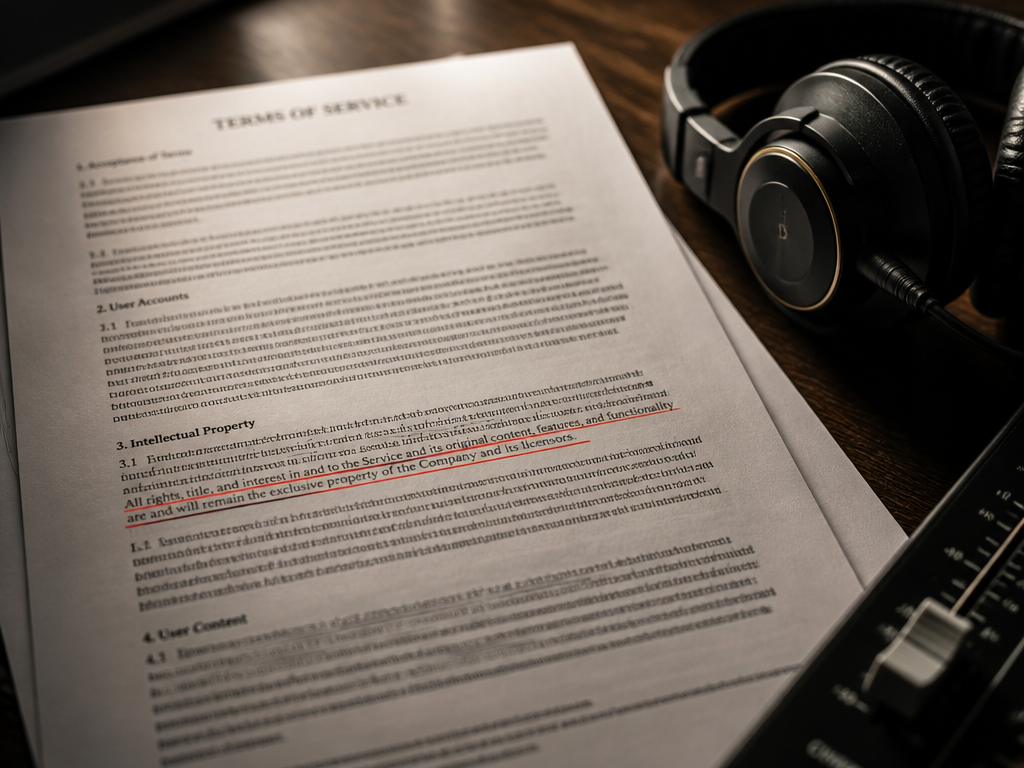
Last month I ran a small experiment I should have run a year ago. I generated a track — a slow, smoke-damaged trip-hop thing, roughly 82 BPM in F minor, a detuned Rhodes over a filtered break — and instead of dropping it straight into a client edit, I sat down and read the terms of service line by line. Not the summary. The actual document. I wanted to know one thing: if I put this under a paying client's ad, what do I own, and what happens if someone challenges it?
The answer changed how I use these tools, and it's the reason AI copyright is the single most misunderstood thing in this corner of production right now.
Here's the verdict up front: with most AI music generators you can legally use the output commercially, but "use" and "own" are not the same word, and the copyright sitting under an AI-generated track is far thinner — sometimes nonexistent — than the checkout page implies. That gap is where independent musicians get hurt.
The track, and the moment the terms contradicted me
My test file came out clean. 48kHz WAV, stereo, no artifacting on the low end, which is not always the case — I've had plenty of renders where the bass turns to porridge below 80Hz and the "vocals" dissolve into a wet consonant soup. This one was usable. On a paid tier, I had the right to use it commercially. So far, so good.
Then I looked for the sentence I actually wanted, the one that says: this output is yours, and it is protected.
It wasn't there. What was there, across the tools I checked, was a grant of a license to use the output — often broad, often including commercial use on paid plans — paired with careful language declining to promise that any copyright vests in you at all. One platform, after litigation pressure, quietly tightened this exact area of its terms. The direction of the edit was telling: less promise of ownership, not more.
That is a strange thing to hold in your hand. I had a commercially usable master and, functionally, no guarantee I owned the thing I could sell. If you have ever been burned by a stock-music subscription that buried "commercial use" behind a footnote, this is the same trap wearing a newer jacket. The difference is that here the question is not just may I use it — it's is there anything to own in the first place.
Why the copyright underneath is so thin
To understand why, you have to separate two ideas that the marketing works hard to blur together:
- A license to use is a contract between you and the platform. It says the company will not sue you for using the file, and usually that you can make money from it.
- A copyright is a property right in the work itself, recognized by law, that lets you stop other people from copying it.
The first one the platform can hand you all day, because it costs them nothing to promise not to sue you. The second one they mostly cannot give you, because in the United States it may not exist to give.
The reason sits in a requirement older than any of these tools: copyright protects works of human authorship. The U.S. Copyright Office has been consistent — and, over the last couple of years, increasingly explicit — that material generated by a machine without meaningful human creative input is not eligible for registration. A prompt, in their current framing, is treated more like a set of instructions to the machine than an act of authorship. You describe the vibe; the model makes the thousand micro-decisions — the arrangement, the timbre, the note choices, the mix — that actually constitute the work. As of writing, that reasoning is what stands between a text prompt and a defensible copyright.
This is not settled forever, and I want to be honest about the edges. The Office has signaled that works combining AI generation with sufficient human authorship — significant editing, arrangement, selection and combination of AI elements into a larger creative whole — can be protected in the human-authored parts. So the producer who generates stems and then re-plays, re-arranges, resamples, re-mixes and layers real performance over the top is in a genuinely different legal position from the person who types a sentence, hits generate, and uploads the raw render. The craft you add is not decoration. It may be the only thing in the file the law is willing to protect.
But even that is a live question. How much human input is "enough"? Nobody can give you a bright line, because there isn't one yet.
This is where the history rhymes

If you feel a familiar shape here — value being created at one end and captured at the other — you are not imagining it. The music business has spent a century building infrastructure that sits upstream of the artist.
Think about terrestrial radio in the U.S., which for decades has paid songwriters and publishers but not, in the same way, the performers on the recording. The record spins, money moves, and a specific class of rights-holder collects while another does not — not because of some natural law of sound, but because of how the rights infrastructure was negotiated generations ago and who was in the room. Streaming rebuilt a version of the same asymmetry with new plumbing. The through-line is that the people who control the system — the catalog, the license, the distribution rail — capture value more reliably than the people who make the sound.
AI music tools are the newest layer of that infrastructure, and they are being built by companies negotiating with the same major labels, under litigation, with settlements on the table. When those deals get cut, the parties at the table are the platforms and the rights-holders. The independent musician typing prompts is not in that room, and the terms of service are the document that tells you so — politely, in the language of a license grant.
I am not saying this out of hostility to the tools. I use them. The detuned Rhodes thing is going in a project. The point is narrower and more useful: the thinness of AI copyright is not an accident of the technology. It is partly a choice about how the product is built and how the business is structured.
The design choice nobody's forced to make
A tool that generated music through genuine, documented, real-time human authorship — where your specific interventions were captured, logged, and structured to build a paper trail toward registration — is technically imaginable. Some corners of the industry are inching toward it. But it is slower to build and harder to demo than a box where you type a sentence and get a finished song forty seconds later. The prompt-and-render model won because it was faster to ship and easier to sell, not because it was the version most likely to leave you holding a defensible right.
So when you evaluate one of these platforms, you are not merely evaluating audio quality. You are evaluating a rights posture that somebody designed. That is the lens I'd bring to any purchase decision.
How I'd decide
Here are the criteria I actually use now, in the order they matter to me. None of this is legal advice — I score films and build sound, I don't practice law — but these are the questions that separate a usable tool from a liability.
1. Use rights vs. ownership — read which one they promise
Find the exact clause. Does the platform grant you a license to use the output, or does it claim to assign ownership? Most grant use. Very few can meaningfully promise a copyright, for the reasons above. If the marketing says "you own your songs" but the terms say "we grant you a license," believe the terms. The terms are the enforceable document; the marketing is a mood.
2. Commercial use and the free-tier trap
On many platforms, free-tier output is not cleared for commercial use — it's for personal or evaluation use only, and commercial rights start on a paid plan. This is the single most common way people get into trouble: they audition on the free tier, love a track, and ship it without upgrading. If a client is paying you, you almost certainly need the paid tier, and you need to keep proof of which plan generated the file.
3. Indemnity — who eats the lawsuit
This one is quietly the most important, and it changes fast, so treat any specific claim as a snapshot. Does the platform indemnify you — agree to cover you — if a third party claims the output infringes their work? Some enterprise and paid tiers of AI tools in adjacent fields offer indemnity; many music tools, as of writing, do not, or cap it hard. If there's no indemnity and no ownership guarantee, you are carrying the risk personally. Price that in.
4. License clarity across tiers
Read what changes between tiers, not just the price. Watch for:
- Whether commercial rights are perpetual or expire if you stop paying (a genuine trap — some licenses evaporate when the subscription lapses)
- Whether the platform retains a right to use, resell, or train on your generated tracks
- Whether attribution is required
- Territory and media limitations
A license that dies when you cancel is not ownership by any definition. If your track is in a client's evergreen ad, a lapsing license is a time bomb.

5. Export formats and stems
For actual production work you want, at minimum, 48kHz WAV, and ideally stems — separated parts you can re-mix, re-arrange, and layer over. Stems matter twice: once for the mix, once for the law. The more you genuinely re-author from stems, the stronger your claim to a copyright in the resulting work. A tool that only exports a stereo MP3 locks you out of both.
6. Cost over twelve months, not per month
Run the real number. A tool at a monthly rate looks cheap next to a stock-library subscription until you factor in that you may need the top tier for full commercial rights, and that the license may not survive cancellation. Twelve months of the plan that actually clears your intended use is the honest figure. Compare that to your alternatives.
7. Who it's wrong for
I'll name this plainly below, because it's the criterion people skip.
Who this is for, and who should skip it
Use these tools with confidence if:
- You need background beds, temp music, mood pieces, or reference tracks where the priority is usable audio, not defensible ownership. Corporate video underscore, a podcast intro you want to sound less generic, a game prototype's placeholder loop — the risk of someone stealing your AI-generated bed and you needing to sue them is close to zero. Here, the thin copyright barely matters.
- You treat the output as raw material — you pull stems, re-play parts on your own gear, re-arrange, resample, and layer real performance until the final work is substantially yours. Now you're building human authorship back into the file, and you're on firmer ground.
- You're on a deadline and the alternative is a stock library with equally murky terms and a worse sound.
Think hard, or skip it, if:
- You're trying to build a catalog you intend to own and enforce — releasing under your artist name, registering with a PRO, expecting to collect royalties and stop others from copying you. A pile of pure prompt-to-render tracks is a weak foundation for that. You may be building a house on land you can't get the deed to.
- You need airtight indemnity for a big-brand client with a nervous legal department. Read whether the platform offers it in writing before you promise the client anything.
- Your entire value proposition is originality you can defend. If a competitor can generate something near-identical from a similar prompt, "distinctive" is not the word for what you're selling.
If there's a clear winner for a given workflow, here it is: for temp, background, and raw-material use, AI generators are a straightforward yes — pay for the commercial tier, keep your receipts. For an owned, enforceable, royalty-collecting catalog, no current prompt-to-render tool gives you what you'd get by tracking it yourself, and pretending otherwise is how people get hurt.
Back to the track
So what did I do with the smoke-damaged trip-hop thing?
I pulled it apart. I bounced what stems the tool would give me, re-triggered the break through my own drum bus, re-played the Rhodes figure by hand because the generated one drifted flat in a way I didn't like anyway, and printed a new mix at 48kHz. By the end, maybe a third of the original render survived, buried under choices I made. Is that enough human authorship to register? I genuinely don't know, and neither does anyone who tells you they do with certainty. But it is a lot more of a claim than the raw file gave me, and it's a better piece of music, which was the point in the first place.
For the client, I did the boring, correct thing: generated on the paid commercial tier, saved a dated record of the plan and the terms as they read that day, and told them in writing what the license did and did not cover. Not because I expect a problem. Because "I didn't read the terms" is the most expensive sentence in this business.
Here is what I keep circling back to, and where I'll leave you, because the honest answer is that it isn't resolved. The Copyright Office says human authorship is required and prompts alone aren't enough. Fine. But the moment you re-author — the moment you resample, re-play, arrange, and mix an AI render into something substantially your own — nobody can yet tell you exactly how much is enough, or how a registration built on that hybrid would hold up when a court finally tests it hard.
We are all generating masters against a line that hasn't been drawn yet. So the real question isn't whether you can use these tools. It's this: when the case that settles it does arrive, which side of that undrawn line will your catalog be sitting on?
Not sure which tool to use?
Compare the top AI music and sound tools side by side — honest reviews, real pricing, no sponsorships.