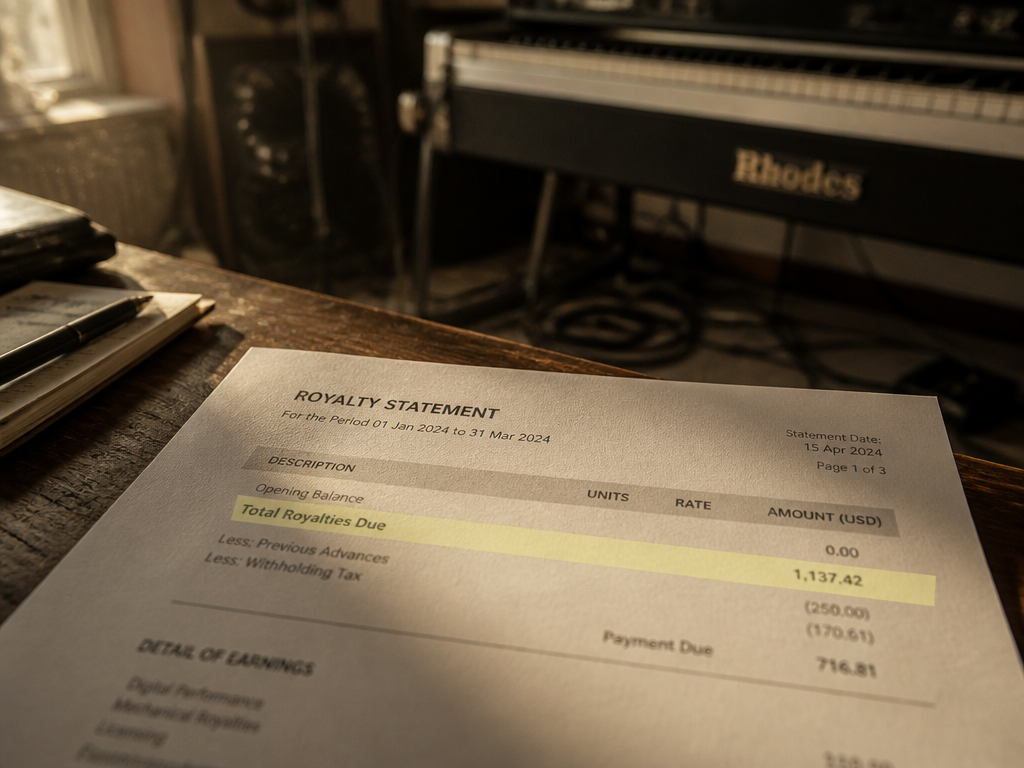
I spent a Tuesday afternoon doing something unglamorous: reading a royalty statement out loud to nobody, line by line, trying to find the number that matters. A cue I wrote for a short film in 2019 — a slow, detuned Rhodes progression in D minor, roughly 68 BPM, the kind of thing that sits under a montage — had earned me, across all platforms that quarter, a sum I could cover with a sandwich and a coffee. That is not a complaint. That is the baseline. It's the number every argument about AI regulation and songwriters eventually has to reckon with, because it tells you how little margin there is before a working writer stops being able to work.
I bring up the sandwich because the debate over AI and music tends to float several thousand feet above it. The press releases talk about milestones and momentum. The actual question is narrower and harder: when a model trains on ten thousand cues like mine and then generates a replacement for the next one, what is owed, to whom, and who checks?
What songwriter advocates are actually asking for
If you strip the institutional language off the current wave of creator-rights campaigns, the demands are surprisingly concrete, and they cluster into four buckets.
Transparency. Advocates want AI developers to disclose what was used to train a model. Not a vague gesture at "publicly available data" — an itemized, auditable record of copyrighted works ingested. Without it, no writer can know if their catalog is in the machine, and no court can weigh infringement.
Consent. The right to say no. Under many current legal frameworks, text-and-data-mining exceptions let developers scrape works unless the rightsholder actively opts out — and opting out is often impossible in practice because you can't opt out of a dataset you were never told about. Advocates want that flipped toward opt-in, or at minimum a functioning, honored reservation of rights.
Remuneration. If a work is used, the writer gets paid. This is the least controversial principle and the hardest to operationalize, because it depends entirely on the first two.
Procurement. A newer, sharper ask: that governments and public broadcasters not spend public money on AI-generated content trained without consent. State-funded AI music, in the campaigners' framing, is a public subsidy for a system that undercuts the taxpayers who happen to be songwriters.
That fourth point is where the advocacy has gotten specific enough to be legislated, and it's where the current parliamentary energy is concentrated.
The institutional moment, described plainly
Over the past couple of years, the pattern has repeated across several jurisdictions. A creators' body — the Ivors Academy in the UK and Ireland, collecting societies elsewhere, musicians' unions almost everywhere — drafts a motion or a position paper. A sympathetic legislator carries it into a committee or a chamber. A union endorses. A press release names the date, the politician, the organization, and calls it progress.
The naming matters. It's how a diffuse creator anxiety becomes a thing on a parliamentary calendar. When Irish advocates press their government on songwriter protections, part of the leverage is timing: Ireland has periodically held influence within EU institutions, and campaigners argue that a country shaping the European conversation could push the whole bloc's standards on training-data transparency and consent.
I want to be careful here, because this is where reporting can drift into wishful framing. A motion debated is not a law passed. An EU presidency or a seat at the table is an opportunity, not an outcome, and it's fair to ask whether "Ireland could lead" is a strategy or a hope. The honest read as of writing: the advocacy has succeeded at getting the questions onto the record. Whether it converts into enforceable text is unsettled.

What "protect copyright" looks like when it's real
The phrase "protect creators' copyright" does almost no work on its own. Here's what it has to become to mean anything:
- A statutory transparency obligation — developers must publish sufficiently detailed summaries of training content, with penalties for omission that exceed the cost of compliance. The EU's AI Act moved in this direction with training-data summary requirements; the fight is over how granular "sufficiently detailed" turns out to be.
- A rights-reservation mechanism that actually functions — machine-readable, respected across borders, with the burden on the developer to check rather than on the writer to police.
- A licensing pathway so that lawful training is possible and paid, not just prohibited. Blanket bans help nobody if the alternative is offshore scraping with no recourse.
- A public-money condition — the procurement ask — that's genuinely the easiest to write into law, because governments already attach conditions to their own spending.
Notice that three of the four are plumbing. They're about audit trails and machine-readable flags and cross-border enforcement — deeply boring, entirely decisive. The slogan version of AI music policy is a stadium chant. The version that changes my royalty statement is a spreadsheet with teeth.
The gap between the release and the mechanism
Here's my worry, said out loud. The advocacy is winning the framing war. Creator-rights language now shows up in committee rooms, in party motions, in the mission statements of collecting societies that a few years ago barely mentioned AI. That's real, and the people doing it are doing careful work.
But framing wins are cheap for governments to grant and expensive for them to honor. A minister can endorse "protecting songwriters" on a Tuesday and let the transparency provision get watered down to a paragraph of boilerplate by Friday, and both events will generate a supportive headline. The test isn't whether AI music regulation gets debated. The test is whether the final text lets a writer like me — with no legal budget and a catalog spread across a dozen libraries — actually find out if my work was used, and do something about it if it was.
That's not cynicism. It's the same instinct that makes me read the royalty statement line by line instead of trusting the summary at the top.
Back to the ledger
So I went back to that D minor cue. I ran a rough version of it through a couple of generative tools, the way anyone evaluating a threat would. Some renders came out mushy — the harmonic movement flattened into wallpaper, which is a small mercy. One came back close enough in mood that a music supervisor on a deadline might not fight me for the original. That's the actual stakes, in one file: not a robot replacing my artistry, but a good-enough substitute arriving at a lower price point in the exact market where my sandwich money lives.
The advocacy campaigns are, in the end, arguing about who bears the cost of that substitution. Right now it's me. The proposals on the table — transparency, consent, remuneration, procurement conditions — are an attempt to move some of that cost back onto the systems doing the substituting. As policy goes, it's coherent. As politics, it has more momentum than it did.
What I can't tell you yet is the part that decides everything: when a writer eventually claims their work was used without consent, will there be a mechanism that lets them prove it — and will a court, or a regulator, or a public procurement office actually make the developer pay? Everything else is preamble to that question, and the answer isn't written yet.
Not sure which tool to use?
Compare the top AI music and sound tools side by side — honest reviews, real pricing, no sponsorships.