Picture a release you scheduled for a Friday. Distributor confirmed it weeks ago, the artwork's clean, you told your list. Then Friday comes and the track is live but strange — no editorial placement, no algorithmic push, and three weeks later the royalty line reads a number that doesn't move. Nothing was rejected. Nothing bounced. It went quiet on the inside, in the part of the pipeline you never see.
That silence is where AI music policy now lives. Over the last couple of years the major streaming services and several distributors have built rules about machine-generated audio into the same pipeline that decides whether your song gets paid and whether anyone hears it. The rules are not loud. They rarely arrive as a rejection email. They act earlier, quieter, and further upstream than most independent artists realize — and if you release with any AI in your chain, the mechanism is worth understanding in the order it actually runs.
What happens first: the upload declares itself
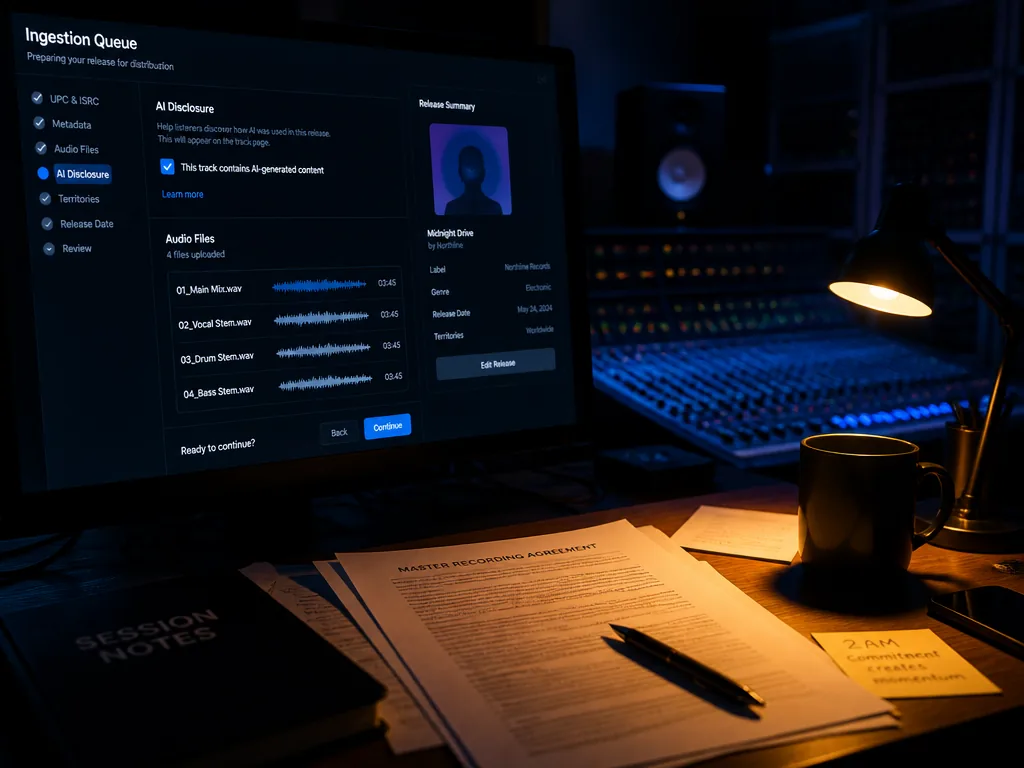
Before a listener ever presses play, your file passes through ingestion. This is the boring plumbing — the moment a distributor or platform reads your audio, your metadata, and increasingly, a question you have to answer about how the track was made.
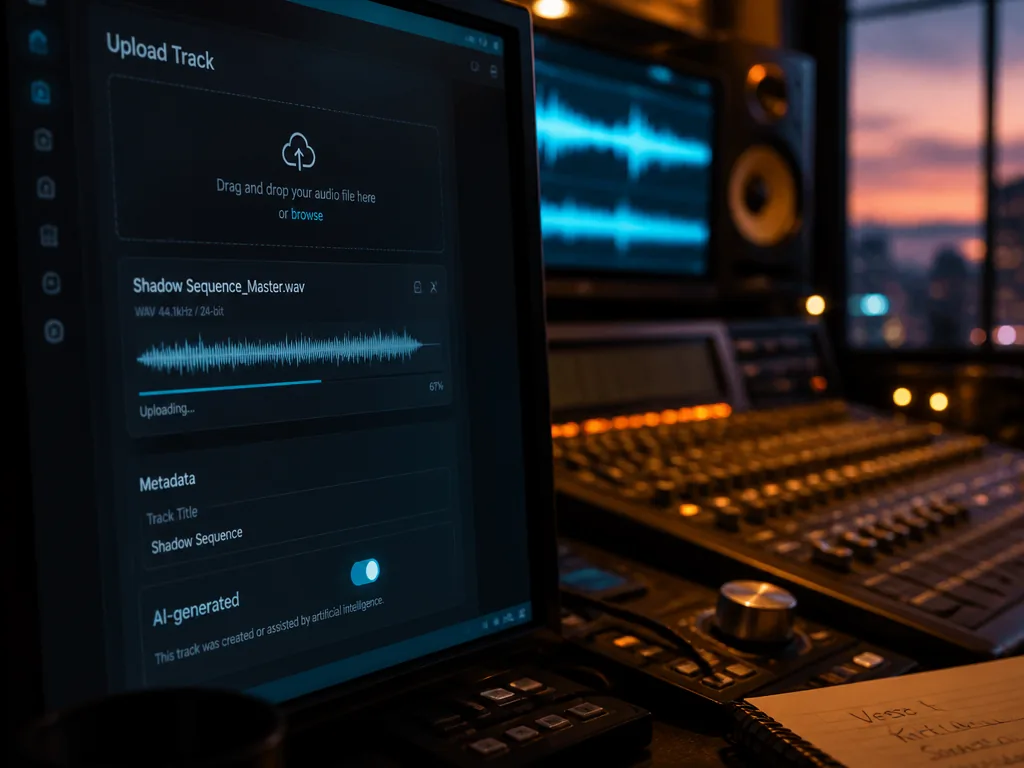
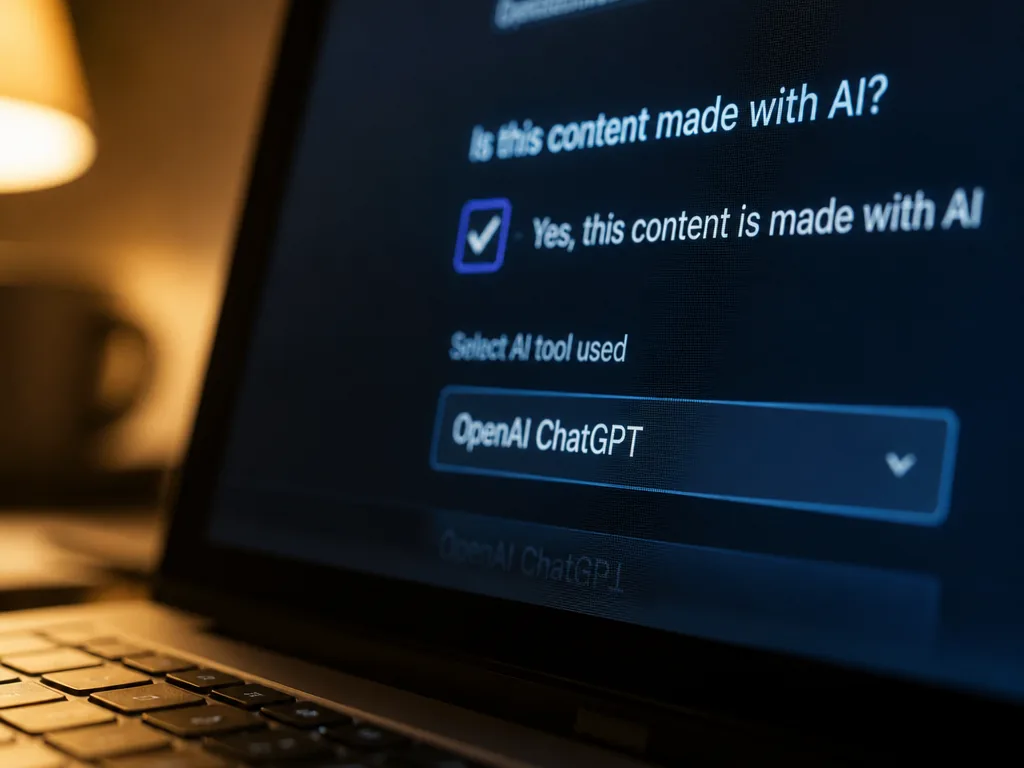
That disclosure field is newer than most people think and it's spreading fast. Distributors have started adding checkboxes or dropdowns asking whether a release contains AI-generated content, and if so, how much. Some ask a blunt yes/no. Some ask you to distinguish between a track built entirely by a model and one where you used AI for a part — a generated pad, a mastering assist, a stem you regenerated forty times until one landed.
Here's the thing to internalize: your answer travels with the file. It becomes metadata. It gets passed downstream to the platforms, and it can be checked against what their own analysis finds. This is the first branch in the road, and it happens before a single stream is counted.
Two failure modes show up right here. The first is under-declaring — leaving the box unchecked on a track that has obvious generated fingerprints, which sets you up for a mismatch later. The second is over-declaring out of caution — flagging a song as AI-generated when you played bass, sang the hook, and used a model only to sketch a string arrangement you then re-recorded. Both answers follow you. Neither is trivial. The disclosure isn't a formality; it's the input that shapes everything downstream.
Can you make money from AI music on streaming?
Yes, in most cases — but how much depends on how the track was made and which platform you're on. As policies stand at the time of writing, AI-assisted music (where a human writes, performs, arranges, or substantially produces the track) is generally treated like any other release and earns royalties normally. Fully machine-generated tracks are the contested category: some services still pay on them, some restrict how they earn, and at least one has moved to withhold full monetization from tracks it judges to be entirely AI-generated. Detection isn't perfect and definitions differ between platforms, so the honest answer is that a human-led hybrid workflow is the safest ground for reliable income, and pure prompt-to-master output is where you're most exposed to policy risk.
That's the short version. The mechanism underneath it is where the real money and visibility get decided, so keep reading in order.
What happens next: the platform tries to classify what you sent
Once your file lands, the platform runs its own analysis. This is the detection layer, and it's the part most artists imagine wrong. People picture a single AI-detector that spits out a verdict. What's actually running is closer to a stack of signals feeding a judgment call.
Some of those signals are acoustic. Generated audio can carry statistical fingerprints — spectral regularities, artifacts in the high frequencies, phase behavior that differs from a mic'd or DI'd source. Some vocal synthesis leaves telltale formant patterns. Some renders have a uniform noise floor no real room produces. Detectors trained on large sets of generated versus recorded audio look for these.
Other signals have nothing to do with the waveform. Upload velocity matters — a brand-new account dumping fifty tracks in a week reads differently than a working artist releasing every six weeks. Metadata consistency matters. Whether your declared answer matches the acoustic analysis matters most of all, because a mismatch is a flag on its own.
Now the honest part: detection is not accurate the way the announcements imply. It produces false positives. Heavily processed electronic music, dense granular textures, vocaloid-adjacent work, and aggressively quantized production can trip a detector that was tuned on cleaner examples. A producer working in ambient, hyperpop, or experimental noise can look "synthetic" to a classifier that's really only confident about pop. The systems also drift — a detector trained on one generation of models gets less reliable as the models change, which they do constantly.
So the classification you get is a probability, not a fact. The platform then has to decide what to do with an uncertain probability, and that decision is the next stage.
What happens next still: classification turns into a payout tier
This is where policy stops being abstract and starts touching your bank account. Once a track is classified, platforms apply consequences — and the consequences are not uniform. They fall into roughly three postures, and it's worth knowing which one you're dealing with because they hurt differently.
Posture one: label only. The platform tags the track as containing AI-generated content, shows that label to listeners or in the artist dashboard, and otherwise pays and distributes normally. The stakes here are reputational and about listener trust, not income. This is the lightest-touch approach and, for now, a common one.
Posture two: throttle discovery. The track earns royalties on the streams it gets, but the platform declines to actively push it — no editorial playlist consideration, reduced weight in algorithmic recommendation, lower ranking in search adjacent to human-made work in the same genre. You still get paid per stream. You struggle to get the streams. For an independent artist relying on discovery to build an audience, this is arguably worse than a labeling policy, because it's invisible. You can't see the placements you didn't get.
Posture three: withhold full monetization. This is the hardest line, and it's the one that made news when a platform moved to stop paying full royalties on tracks it deemed entirely machine-generated. The reasoning is about protecting the royalty pool — every payout to a mass-produced generated track is a payout not going to a working performer, and platforms facing floods of low-effort uploads have started drawing that line. The track can still exist on the service. It plays. But the economics change or disappear.
The distinction that matters across all three: "won't pay" and "won't recommend" are different penalties, and most artists only worry about the first. A track can be fully monetizable and functionally invisible. If your release went quiet on that Friday, throttled discovery is the likelier culprit than a monetization block — and it's the one nobody sends you an email about.
What happens last: the flag outlives the track
Here's the part the announcement-style coverage skips, because it unfolds over months. A classification doesn't just affect the one track. It can feed a picture of you.
Recommendation systems and trust scoring tend to operate at the artist and account level, not only the release level. If several of your uploads get flagged — rightly or through false positives — the cumulative signal can shade how the platform treats your next release before it's even analyzed on its own merits. New drops from an account with a history of flags may start further back in line. This is not published policy anywhere I can point you to; it's the logical behavior of trust systems, and it's the risk of accumulation.
The catalog carries it too. A labeled track sits in your discography where listeners and, more importantly, playlist curators and sync licensors can see it. A music supervisor evaluating your work for a placement is looking at your whole page. A prominent AI-content label on half your catalog is a conversation you'll have to have, and it can cool a licensing deal that would otherwise have closed. The flag you got on one experimental track in March becomes context for a sync opportunity in September.
None of this is designed to punish you specifically. It's the natural downstream behavior of systems built to sort a flood. But it means the cost of a misclassification isn't contained to one release's royalties — it compounds. Which is exactly why the disclosure at the very start of the pipeline, the boring checkbox, ends up being the most consequential decision in the chain.
A pre-release disclosure checklist
Run this before you hit distribute on anything that touched a model. It takes ten minutes and it's the cheapest insurance in the process.
- Inventory the AI in the chain. Write down every place a model touched the track: generated stems, regenerated sections, AI mastering, synthesized backing vocals, arrangement sketches. You can't disclose accurately if you haven't listed it.
- Decide the honest category. Is this human-led with AI assistance, or is the core of the track machine-generated? Be truthful with yourself — the acoustic analysis will be.
- Keep your source and session files. Bounce and archive your DAW session, your recorded performances, your MIDI, your vocal takes. If a track gets flagged as a false positive, evidence of human authorship is your appeal.
- Check each platform's declaration field and fill it consistently. If your distributor asks and the platform asks, the answers should match. Mismatches are their own flag.
- Isolate your experiments. Consider whether pure-generated experiments belong on your main artist profile or on a separate alias. This protects the trust score on your primary catalog.
- Read the current terms, not last year's. These policies change quarterly. What was allowed on your last release may have shifted.
How the postures compare
Platform-specific rules move too fast to pin exact terms to names here, but the postures are stable enough to map. Use this to figure out which kind of policy you're actually up against, then verify the current specifics on the service itself.
| Policy posture | What it does to a flagged track | Where it hurts most | Who tends to feel it |
|---|---|---|---|
| Label only | Tags the release, pays and distributes normally | Listener trust, sync/licensing optics | Producers doing hybrid work who don't want the label |
| Throttle discovery | Pays per stream, reduces editorial and algorithmic push | Audience growth — invisibly | Independents relying on discovery to build a following |
| Withhold full monetization | Restricts or removes royalty earning on fully-generated tracks | Direct income | High-volume, prompt-to-master uploaders |
The important read here is that "label only" is a listener-facing move, while the other two are economic. If you make hybrid music, a labeling policy is mostly an optics question you can plan around. Throttling and withholding are the ones that touch your livelihood, and they're distributed unevenly across services and across how your track was actually built.
Where this leaves the AI-assisted producer
If you're the kind of producer this publication is written for — someone using a model as one instrument among four broken synths and a room full of gear — the mechanism above is mostly reassuring, with one asterisk.
The reassuring part: nearly every policy I've seen draws its hard line at fully machine-generated tracks. Human authorship — you writing the topline, playing the parts, arranging, mixing, making the decisions that make it yours — is the safe harbor across the board. A song where AI generated a texture you chopped, resampled, and buried under a live bassline is not the target of these rules, and it's very hard for a detector to confidently flag when there's real performance in the mix. The more of your hands are on the track, the less any of this applies to you.
The asterisk: detection can't read your intent, only your waveform. If your aesthetic lives in the exact zone that trips false positives — pristine synthetic textures, quantized-to-the-grid production, synthesized vocals as a deliberate choice — you can get caught by a system that's wrong about you. That's not a reason to change your art. It's a reason to keep your session files and your disclosure honest, so that when the classifier misfires, you have the receipts to correct it.
This is also where the tooling you build on matters. The point of a service like City of Punk's neural sound foundry is original, commercially-safe audio you own and can defend — sounds generated to be used, cleared, and built into your work, not tracks you pass off as human performance you didn't do. The distinction the platforms are drawing is between machine output presented as an artist's labor and machine output used as material by an artist doing the labor. Stay on the right side of that distinction and the policy pipeline mostly leaves you alone. Blur it and you're gambling on a detector's mood.
Nobody at these platforms is trying to end AI in music. The rules exist because inboxes and ingestion queues have filled with uploads designed to skim the royalty pool, and the pool is finite. The response is clumsy, sometimes wrong, and getting refined in public. But the underlying logic — pay the people doing the work, don't drown them — is not something to be angry at. It's something to make sure you're clearly on the right side of.
What to try this week
Pull up your live catalog on your main distributor and your two biggest streaming services, and read the AI-disclosure and content-eligibility sections of each one's current terms — not a blog summary, the actual policy page, dated to now. Then check whether your last release's declaration field, if there was one, matches how you'd honestly describe that track today. If it doesn't, or if you never saw the field, that's your answer about how closely you've been watching a mechanism that's been watching you back.
The track that goes quiet on release day usually didn't get rejected — it got sorted, and you weren't in the room.
Not sure which tool to use?
Compare the top AI music and sound tools side by side — honest reviews, real pricing, no sponsorships.