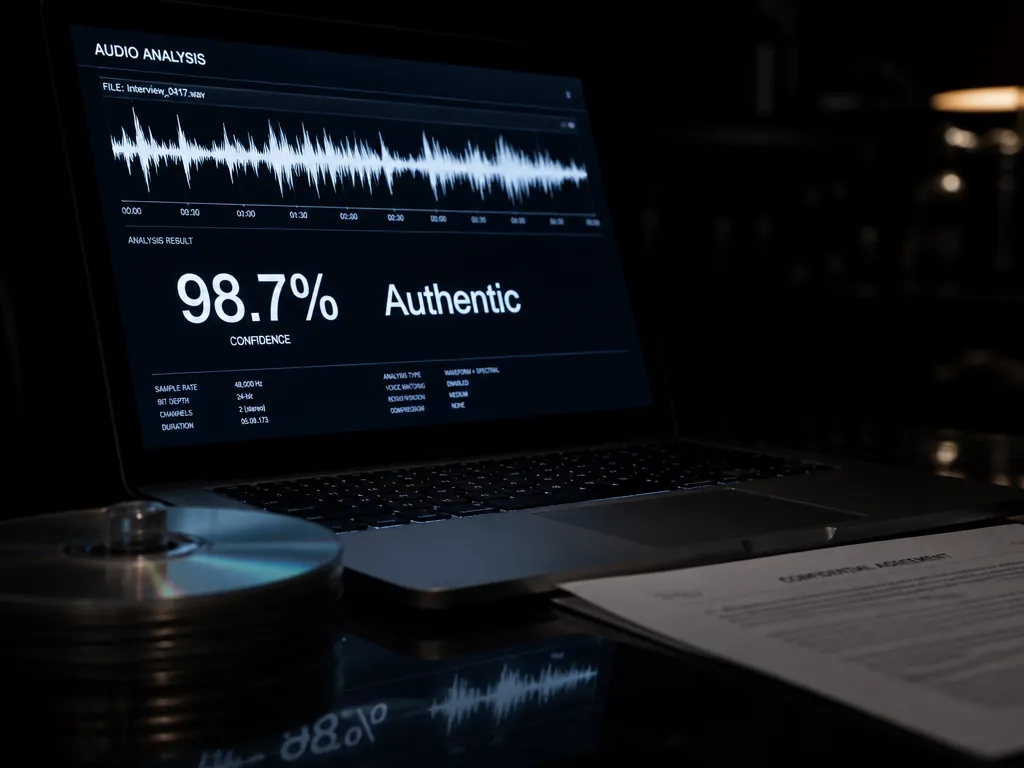
A friend sent me a demo this spring: five minutes of drone built from a Juno-106 with two dead voices, a contact mic taped to a radiator, and a vocal take pushed through enough saturation that it sounds like a fax machine praying. I ran it through a consumer detector as a joke. The tool came back 87 percent confident the track was machine-generated.
That is the honest starting point for any conversation about AI music detection and identification. The tools are real. They work better than nothing. And they will tell you, with a confidence score attached, that a man with a radiator is a language model.
If you run an independent label, that failure mode is not a curiosity. It is the thing standing between you and every remedy currently on offer — because almost every proposed protection for independent catalog, from playlist exclusion to royalty-pool ringfencing to statutory disclosure, assumes someone can reliably sort the synthetic from the human at scale. Whoever holds that sorting function holds a great deal of power over your revenue.
The myth: the detectors work, the platforms won't switch them on
Here is the version you have heard at a conference bar, probably from someone credible: detection is basically solved. Academic labs hit high-nineties accuracy on audio deepfake benchmarks. Vendors sell classifiers with API endpoints. Deezer built one in-house and started tagging albums with it. Therefore the only reason your feed is full of synthetic country ballads with 40,000 plays and no discography is that the largest platforms have no commercial incentive to run the check, because catalog they pay less for — or pay no one for — is catalog that improves their margin.
The second half of that argument has real force. The first half does not survive contact with the tooling.
There is a persistent conflation between three different technical problems, all of which get called "detection," and only one of which is anywhere near solved. Sorting them out is the difference between a label strategy that works and one that spends a year's budget on a dashboard.
What the last two years actually showed
Start with the evidence, because the pattern in it is more specific than "there's a lot of AI music now."
In summer 2025, an act called The Velvet Sundown accumulated over a million monthly Spotify listeners on the strength of a plausible, mid-tempo, Laurel-Canyon-adjacent sound. Journalists asked. A spokesperson denied it, then turned out to be a hoaxer, and the project's own channels eventually described it as a synthetic music project — an "artistic provocation." Nobody's detector caught it. Journalists caught it, by noticing that the band had no live history, no session credits, and press photos with the particular plastic sheen of an image model.
Around the same time, tracks began appearing on the Spotify artist pages of musicians who could not have recorded them, including Blaze Foley, who has been dead since 1989. The uploads came through legitimate distribution channels with metadata pointing at the wrong artist profile. Spotify pulled them and attributed the problem to fraudulent uploads at the distributor layer. Note what kind of failure that is: not a failure to identify a track as synthetic, but a failure to verify that the person delivering it had any right to that artist page. Those are completely different controls, and the second one is much older and much more solvable.
The money case is the clearest of all. In September 2024 the U.S. Attorney's Office for the Southern District of New York indicted a North Carolina musician for a scheme that allegedly used hundreds of thousands of AI-generated tracks, spread thinly across bot-driven accounts to evade per-track anomaly detection, to extract more than $10 million in royalties over several years. The fraud was not caught by listening to the music. It was caught by following the streaming patterns and the payouts.
Meanwhile Deezer, the one major platform that publishes numbers, has watched fully AI-generated material go from a small fraction of daily uploads at the start of 2025 to something on the order of a third by the end of it, by its own counting — and its counting is essentially the only counting anyone has. Deezer also commissioned a survey from Ipsos across eight countries and found that the overwhelming majority of listeners could not reliably tell an AI track from a human one in a blind comparison. Both figures come from a company with a commercial interest in being seen as the platform that takes this seriously. That does not make them wrong. It does mean the industry's core statistics on this problem are supplied by a single interested party, which is its own kind of finding.
And the community-run trackers — the spreadsheets and bots that fans and working musicians have built to flag suspected synthetic acts — have been quietly pulling entries after legal threats from artists insisting they are human. Some of those artists presumably are. There is no appeals process for being wrongly identified by a volunteer with a classifier, which is exactly the situation my friend's radiator drone would land in.
Three things people call detection
Fingerprint matching
This is the mature technology, and it is not AI detection at all. Systems like the ones behind Content ID and the major rights-management stacks compute a compact perceptual hash of an audio file and match it against a reference database. It answers "is this the same recording as one I already know," and it answers it well, surviving transcoding, pitch shifts, tempo changes, and layering under dialogue.

What it cannot do is recognize something it has never been shown. A model-generated track that copies your artist's timbre, phrasing, and production choices without reproducing any specific master will pass fingerprint matching cleanly, because it is not a copy in the sense the algorithm understands. This is why "we already have Content ID" is not an answer to soundalikes. The negative here is structural, not a matter of tuning: the reference-database model works only against duplication.
Forensic classifiers
This is what people mean when they say detector. A model is trained on paired corpora of human and machine-generated audio and learns to separate them from signal characteristics rather than from any registry.
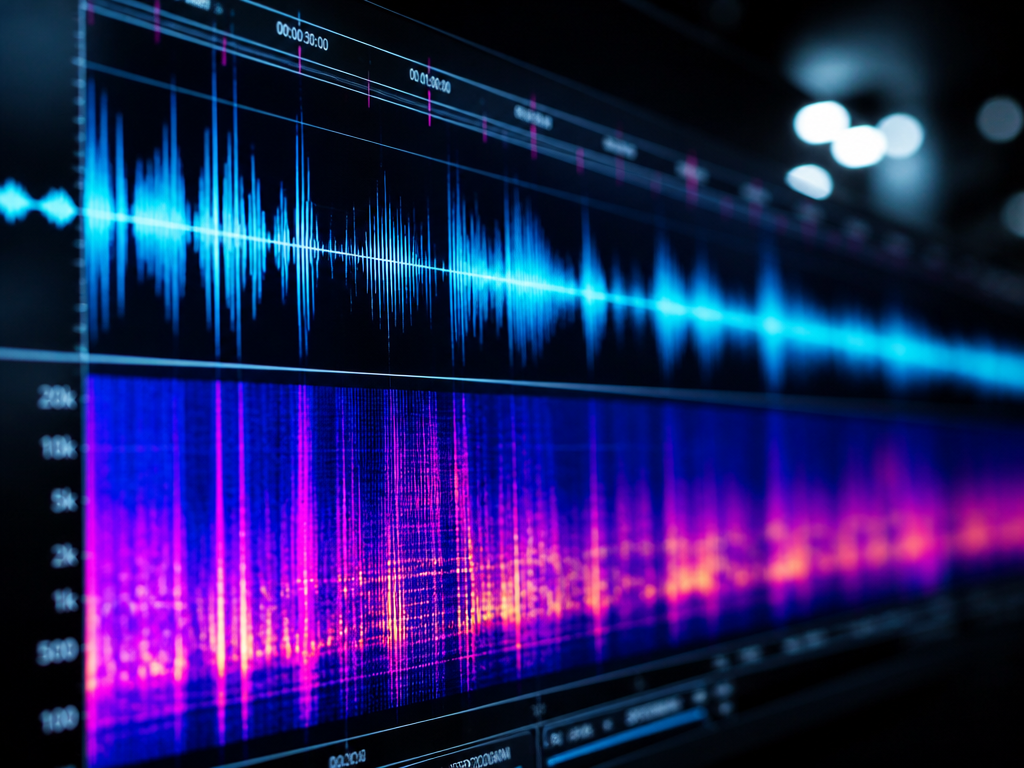
The artifacts it learns are real and physically explicable. Most generative audio systems render through a neural vocoder or a learned codec that reconstructs a waveform from a compressed latent representation. That reconstruction leaves traces: characteristic behavior in the upper spectrum where the decoder has to invent detail, phase relationships between harmonics that are too tidy or too regular, transient smearing on percussion, and periodic structure at the model's frame rate that shows up as faint horizontal banding on a high-resolution spectrogram. Some systems also produce a subtle spectral shelf at a fixed frequency, an inheritance from the sample rate the decoder was trained at.
Those are genuine tells. They are also fragile in every direction that matters commercially:
- Mastering destroys them. Heavy limiting, saturation, tape emulation, and a final lossy encode all attack exactly the high-frequency and phase evidence the classifier depends on.
- Analog gear fakes them. Aggressive resampling, bitcrushing, granular processing, or a signal chain built around broken hardware produce artifacts that look statistically similar. This is the false-positive mechanism, and it lands hardest on experimental and lo-fi catalog — which is to say, on independent catalog.
- They are version-specific. A classifier trained on the output of the models available last year is a classifier trained on a distribution that has since moved. Vendor accuracy figures north of 95 percent are usually measured against a held-out slice of the same corpus the model was trained on. Against a generator released after training, performance drops, and no vendor publishes that number by default.
- A person can launder them. Render, print to tape or through an analog summing chain, re-record, re-master. The output is now a human recording of a machine performance, and no forensic classifier has a principled answer to that.
Provenance and watermarking
The third approach abandons forensics and asks the generator to declare itself: an inaudible watermark embedded at synthesis time, or signed metadata travelling with the file. Several major generative audio systems watermark their outputs. The C2PA content-credentials spec, developed for images and now extending to audio, does the signed-manifest version.
Provenance is the only one of the three with a clean logical structure, because it does not attempt to infer intent from a waveform. It also has the shortest failure path: it works only for participating generators, and the metadata is stripped by nearly every step of a normal production pipeline. Bounce to WAV, import to a DAW, re-render — the manifest is gone unless every tool in the chain preserves it, and most do not. Audio watermarks are more durable but still vulnerable to the same mastering chain that eats forensic artifacts, and open-weight models can be run with the watermarking step removed by anyone who can edit a config file.
The gradient nobody has defined
Underneath all three sits a problem that no amount of engineering fixes: there is no agreed definition of what the classifier is supposed to be detecting.
Run the cases. A producer generates a four-bar loop, resamples it, and builds a track around it — synthetic or human? A vocalist sings the take and uses a model to correct two words — where does that land? A composer writes and performs everything, then uses a stem separator that reconstructs the isolated parts with a generative model, which most modern separators do? A label commissions a track that is fully generated, then hires a mixing engineer, cuts a vinyl master, and books a tour with session players who learn it? That last one has already happened.
This is not a philosophical aside. Supervised classifiers require labelled training data, and labelling requires a boundary. The available corpora mostly draw it at "was the audio rendered by a generative model end-to-end," because that is the only version you can cheaply construct at scale. So the detectors answer that question, and the industry then reads their output as though it answered a different one: did a person make this, and should they be paid like one.
The DDEX disclosure fields, which Spotify adopted in autumn 2025 and which several distributors now pass through, handle this better than any classifier can — they let a rightsholder declare AI involvement per contribution, at the vocal, instrumental, and post-production level. Declaration lets you describe a gradient. Classification forces a binary onto material that does not have one.
What independent labels actually get
Here is the posture of the major platforms as of writing, which is where the practical support for independent catalog currently sits.

| Platform | What it does | What it doesn't |
|---|---|---|
| Deezer | Tags fully AI-generated albums in the UI; excludes them from algorithmic and editorial recommendation; strips detected fraudulent streams from the royalty calculation | Detector is proprietary and unaudited by any third party; tagged tracks still stay on the service; affects one platform's share of your revenue only |
| Spotify | Impersonation policy with a takedown route; music spam filter (75 million spammy tracks removed in the preceding twelve months, by its own count); AI disclosure carried in credits via the DDEX standard | No user-facing AI label on tracks; disclosure is voluntary and self-reported by whoever uploads, which is the same party with the incentive to omit it |
| YouTube | Mandatory disclosure for realistic altered or synthetic content, surfaced to viewers; likeness-detection tooling for creators | Disclosure enforcement leans on self-reporting; the music-specific case is weaker than the deepfake-video case it was designed for |
| Most other DSPs | Terms-of-service prohibitions on fraud and impersonation | No detection layer, no labelling, no public numbers |
Two pieces of law change this arithmetic. Tennessee's ELVIS Act, effective July 2024, extended right-of-publicity protection explicitly to voice and gave a cause of action against tools whose primary purpose is unauthorized vocal imitation — useful if your artist has a distinctive voice and you can afford Tennessee counsel. The federal NO FAKES Act remains, as of writing, a bill. And the transparency obligations in Article 50 of the EU AI Act come into application on 2 August 2026: providers of systems generating synthetic audio must mark outputs in a machine-readable format. That is a provenance mandate, not a detection mandate, and it is the single most consequential thing on this list for independent rightsholders — because it shifts the burden from you proving a track is synthetic to the generator being required to say so.
What none of it touches is the pool. On a pro-rata service, total subscription revenue is divided by total qualifying streams. Every synthetic track that clears the threshold and takes a play reduces the per-stream rate for everything else, including your catalog. Detection changes who gets flagged. It does not, on its own, change the denominator — and Spotify's 1,000-stream monetization threshold already demonstrated how quickly a rule aimed at low-value uploads reallocates money away from small independent catalog that happens to sit under the same line.
How I'd decide if I ran a label
Five criteria, in the order I would spend money on them.
Artist-page integrity first. The Blaze Foley failure is the cheapest one to defend against and the most damaging when it happens. Claim every artist profile across every DSP, lock the distributor account with hardware two-factor, and set a weekly check on your own catalog pages. This costs nothing and closes the attack that has actually hit real independent catalog.
Metadata hygiene second. Correct ISRCs, correct artist identifiers, disclosure fields populated honestly at delivery — including on your own releases where a model touched the process. A label whose deliveries are clean can prove provenance later. A label whose deliveries are sloppy will spend that argument on itself.
Contract language third. Every producer and topline agreement signed from here should specify what generative tools were used and warrant it. This is the mechanism that lets you answer a question in 2029 about a session in 2026.
Detection fourth, and as triage only. A classifier is a reasonable way to rank a queue of suspect uploads for a human to review. Treat any score as a prompt to look, never as a finding. If a vendor will not tell you how their model performs against generators released after their training cutoff, that silence is the answer.
Collective leverage fifth, and possibly first in practice. The independent sector's real instruments here are the trade bodies and the licensing agencies — the positions IMPALA, A2IM, and the rights agencies take on training-data consent and on how synthetic uploads are treated in royalty calculations. A single label with 40 artists cannot negotiate pool structure. A few thousand of them, licensing collectively, can at least be in the room.
Who this helps, and who should skip it
If you hold catalog with a distinctive vocal identity — a recognizable singer, a voice a fan would name in one bar — the impersonation and publicity-rights routes are worth real money and real legal budget, and detection tooling is a credible early-warning tripwire.
If your catalog is instrumental, ambient, library, or production music, understand that you are the most exposed category and the least protected one. There is no likeness claim in a lo-fi beat. Your exposure is pool dilution and sync-market substitution, and no detector addresses either.
If you are a label of five artists deciding whether to buy a detection subscription this quarter: don't. Spend it on page monitoring and metadata, which fix failures that have demonstrably occurred, rather than on a confidence score you cannot act on.
The question that's still open
Everything above rests on an empirical claim nobody has settled: whether generated audio carries a durable, model-independent signature at all, or whether the tells we can currently measure are contingent artifacts of one generation of vocoders and codecs — a phase of the technology rather than a property of it.
The honest state of the research is that we do not know. Every published detector is a description of the models it was trained against. Each new architecture is a fresh distribution, and the physical rationale for the artifacts — that a decoder has to invent high-frequency detail it never had — weakens as decoders get better at inventing it. It is entirely possible that in five years the only reliable way to know how a recording was made will be that someone wrote it down at the time.
So which is it: does synthetic audio have a permanent tell, or have we been measuring the sound of a technology that has not yet finished learning to cover its tracks?
Not sure which tool to use?
Compare the top AI music and sound tools side by side — honest reviews, real pricing, no sponsorships.