I put twenty dollars on a song last month. Not on the artist, not on a stream-count milestone three years out — on a specific question with a specific deadline: would a particular pop single still sit inside the Spotify Top 10 on a given Friday. I logged the entry price, screenshotted it, and went back to mixing a trailer cue. By the time the question settled I'd made about nine dollars and learned more about where music money is heading than I had from a year of label earnings calls.
That trade is the smallest possible version of a category that analysts now value at over half a billion dollars: prediction markets. The mechanics are old — people have always bet on outcomes — but the packaging is new. A prediction market turns a future event into a tradable contract that settles at a known value when the event resolves. Elections, weather, box-office. And now, quietly, songs. SongPicks is the cleanest example I've seen of music being wired directly into that machinery, and for anyone tracking how music data gets monetized outside streaming royalties, it's worth a hard look.
What a prediction market on music actually is
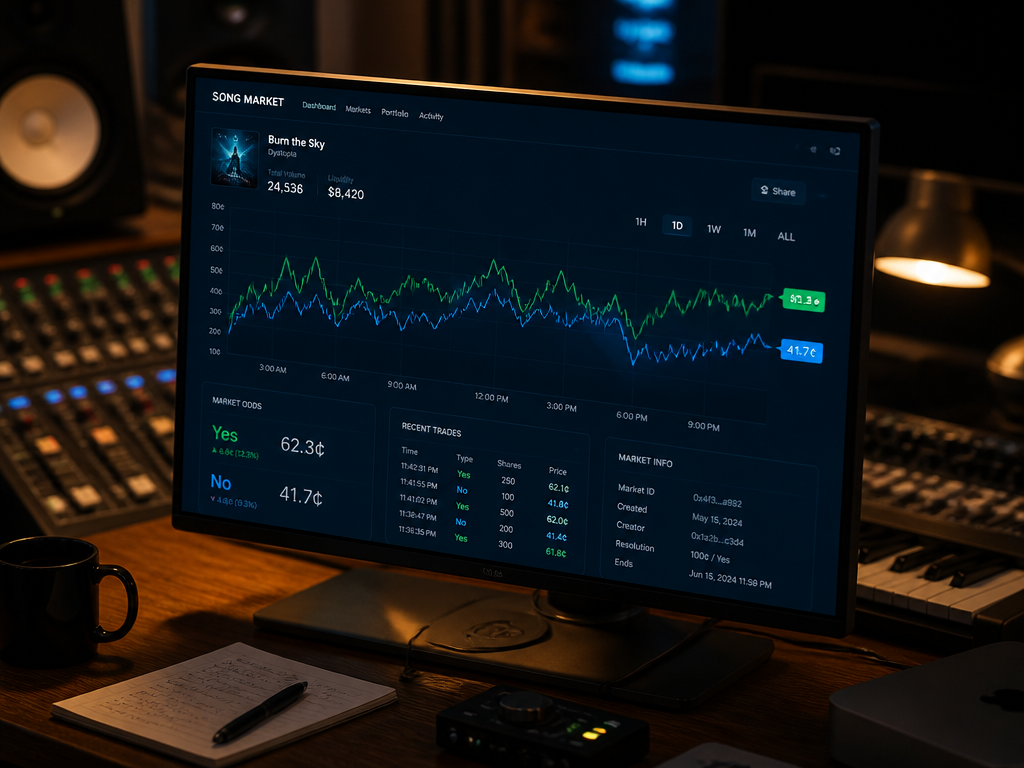
A prediction market on music is a venue where you stake money on a measurable future outcome about a song, artist, or chart — "Track X reaches the Top 40 by month's end," "Artist Y's new single outstreams their last in week one" — and the contract pays out a fixed amount if you're right. The price you pay to enter reflects the crowd's current estimate of the odds. If the market thinks there's a 30 percent chance, a yes-contract costs roughly thirty cents on the dollar; if the song catches fire, that contract climbs toward a dollar and you can sell or hold to settlement.
That's the whole idea, and it's worth being precise about what it isn't. It is not a fan-voting poll where the prize is bragging rights. It is not a fantasy-sports scoreboard with no cash at the bottom. The defining feature is real money settling against a verifiable, time-stamped data source. That last part — the data source — is where music technology stops being decoration and starts being the load-bearing wall.
Because here's the problem a prediction market has to solve before anyone can place a bet: who decides the song actually hit the Top 10, and how fast, and from whose numbers? You can't settle a half-billion-dollar category on a screenshot. You need a licensed, auditable feed of chart and consumption data, delivered on a clock, with the rights cleared to use it commercially. That requirement is the entire business opportunity, and it's the reason the interesting deals here look like B2B plumbing rather than consumer apps.
The deal underneath SongPicks
Strip away the front-end and SongPicks is a licensing-and-data arrangement dressed as a fan product. The pattern is familiar to anyone who's watched the back end of music tech: a platform company that already holds catalog access, metadata pipelines, and the licensing relationships supplies the infrastructure; a consumer-facing app supplies the audience and the game design. Think of the structure as Tuned Global-style middleware sitting under a FanLabel-style fan engagement layer, with prediction-market questions as the product on top.
The middleware partner brings three things that are hard to assemble and harder to clear:
- Catalog and metadata access — the rights to surface tracks, artwork, and artist info inside the app without a fresh negotiation per song.
- Consumption and chart data — a feed clean enough and timely enough that an outcome ("did it chart?") can be settled without a dispute.
- Licensing cover — the contractual layer that makes the whole thing legal to operate commercially, which is precisely the part a startup can't bootstrap over a weekend.
The consumer partner brings the part the middleware company has no appetite to build: the loop. The push notifications, the leaderboards, the social proof, the sense that you're playing against other people who think they know more about next week's charts than you do.
What makes this a category-creation move rather than a one-off product launch is that the same infrastructure can sit under a dozen different front-ends. Once you've licensed the data and built the settlement layer, "predict the chart" is one product. "Predict tour sell-outs," "predict sync placements," "predict the streaming half-life of a viral clip" are all the same engine with a different question on the surface. The deal isn't a game. It's a rail.
Where the money actually sits
For an investor evaluating this, the relevant question isn't "will fans bet on songs" — some will, and we'll get to the evidence. The relevant question is which surfaces generate durable revenue, and there are three.
The licensing surface. Every prediction question that references a real track, a real artist, or a real chart needs rights cleared. The middleware company that already holds those relationships earns on access fees, data subscriptions, and revenue share with the front-end. This is the least sexy and most defensible layer — it looks like a SaaS line item, and it survives whether or not any single consumer app catches on.
The data surface. Settlement requires authoritative numbers, and authoritative numbers are an asset. A company that can deliver chart-position and consumption data on a reliable clock isn't selling music — it's selling the oracle that resolves every contract. That's a recurring, defensible position, and it compounds: the more markets that settle against your feed, the more the feed becomes the standard.
The fan engagement surface. This is the one labels and managers care about, because a prediction market is a real-time read on belief. When thousands of people stake money on a single charting, you've generated something a focus group can't: a price. That price is a demand signal, time-stamped and continuous, on a song you might be deciding whether to push to radio. The data exhaust from the betting is arguably worth more to the industry than the rake on the bets.
Notice that none of these three depends on the app being fun. They depend on the app existing, on the data being clean, and on the rights being clear. That's why the smart money in this category is positioned in the middleware, not the front-end — the front-ends are interchangeable; the rail is not.
The evidence that this is already real
I'll admit my first reaction to "fans will bet on chart positions" was the same as yours probably is: a polite, skeptical nod. Then I went and looked at the receipts, and the skepticism didn't survive contact with the numbers.
Start with the size of the room. Regulated prediction-market platforms — Kalshi being the most-cited example in the US — have turned event contracts into a category measured in the hundreds of millions, with individual high-profile questions attracting seven-figure pools of staked money. When a single event can have over a million dollars riding on its outcome, the behavior is no longer hypothetical. People stake real money on resolvable questions, at volume, today. The only open question is whether music questions attract the same appetite as elections and sports.
There's reason to think they might, and it comes from an asymmetry in the audience. The people most confident they can call next week's charts are the same people who already spend hours a day inside music — the playlist obsessives, the early-adopter fans, the bedroom A&Rs who've been "right" about an artist before their friends for years and never had a way to cash it. Sports betting works because fans believe they have an edge. Music fandom runs on the identical belief: I knew about them first. A prediction market is the first product that lets that belief settle into a payout.
That's the conversion moment. "Prediction markets on music are interesting" is a dinner-party take. "There is over a million dollars in play on a single question, and the audience that's most confident is the audience already glued to the catalog" is a thesis. The deal under SongPicks is a bet that the second sentence is the true one, and that the value isn't only the rake — it's owning the rail every future music-prediction product has to run on.
The unglamorous parts, which are the whole story
If you're underwriting this category, the interesting risk isn't whether fans show up. It's three things that live in the back office, and any analyst who skips them is reading the press release instead of the deal.
Rights are not a solved problem
Surfacing a track inside a betting product is a different rights conversation than surfacing it inside a streaming app. The question "can we reference this song in a paid prediction contract" doesn't have a settled answer across every territory and every catalog, and the terms vary — by label, by territory, by whether the artist's representation views betting markets as brand-safe. Some artists will treat a market on their song as free demand signal and promotion. Others will see a Vegas line on their art and want nothing to do with it. The licensing layer has to absorb that variance, and the breadth of catalog a given front-end can offer will rise and fall with how those negotiations go.

Regulation decides the addressable market
Whether a music-prediction product is a "game," a "skill contest," a "sweepstakes," or a regulated event-contract market changes by jurisdiction, and that classification determines who can play and where. The half-billion-dollar figure for prediction markets sits inside a regulatory environment that is still moving. A music-prediction operator inherits all of that uncertainty plus a layer of its own. The durable businesses here will be the ones that picked their regulatory framing carefully at the start, not the ones that ran fastest.
Settlement integrity is the entire trust proposition
A prediction market is only as credible as its ability to resolve disputes. If a song sits at number 11 by one chart methodology and number 10 by another, and a contract was written against "Top 10," somebody is going to lose money on a definition. That's why the data partner matters more than the app: the feed has to be authoritative enough that settlement isn't arguable. This is unglamorous infrastructure work, and it's also the moat. Whoever becomes the trusted oracle for "did the song chart" owns a position that's very hard to dislodge once contracts are settling against it at scale.
None of these are reasons the category fails. They're the reasons it's a real business and not a toy — moats are usually made of exactly this kind of friction.
A quick map for the analyst
If you're sizing this opportunity, here's the shape of it without the marketing gloss.
| Layer | What it sells | Defensibility | Who wins |
|---|---|---|---|
| Data / oracle | Authoritative chart & consumption feeds for settlement | High — becomes the standard | Established music-data middleware |
| Licensing | Cleared rights to reference catalog in paid products | High — relationships, not code | Platform companies with existing label deals |
| Front-end app | The betting loop, audience, retention | Low — interchangeable | Best UX and marketing, churns fast |
| Industry data buyers | Real-time demand signal from staked bets | N/A — they pay for the exhaust | Labels, managers, sync agencies |
The pattern to watch for in future announcements is the one SongPicks follows: a B2B deal made newsworthy by a consumer surface. When you see a music-data company partner with a fan app and the words "prediction" or "fan engagement" appear, read past the app. The deal is almost always about who controls the data rail underneath.
Back to my twenty dollars
My contract settled on the Friday it was supposed to. The single held its spot, my yes-position resolved at a dollar, and I came out about nine ahead before whatever the venue takes. The transaction was clean, fast, and slightly addictive in a way I want to be honest about — the loop works, and that's not a neutral observation when the underlying asset is somebody's art.
What the trade told me: the demand is real, the settlement can be made clean, and the thing I was actually doing — staking money on a number that a licensed data feed would later confirm — is a complete business pattern, not a novelty. The price I paid to enter was, in effect, the crowd's belief that the song would hold, rendered as a number. I find that genuinely interesting as a demand signal, separate from whether I want a betting layer wrapped around music at all.
What the trade did not tell me, and what this piece can't: whether the engagement is durable or a launch-window spike, what the take rate actually is across these venues, how much of the catalog clears for betting versus how much sits behind an artist's hard no, and how regulators in the major markets will eventually classify a paid contract on a chart position. Those are the four numbers that decide whether this is a category or a moment, and none of them is public yet.
So that's where to look next. Not at the consumer apps, which will multiply and churn. Watch the data-licensing terms in the next two or three of these partnership announcements — the settlement source named, the catalog breadth disclosed, the revenue split if anyone's foolish enough to print it. The rail will tell you whether prediction markets on music are a business. The apps will only tell you whether they're fun, and we already know the answer to that. I'm out nine dollars ahead and a little more skeptical of my own enthusiasm, which is usually the sign that something real is happening.
Not sure which tool to use?
Compare the top AI music and sound tools side by side — honest reviews, real pricing, no sponsorships.