Twenty tracks, thirty seconds each, no skipping ahead to the vocal. A friend built the playlist and would not tell me the ratio. I got thirteen right. What bothers me, months later, is not the seven I missed — it is that two of my most confident wrong answers were human beings: a bedroom producer in Lisbon whose drums I called synthetic because they sat too clean in the pocket, and a session guitarist whose tone I read as a model artifact. I ran that test before the Spotify AI labeling policy started surfacing in credits, and it left me with the question this piece is about: when a platform tells you a machine was involved, what have you actually learned?
What the disclosure credit actually says
In plain language: the credit tells you which parts of a record involved AI tools — vocals, instrumentation, post-production — as declared by whoever delivered the track to the platform. It is a process credit, not a verdict on authorship. As of writing, the disclosures ride on an industry credits standard that distributors and labels feed into, which means the information arrives the same way "mixed by" and "mastered at" arrive: somebody typed it into a form. Alongside the credits, platforms have been pairing labeling with two enforcement moves that matter more than the label itself — filtering bulk spam uploads out of monetization, and taking down voice clones that impersonate a named artist without permission. Those are the parts with teeth. The credit is the part with information.
That distinction gets lost fast. A label is not a scarlet letter and it is not a certificate of authenticity. It is a field in a metadata packet, filled in by the person with the most to lose from filling it in wrong.
The gradient nobody wants to draw a line across
Here is where honest reporting has to slow down. Pick up any record released in the last fifteen years and start subtracting the machine assistance: pitch correction on the lead, drum replacement on the snare, an amp sim instead of a mic'd cabinet, a mastering chain whose settings were suggested by a model, stem separation to rescue a sample from a mono bounce. Nobody calls that record synthetic. Now add one generated pad, 90 BPM, sitting a fifth below a real vocal take, and the delivery form says AI was used.
That record and a track assembled from a text prompt in ninety seconds can come back wearing the same tag. The tag is true in both cases. It describes almost nothing about the labor in either. A producer I trust described her workflow as "I generate forty pads, throw away thirty-nine, then spend two days making the survivor sound like it belongs in the room." There is no field for that.
A five-minute check before you call a record fake
If you are a listener, a sync supervisor, or a booker trying to decide whether there is a person behind a project, the credit is your first data point, not your last. What follows takes about five minutes and is more reliable than your ears — mine were 65 percent reliable, and I do this for a living.
- Read the full credits, not the badge. Look for an engineer, a mixer, a named mastering house. High-volume upload operations rarely bother to invent a mastering credit, because the credit is checkable.
- Look for room tone. Any live footage, any soundcheck clip, any recording where a chair creaks. Rooms are still expensive to fake convincingly.
- Check catalog velocity. Forty releases in six weeks across three unrelated genres is a workflow, not a discography. Two EPs a year is a person.
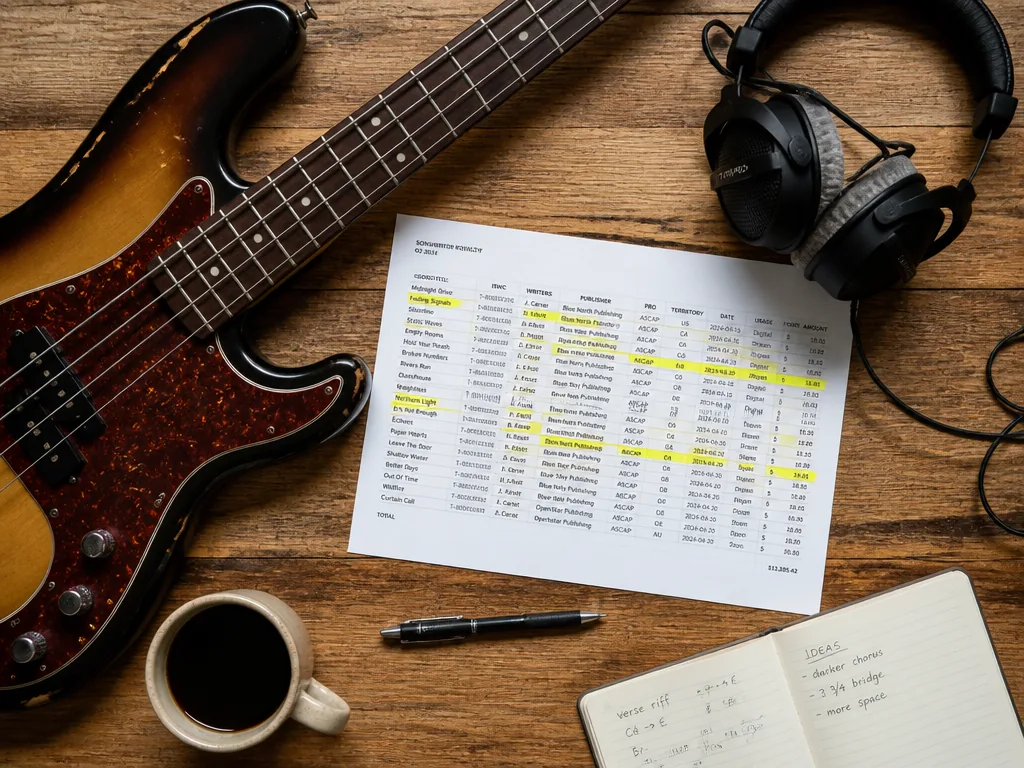
- Check the footprint off-platform. A Bandcamp page with liner notes and stems, a performing-rights registration, a mastering invoice mentioned in a post — these are boring and hard to manufacture at scale.
- Ask. Real makers answer with session detail. "The bass is a Jazz bass straight into a DI, the reverb is my hallway with a phone as the return." Nobody who prompted it can tell you what the hallway sounded like.

None of these prove anything on its own. Together they tell you whether a project has the sediment a working practice leaves behind.
| The AI credit tells you | The AI credit does not tell you |
|---|---|
| That the deliverer declared AI involvement | Whether anyone chose, edited, or arranged the result |
| Roughly which elements were touched, when the fields are filled in | How much of the record survived the first pass |
| That the release passed platform ingestion checks | Whether an undeclared release slipped through beside it |
| That impersonation and bulk-spam rules applied at upload | Whether the artist is a person, a collective, or a shell |
Who the policy is actually protecting
The generous reading is that labeling protects listeners from being lied to. That is real, and it is also not the whole ledger. Streaming royalties come out of a finite pool. Every low-effort upload that captures playlist minutes takes a fraction of a cent from everyone else in the pool, which is why the spam filtering and the monetization thresholds land harder on the economics than the badge does. Labels want the pool defended. Distributors want liability off their books. Listeners, in my experience, mostly want to know they were not deceived — they are less bothered by tools than by being played.
DIY artists are the constituency with the most mixed feelings, and they are right to have them. They benefit from the same enforcement that clears out upload farms, and they are the ones most exposed if a probabilistic system flags a human record with no press officer to escalate the appeal.
Where the answer is honestly "it depends"
Three places, and they are not small ones.
Self-reporting cuts the wrong way. A disclosure regime rewards the honest with a tag and rewards liars with nothing, until detection catches up. The producer who declares a generated pad gets marked; the operation running a hundred undeclared uploads a week gets marked only if the platform's own detection finds it.
Detection is probabilistic. Everything I have seen and everything I did in that listening test says classification of audio provenance produces false positives, and false positives land on clean, quantized, in-the-box human production — which describes most bedroom records made after 2015.
A label is a fact that behaves like a judgment. Ask a library composer who discloses AI-assisted variations on a cue whether the tag has cost them placements. As of writing, that is the open question the labeling policy cannot answer for itself, because it depends on how the tag is displayed, whether recommendation systems treat it as a demerit, and what listeners decide it means.
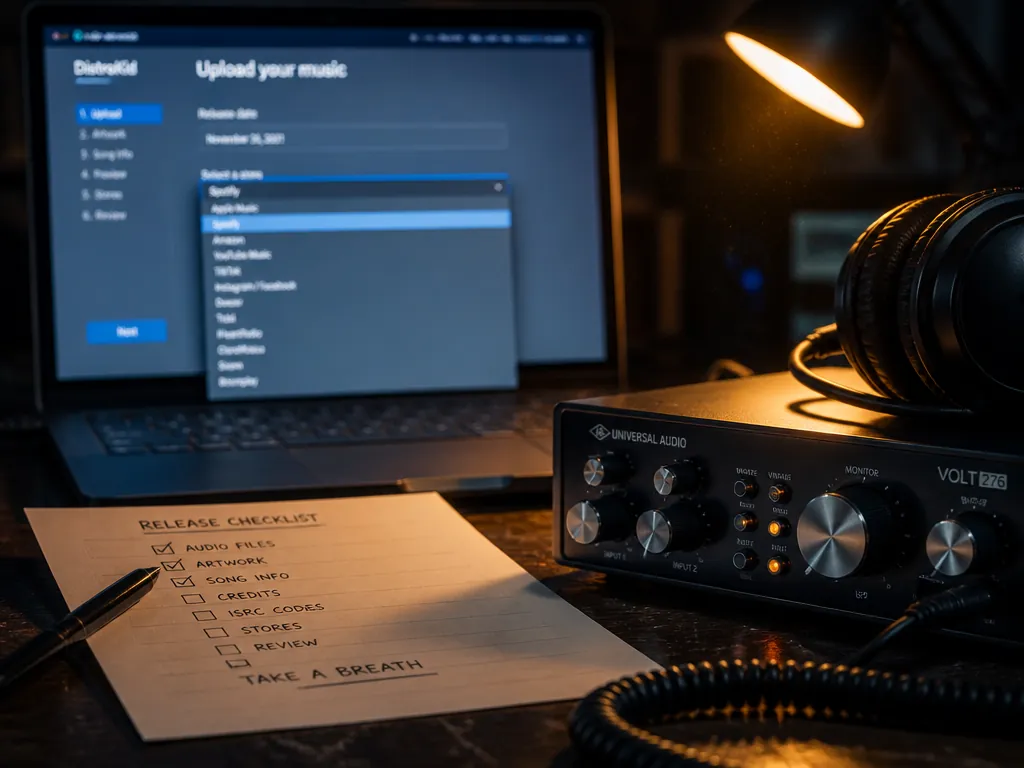
What credibility defense looks like from the studio side
If you make records, the useful response to all of this is not indignation. It is documentation, and it is cheap.
Keep project files, not only bounces. Keep dated 48kHz WAV stems for anything you might have to defend. Fill in the credit fields at your distributor instead of leaving the defaults — engineer, room, instruments, and the AI fields where they apply. Film thirty seconds of the tracking session on your phone. Publish short liner notes describing what you played and what you generated, in your own words, before someone else writes that description for you. If a flag ever comes, the artists who can produce a session folder with 200 takes in it will resolve it in a week, and the ones who cannot will spend a month arguing about their own record on the internet.
Thirteen out of twenty. I have stopped quoting that number as a party trick, because I finally understand what it measured: not whether a machine was in the room, but whether I liked the way something sounded. The disclosure credit solves the part I was already passable at, and leaves untouched the part I got wrong — the two human records I accused of being synthetic because they were tidy. No badge protects those artists. Their session files do.
The credit tells you what touched a record; only the paper trail tells you who stayed up with it.
Not sure which tool to use?
Compare the top AI music and sound tools side by side — honest reviews, real pricing, no sponsorships.