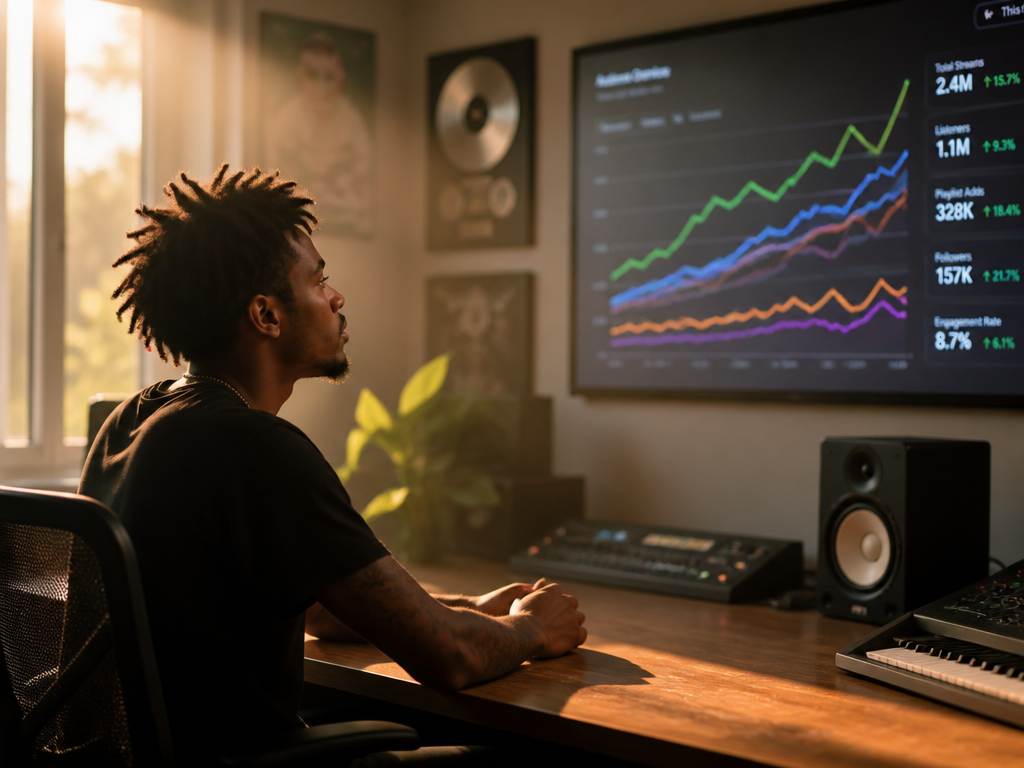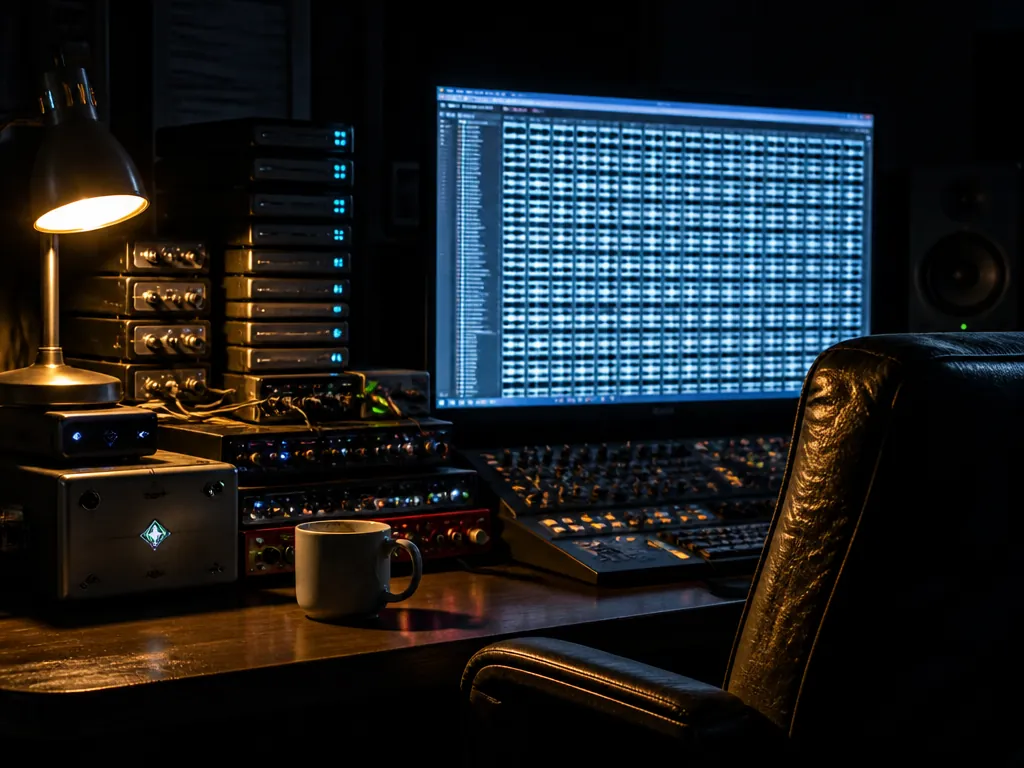
Last Tuesday I set a kitchen timer for sixty minutes and tried to bury my own hard drive. One text prompt after another, minor variations, no listening back beyond a few seconds to confirm the render wasn't garbage. When the timer went off I had 41 finished tracks — two to three minutes each, exported as 48kHz WAV, loosely tagged by mood. Maybe eight were genuinely usable. A dozen more were mushy in the low mids, the kind of thing where the kick and the bass fight and neither wins. The rest were filler. But all 41 were uploadable, and that word is the whole story. This is why AI-generated music bans are spreading across platforms right now, and why the argument has almost nothing to do with whether the music is any good.
The number I care about isn't eight-out-of-41. It's the cost of the run: a few dollars of compute and an hour I mostly spent refilling coffee. Scale that. A person who wanted to could produce a few hundred tracks a day without breaking a sweat, each one a real file with a real waveform, indistinguishable at the container level from something I sweated over for a week. The marginal cost of the next upload has fallen through the floor. That is the fact every platform is now reacting to, whether it admits it or not.
What a platform is actually protecting
Here's the plain-language version, the part you'd want if you only read one paragraph. A ban on machine-made tracks is rarely a judgment that the tracks sound bad. It's a defense of scarcity. Being early to an artist, holding one of the first spots in a small community, discovering someone before the algorithm did — those things carry value only because they're hard to fake. The moment anyone can mint a thousand plausible "artists" overnight and claim a thousand front-row seats, the seats stop being worth sitting in. The platform isn't policing taste. It's policing whether its own economy still means anything.
I find this framing more honest than the purist one. Nobody at these companies is losing sleep over the sanctity of the human soul in art. They're looking at a spreadsheet where supply just went vertical and asking what that does to the thing they sell — proximity to real people. When a community numbers its members, or sells early access, or builds a leaderboard, the whole structure rests on there being a finite number of humans on the other end. Remove the finite, remove the humans, and you've got a very fast content firehose pointed at an empty room.
Why the filter idea keeps failing
The reflex is to reach for detection — train a classifier, scan the audio, flag what came out of a model. I understand the appeal. I also spent an evening feeding a detector my own catalog, human tracks and machine tracks mixed together, and watched it call a live-tracked bass session "synthetic" while waving through three renders I'd made that afternoon. That's not a knock on one tool. It's the nature of the problem. A finished master is a finished master; the file doesn't carry a receipt for how it was made. Every month the models get closer to the texture of a room mic, and every classifier is fighting the last war. Anyone promising you a reliable audio-based verdict is selling the promise, not the result.
So the platforms that are serious have stopped trying to catch the output and started guarding the entrance. The enforcement is structural: a human vouches for the work at the gate, before it ever gets a spot in the community. Not "does this recording sound human" but "did a person stand behind it and say, I made this." You move the question from the waveform, which lies, to the account, which can be held responsible. It scales the way a membrane scales, not the way a scanning server does — you check admission, once, instead of re-litigating every file forever.
The line is authorship, not the toolkit
The objection lands immediately, and it's fair: I use autotune, I use AI mastering, half my drums are quantized to a grid — am I banned too? The workable policies I've seen draw the line at authorship, not at software. Pitch correction, a neural amp sim, an AI-assisted stem separator, a mastering algorithm — those are instruments and processors serving a person who decided what the piece should be. A prompt that hands the entire authorial decision to a model is a different thing. The distinction isn't "which plugins touched the file." It's "did a human make the choices that make it this song and not another one." That line is defensible in a way a plugin blocklist never could be, because it survives the next model release.
If you're building moderation and you want something that holds without an automation budget, the split looks like this:
| A gate check can verify | An audio filter cannot reliably tell |
|---|---|
| A person will attach their name and account to the work | Whether a master was rendered or recorded |
| Consistent authorship across a catalog over time | A trained model from a well-tracked live take |
| Accountability if the claim turns out false | Human intent from the waveform alone |
| A retired spot when a fake is removed | "Made with AI" from "finished with AI" |
The left column is enforceable by one reviewer and a clear rule. The right column is a research problem you will never finish paying for. Pick your battles accordingly — and if a claimed identity turns out fake, the honest move is to retire the spot it held rather than quietly reissue it, so the scarcity you're protecting doesn't leak out the back.
None of this is a verdict on AI as an instrument. I'll keep using it; it's the newest strange box in a studio that already has four broken synths in it. The economics of a marketplace and the ethics of a creative tool are two different conversations, and the mistake is letting the first one masquerade as the second. A platform can ban a firehose without insulting the fire.
Which brings me back to those 41 tracks. They're still on my drive, in a folder I named "do-not-upload," and I've kept the rule. Not out of principle — out of the same math the platforms are running. The eight usable ones would dilute the handful of things I actually stand behind, and the discovery value of my own small audience only holds if what I put in front of them is scarce because I made it scarce. So the folder sits there, 41 files, roughly a dollar's worth of compute, quietly demonstrating the exact problem it isn't allowed to become.
Not sure which tool to use?
Compare the top AI music and sound tools side by side — honest reviews, real pricing, no sponsorships.