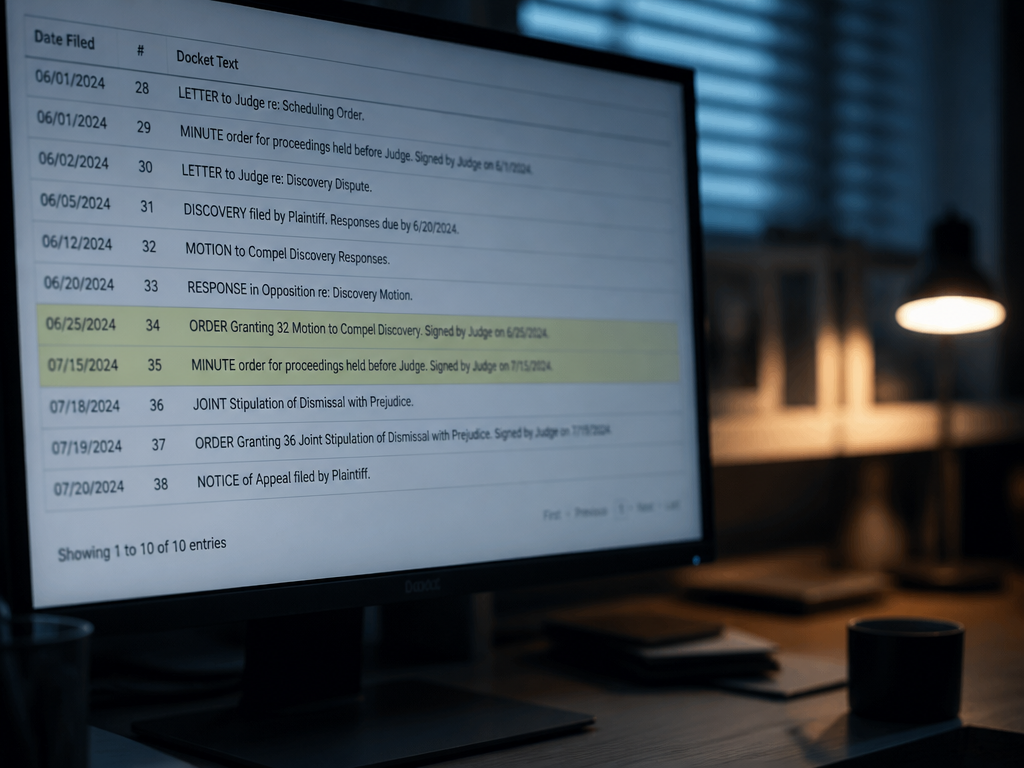
I spent a Tuesday morning refreshing a court docket, which is not how I planned to spend it. The National Music Publishers' Association's copyright infringement suit against X — the platform formerly known as Twitter — had gone quiet for months, and then two lines appeared in the electronic record: stipulations of dismissal. No press release. No joint statement. No number. Just the procedural equivalent of two parties walking out of a room and closing the door behind them.
That silence is the story. A copyright infringement fight that began with roughly 1,700 works and a headline damages figure in the hundreds of millions ended not with a verdict or a announced license, but with a docket entry you'd miss if you weren't looking. For anyone tracking platform licensing compliance, the way this dispute closed tells you more about X's music strategy than any deal memo would — precisely because there is no deal memo to read.
Where the case started
Rewind to June 2023. A coalition of music publishers, marshaled through the NMPA, sued X in federal court in Nashville. The complaint was ordinary in its architecture and unusual in its target. The allegation: X hosted videos containing copyrighted compositions without licenses, ignored takedown notices, and — the part that stung — treated repeat infringers with a permissiveness other platforms had abandoned years earlier.
The publishers pointed to a specific list of works and asked for statutory damages. If you do the arithmetic that plaintiffs always do — up to $150,000 per willful infringement, multiplied across the catalog — you land in nine-figure territory. That number is a negotiating instrument as much as a legal claim, and everyone in the room knew it.
What made X a distinct target was context. Nearly every other major user-upload platform — YouTube, Meta, TikTok, even Snap — had signed blanket licenses with publishers and the performing rights organizations. X had not. It ran a service where millions of videos carried recognizable music and had no publishing deal covering that use. The suit was, in effect, an attempt to force the last big holdout to the table.
The legal judo
Here is where it got interesting for anyone who reads filings for a living. X did not simply defend on the merits. Its response leaned on two arguments that reveal what the company thought the fight was actually about.
First, X contested the doctrine of secondary liability — the theory that a platform can be on the hook for what its users upload. This is the same terrain litigated in Sony Music v. Cox Communications, the case that reshaped how courts think about a service provider's duty to police repeat infringers. Cox, an internet provider, got hit with a massive verdict for failing to terminate subscribers flagged for piracy. Publishers wanted X measured by that standard. X wanted to argue it was categorically different — a communications platform, not a music service — and that the Cox framework didn't map cleanly onto a social feed.
That distinction matters. If the dispute were really about money, you'd expect a quiet fight over the size of a check. Instead, both sides spent energy on the shape of platform liability itself. That suggests the stakes were structural: not "how much does X owe for these 1,700 songs" but "does X owe anyone anything for the millions of songs it will host next year."
Second — and this is the pivot that raised eyebrows — X reportedly reached for an antitrust angle, framing the publishers' coordinated licensing posture as anticompetitive. Antitrust law is an aggressive counter for a defendant in a copyright case. It reframes the plaintiffs from victims of infringement into an alleged cartel setting collective terms. Whether or not it would have survived a motion, invoking it signals a defendant that intends to make litigation expensive and reputationally uncomfortable rather than one hunting for a settlement number.
Then, before any of these theories was tested, the case ended.
How do music copyright lawsuits usually get resolved?

Most large music copyright infringement suits between rights holders and platforms settle privately, and the terms almost never become public. Litigation is slow and expensive, statutory damages create enormous downside risk for defendants, and both sides usually prefer a confidential license or payment to a jury reading a damages number into the record. Public verdicts — like the one in Cox — are the exception, and they tend to happen when settlement talks collapse. So a quiet dismissal is not an anomaly. It is the normal ending. What's unusual here is only how little leaked around it.
That's the frame worth holding onto: the absence of a announced deal is not evidence that nothing happened. It's the default outcome of a system built to keep terms behind closed doors.
Reading the tactics, not the terms
Since the terms are sealed, the tactics are the evidence. Three things stand out.
The antitrust pivot came before the dismissal. When a defendant escalates to a counter-theory that attacks the plaintiff's whole licensing model, and then the case ends, one plausible reading is that the escalation changed the negotiating balance. That does not tell you who paid what. It tells you the fight was live enough that someone decided ending it beat winning it.
Neither side declared victory. Publishers who extract a license usually say so — a signed deal is a template they can wave at the next holdout. X, if it had beaten the claims outright, would have reason to crow about a platform-liability win. The mutual silence is consistent with a compromise neither side wants to model publicly, or with a settlement whose confidentiality clause forbids the usual chest-thumping.
The Cox terrain was never resolved. The case did not produce a ruling on whether a social platform carries the same repeat-infringer duty as an internet provider. That question is still open for the next plaintiff. If you manage rights, that ambiguity is your real takeaway: the law on platform liability for user-uploaded music did not move here.
What a rights manager should actually watch
If you're tracking X's music posture for an operations or licensing team, the settlement number is the least useful thing you could learn. Here is what would tell you more:
| Signal | Why it matters | Where to look |
|---|---|---|
| A published blanket license (X + a PRO or publisher) | Confirms X has entered the licensed-platform club | PRO announcements, NMPA statements |
| New Content ID-style detection on X | Suggests X is building takedown/monetization infrastructure | Platform product changelogs, creator docs |
| Repeat-infringer policy updates in X's terms | The Cox pressure point; changes signal legal caution | X's ToS revision history |
| A second publisher suit filed elsewhere | Would mean the coordinated pressure campaign continues | Federal court dockets (Nashville, SDNY) |
| Antitrust filings against NMPA-style coordination | X's counter-theory could resurface in another venue | DOJ/FTC and defendant filings |
None of these require insider access. They're all in the public record or in the products themselves. A settlement, by contrast, is designed to tell you nothing.
Back to the docket
So I closed the tab with the same question I opened it with. Did X buy a license, or buy peace? Did the publishers win a payment, a policy change, or a quiet retreat dressed as resolution? The filing doesn't say, and the confidentiality that closes these cases means it may never say.
What this piece cannot answer is the one thing operations leads most want: whether X is now a licensed home for music or merely a defendant who paid to make one lawsuit go away. The tactics suggest the fight was about platform liability more than back royalties — but suggestion is not confirmation, and a sealed agreement is a wall, not a window.
Watch the product, not the press release. If detection tooling and a real repeat-infringer policy show up on X in the next few quarters, someone at that company decided the music economy was worth building into. If nothing changes, the dismissal bought silence and little else. The docket told me the fight ended. It's the roadmap, not the settlement, that will tell you who actually won.
Not sure which tool to use?
Compare the top AI music and sound tools side by side — honest reviews, real pricing, no sponsorships.