Open Spotify's Discover Weekly, find the most generic track on it — the warm-lo-fi-piano-rain thing at position seven — and ask yourself honestly whether you'd notice if a machine made it. Now ask whether you'd care. That second question is the one the music industry keeps dodging, and it matters more than the first.
Here is the claim, stated plainly so I have to earn it for the rest of this piece: AI music generation is not coming for the income you think it is. It is not going to write a better song than the one you've been sweating over for three weeks. It is coming for the income you were probably already losing — the functional, nobody-chose-this background audio that used to pay a lot of working musicians' rent. Understanding the difference is the whole game, because the panic and the platforms are both pointed at the wrong target.
A disclosure before anything else: City of Punk builds an AI sound tool. We have a horse in this race. That is exactly why I'm not going to tell you AI is harmless, and exactly why I'm going to be specific about where it actually hurts. A brochure would tell you to relax. I'm telling you to look closely.
The thing AI is actually eating
Think about the music you make versus the music you license out, and split it into two buckets.
Bucket one is chosen music. Someone searched your name. A supervisor wanted your guitar tone for a scene. A fan saved the track because the bridge gutted them. This is music people select on purpose, and a generated stand-in does not substitute for it, because the value was never "a competent song in this genre" — the value was that it was yours.
Bucket two is functional music. The 90-second corporate explainer bed. The meditation-app ambient loop. The 14th royalty-free "uplifting acoustic" cue in a stock library, sold for $39 with a license nobody reads. The mid-tempo nothing that fills a playlist titled Focus or Chill Beats while you do your taxes. Nobody chose it. It needed to be present, in key, and not distracting. That is a spec, not a song.
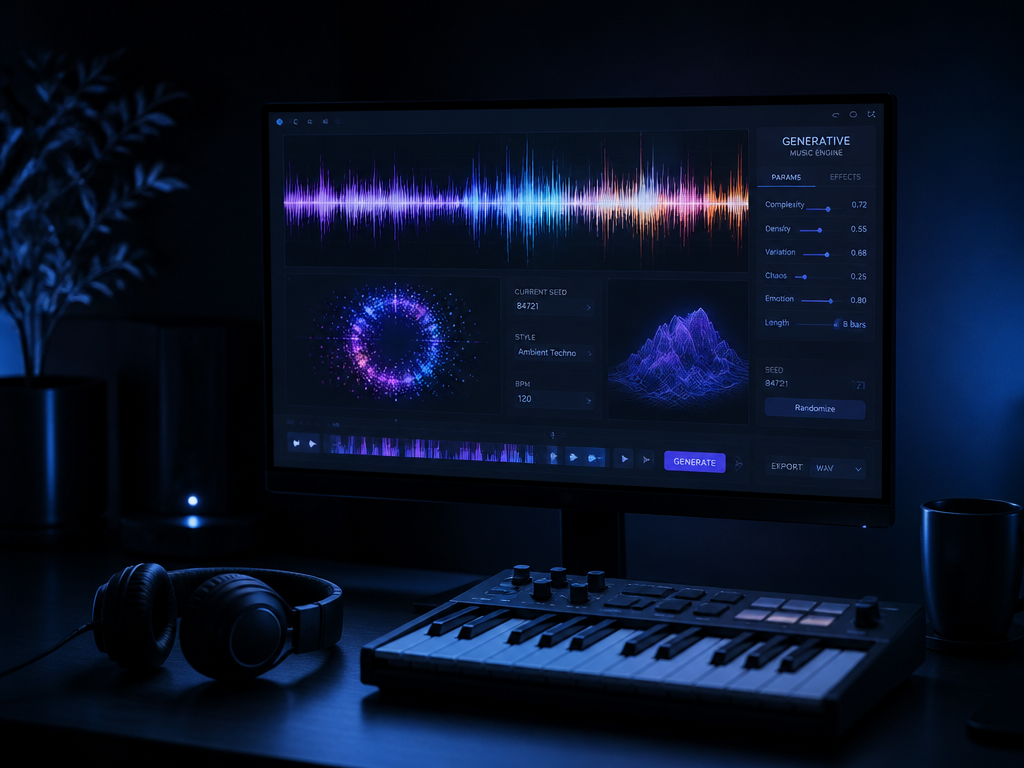
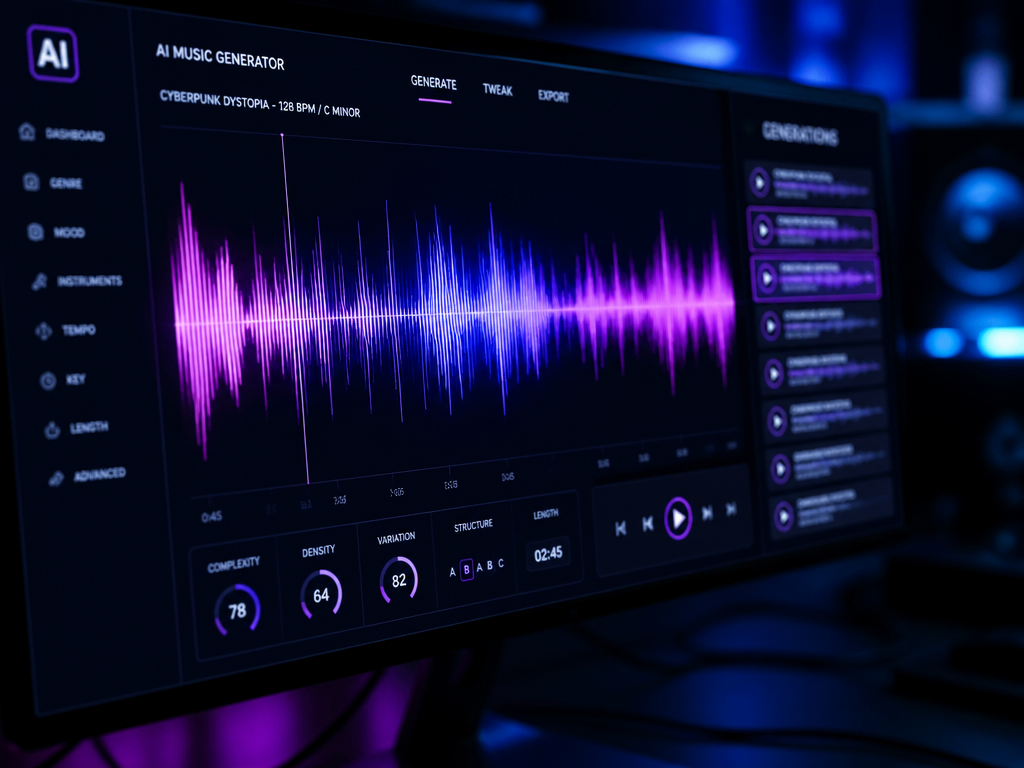
AI music generation is very, very good at bucket two. It was good at it before it was good at anything else, because bucket two has the lowest bar: be inoffensive, be on-format, be cheap. A tool that produces a passable 70 BPM Cmaj7 ambient pad with a soft Rhodes and tape hiss, at 48kHz, in thirty seconds, for the cost of a subscription, has already replaced the human who used to get $50 to make that bed. That displacement is real and it has already started. I'm not going to soften it.
But notice what that means for your panic. If your income depends on bucket two — on being the reliable supplier of generic-but-fine — then yes, the floor is dropping, and it was dropping before generative audio arrived, courtesy of stock libraries that paid pennies and playlists stuffed with cheap production-music outfits. AI accelerated a fall that was already in motion. If your income depends on bucket one, the threat is more indirect, and the people most eager to tell you it's an emergency are often the people standing to profit either way.
The platforms are arguing with themselves
Here's where the story stops being about AI and starts being about hypocrisy, which is more useful.
Watch what the big streaming platforms actually do, not what they say. On one side, you get the reassuring messaging: tools to flag or label AI-generated tracks, public statements about protecting artists, the occasional purge of obviously spammy uploads. On the other side, those same companies invest in, license, or quietly tolerate the flood — because every AI track that fills a mood playlist is a track they don't have to pay a recognizable artist a meaningful royalty for. A catalog of cheap, ownable functional music is a margin story. They are not confused. They are doing both things on purpose, and calling it confusion is more flattering to them than the truth.
So when a platform tells you it's "on the side of human artists," translate it. It is on the side of human artists in the categories where human artists drive subscriptions — the marquee names, the chosen music, bucket one. In bucket two, the same platform's incentive is to make the music as close to free as possible, and generated audio is the cheapest supplier it has ever had. The contradiction isn't a glitch in the messaging. The contradiction is the business model.
This matters to you because the loudest voices framing AI as an existential threat to all musicians are frequently the same institutions whose economics quietly benefit from generated filler. When a major label runs a "real music" campaign while its parent company explores generative licensing, you are watching someone fight with their own left hand. Don't take your strategic cues from a body at war with itself.
"Listeners can't tell" is true and almost beside the point
You've seen the framing: most listeners can't reliably distinguish AI-generated tracks from human ones, especially in passive contexts. Treat that as durably true — it gets truer every quarter, and exact figures vary by study and by genre. Vocals are still the giveaway more often than not; sustained, exposed solo performances still trip the ear; anything with a real arrangement and dynamic risk still tends to out itself. But ambient, lo-fi, generic EDM, library-grade acoustic? The average passive listener does not clock it, and increasingly neither do I on first pass.
Two conclusions get drawn from this, and one of them is wrong.
The wrong one: "If nobody can tell, human musicianship is doomed." That conflates the two buckets again. In passive listening — the playlist running while someone cooks — nobody could tell before AI either, because nobody was listening closely. The inability to distinguish generated functional music from human functional music is a statement about how little attention functional music gets, not a verdict on craft.
The right one: detection is not your defense, and disclosure won't save the category that's actually exposed. Audio detectors exist, they're improving, and they're also gameable — a generated track run through analog gear, re-recorded off a monitor, lightly re-performed, slips past most of them. If your business plan depends on AI music being reliably caught and labeled, plan for that wall to be porous. The transparency fight is worth having for ethical reasons. It is not a moat.
So what's the actual dollar exposure
Let me be concrete about where an indie musician or a small label feels this, framed in a way that'll still be true a year from now because I'm not inventing numbers.
Sync and library placements. If a chunk of your revenue is mid-tier sync — corporate, social-media, low-budget film and TV beds — that's the most exposed income you have. A supervisor on a tight budget who needs "tense underscore, 120 BPM, no melody" now has a generator that yields a usable cue immediately, royalty-free, with no negotiation. The high-end of sync, where a supervisor wants a specific artist's voice for a specific emotional reason, is far safer. The commodity middle is where the erosion happens.
Royalty dilution. Streaming royalties come out of a shared pot. The more tracks getting streamed — including a rising tide of generated uploads filling passive playlists — the more ways that pot gets split, and the more plays drain toward low-cost catalog the platform would rather pay. You don't need a generated track to "beat" yours head-to-head. It dilutes the pool and soaks up the passive listening hours that used to land, however thinly, on human catalog. The mechanism is mundane and it's already underway.
The stock-library floor. If you've been supplementing income by uploading to royalty-free libraries, that floor is collapsing fastest, because those libraries are already buying or generating AI catalog to undercut their own contributors. Read your contributor agreement. Some now reserve the right to train on or generate from the very catalog you uploaded. That's the licensing trap of this era, and it's buried, as these things always are, in a clause you skimmed.
None of this touches the song someone chose because it was yours. Guard the distinction.
Where it's an instrument, not a threat
I'd be a hypocrite to spend a decade scoring games and short films and then pretend I haven't used generative tools in the room. Here's where they earn their place, honestly.
- Sketching and pre-viz. You need a temp cue under a rough edit to feel the pacing before you write the real one. Generating a placeholder in the right tempo and key beats humming into your phone, and it tells the director something concrete on Tuesday instead of Friday.
- Texture and bed layers. A generated pad or noise floor, pitched and filtered and buried under your own performance, becomes raw material — the way you'd sample a field recording. The taste is in what you do to it.
- Variation under deadline. Adaptive game audio needs the same loop in four intensities. Generating rough variants to react against is faster than building each from scratch, and you replace the parts that matter with played performances.
- Breaking your own habits. Prompt-roulette is real and most of what comes back is mush. But occasionally a render hands you a chord movement you'd never have written, and you steal the idea and play it properly. That's not cheating. That's every musician who ever stole a lick.
The limit is constant and worth saying plainly: the generated stuff is convincing in proportion to how little the moment asks of it. The second a passage needs intention — a build that lands here, a vocal that means something, a solo that risks something — the seams show, and your hands are still the only fix. AI is a new instrument. It is not taste, and it does not have anything to say.
Who should worry, who can breathe
Worry, and adapt now, if your income leans on commodity sync, royalty-free library uploads, or being the dependable supplier of competent-but-generic functional music. That ground is moving. Not because a machine is more soulful, but because the buyers in that segment were always paying for "adequate and cheap," and adequate-and-cheap is exactly what generation does best.
You can mostly breathe if your revenue comes from people choosing you — your live draw, your distinctive voice, your name on a supervisor's shortlist, your fans. The threat to bucket one is real but indirect: royalty dilution and attention scarcity, not head-to-head replacement. Your defense is the thing that was always your defense — being identifiably, stubbornly yourself.
You're being played if you take your strategy from an industry institution that profits from generated filler while running a campaign about human authenticity. Their contradiction is not your problem to resolve. Build for your own listeners, not for the platform's mood playlists, which were never paying you properly anyway.
One thing to try this week
Pull up your own income, however informal, and split it into the two buckets. Chosen music — people picked it because it's yours — in one column. Functional music — sync beds, library uploads, playlist filler, anything where the spec was "competent and present" — in the other. Add up the second column.
That number is your actual exposure to AI music generation. Not the panic number, not the headline number. That one. If it's small, you have less to fear than the discourse wants you to believe, and you can spend this week deepening the first column instead — finishing the track only you could make. If it's large, you now know precisely what to diversify away from before the floor finishes dropping, and you've learned it from your own ledger instead of from a platform that's arguing with itself.
The machine can make adequate. Go make the thing nobody chose adequate over.
Not sure which tool to use?
Compare the top AI music and sound tools side by side — honest reviews, real pricing, no sponsorships.