A number ran through every headline about Napster's reinvention: $3 billion. That was the figure attached to the investor backing Infinite Reality, the company that bought the Napster brand in 2025 and set about turning a two-decade-old piracy ghost into an AI music and virtual-commerce platform. The Napster fraud case did not start as a fraud case. It started as a funding announcement, the kind that gets reposted without anyone asking what the number was made of.
Now the Department of Justice has answered that question, and the answer is that a large part of it was made of nothing.
This piece is for the people who read funding rounds the way a sound engineer reads a waveform — looking for the part that's clipping. If you cover music platforms, fintech blowups, or the AI startups stacking up between the two, the useful exercise here is not outrage. It's learning to read what a headline number measures, and what it quietly does not.
What the $3 billion actually measured
The figure described a commitment, not a balance. In startup reporting, those two words live far apart. A commitment is a promise of future capital tied to milestones, tranches, and the continued solvency and honesty of the party making it. A balance is money already in the account. The press cycle around Infinite Reality treated the commitment as if it were the balance, because that is what funding announcements are built to encourage.
According to federal prosecutors, the man behind a substantial slice of that commitment fabricated the evidence that it existed. The DOJ has charged him with wire fraud and securities fraud, alleging he induced investment by manufacturing proof of wealth he did not have. The charges convert what had earlier been reported as a suspicion — that one of the headline backers might be a fraudster — into a formal federal indictment. The escalation is the story: a claim that previously lived in trade-press hedging now lives in a court filing.
That distinction matters for anyone modeling these companies. The $3 billion was never a measurement of cash deployed. It was a measurement of stated intent, and stated intent is only as solid as the person stating it.
What the indictment says he did
This is the part to read slowly, because the mechanics are unusually concrete for a securities case. Prosecutors allege the scheme did not rely on vague verbal assurances. It relied on manufactured infrastructure.
According to the charges, the accused:
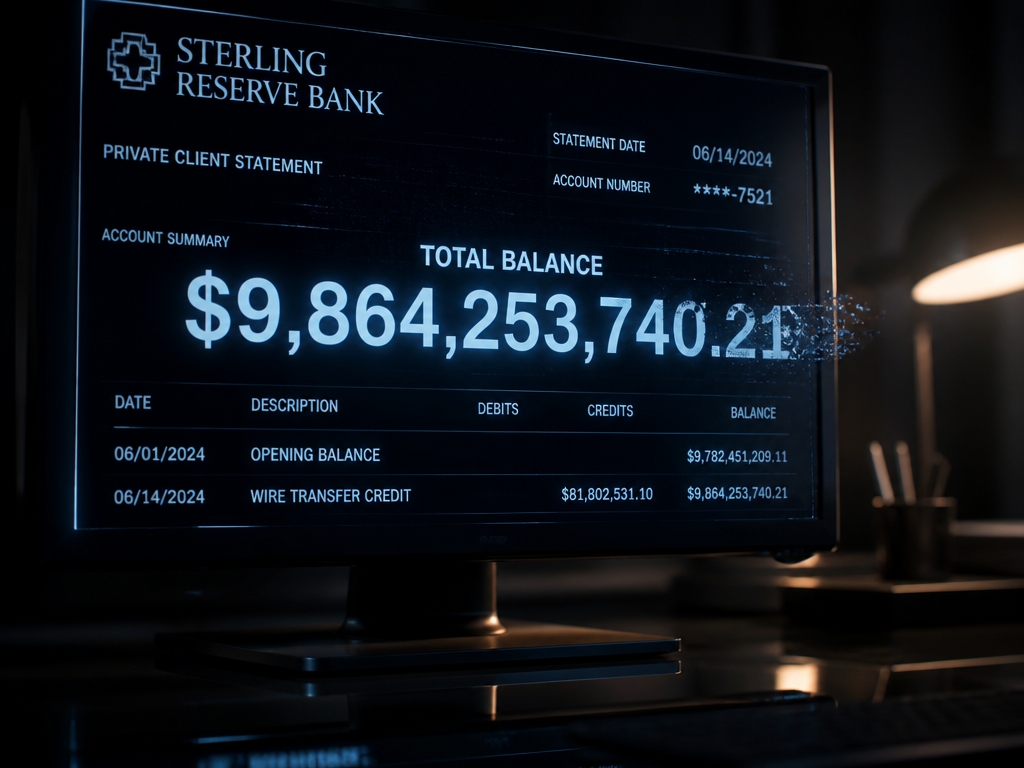
- Produced falsified bank records showing balances that did not exist.
- Generated counterfeit correspondence designed to look like communication from a legitimate financial institution.
- Stood up a lookalike website mimicking a real bank, so that anyone checking the backing would land on something that appeared authentic.
The pattern is worth naming plainly: the fraud was built to survive a casual due-diligence pass. Investors and partners who clicked through to "verify" the funds were routed to a stage set. The deception was engineered for the exact moment a careful person tries to confirm a number — which is the moment most schemes fail.
For an analyst, that's the detail that should reshape how you read any thinly-sourced backing claim. A verification step is only as good as the channel it travels through. If the channel itself was provisioned by the person you're verifying, you've verified nothing.
What the number doesn't measure
Here is where the reporting requires discipline rather than drama.
The indictment tells you that a portion of the announced backing was allegedly fraudulent. It does not tell you how much real money ever reached Napster's operations. It does not tell you whether the company's product roadmap was funded by other, legitimate capital. It does not tell you whether the AI music platform shipping today is solvent, half-built, or running on a different balance sheet entirely.
A fraud charge against an investor is a statement about that investor. It is not, by itself, a verdict on the company that took the investment. Plenty of legitimate businesses have unknowingly accepted money from people who turned out to be criminals; that does not retroactively make the business a fraud. The reverse trap is just as common — assuming the company must be fine because the charges name someone else.
So the honest measurement reads like this:
| Claimed | What the charges establish | What remains unknown |
|---|---|---|
| $3bn investor commitment | A portion was allegedly backed by fabricated proof | How much genuine capital ever cleared |
| AI music platform funded and scaling | The brand was acquired and repositioned | Current runway and operational funding source |
| Verified institutional backing | Verification channels were allegedly counterfeit | Whether other backers conducted independent diligence |
That middle column is the only thing the Napster fraud case currently proves. Everything in the right column is still open, and a careful writer leaves it open.
Why a sound-tools audience should care
If you build with AI music — game loops, video beds, podcast intros — this looks like a finance story two doors down from your actual job. It isn't, quite.
The reason is provenance. The value proposition of an AI music platform is a chain of trust: the model was trained on licensed or rights-cleared material, the company can indemnify its commercial license, and that license will still mean something next year. Every link in that chain runs on funding. A platform that can't make payroll can't defend a license, can't honor an indemnity clause, and can't keep its servers up long enough to deliver the stems you already paid for.
This is the unglamorous due diligence that matters when you're choosing a tool for commercial work. Not "does it sound good" — though a detuned analog pad over a broken 808 at 92 BPM still has to land — but "will the license behind this still exist when a client's lawyer asks about it." When you license a track for a shipped game build, you are betting on the vendor's continuity. A headline funding number is part of how vendors signal that continuity. The Napster case is a reminder that the number is a signal, not a guarantee, and signals can be forged down to the bank website.
The practical move is the same one prosecutors say the fraudster defeated: verify through a channel the vendor doesn't control. Read the actual license terms rather than the marketing summary. Check who indemnifies you and under what conditions. Confirm delivery formats in writing — 48kHz WAV, stems, the rights to modify and redistribute inside your own product. A funding press release tells you about a company's ambitions. The license agreement tells you about your own exposure.
Where it leaves the company
Napster's current incarnation is a working AI music and virtual-experience play, repositioned hard from the brand's piracy origins. The indictment validates the earlier reporting that one of its named backers was suspect. It does not, on its own, settle the company's direction or its viability, and prosecutors have charged an individual, not the platform.
The accused is entitled to the presumption of innocence; an indictment is an allegation tested at trial, not a conviction. What's confirmed is narrower than the headlines suggest and more specific than rumor allowed: federal charges, named conduct, a fabricated paper trail. The brand keeps shipping product while the case that helped fund its reinvention moves through a courtroom that has nothing to say about music.
For analysts tracking the overlap of AI music and fintech, that's the durable lesson. The scandal is not that an old name attached itself to new technology. It's that a nine-figure validation can be assembled out of a fake login page, and that a press cycle will carry the number anyway.
The myth was that $3 billion stood behind Napster's reinvention. The more accurate version is that $3 billion was announced behind it, and a federal indictment now alleges that a large part of the proof was built to look real on the way to looking like fraud.
Not sure which tool to use?
Compare the top AI music and sound tools side by side — honest reviews, real pricing, no sponsorships.