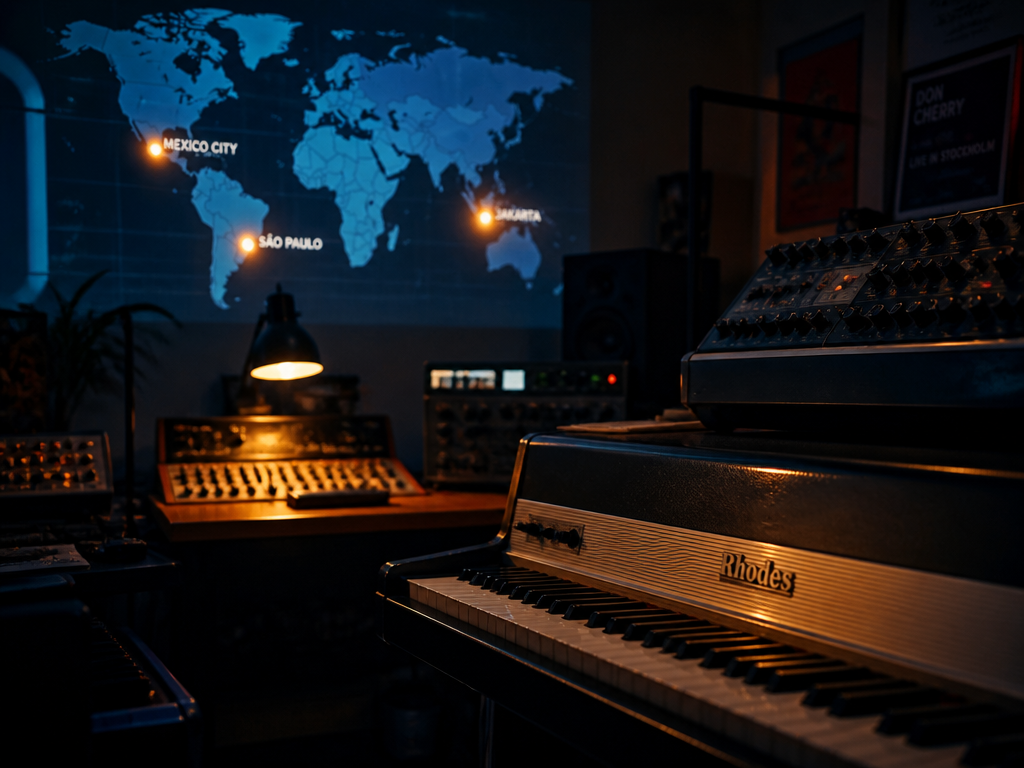
A producer I know shipped an instrumental hip-hop loop pack last year, nothing fancy, a detuned Rhodes over a broken 808 at 84 BPM. His top earning region wasn't Los Angeles or London. It was Jakarta, then Mexico City, then São Paulo. The track that paid his rent was being chopped into background beds by creators in markets he'd never marketed to and couldn't name the currency of.
That inversion is the real story behind Spotify international expansion, and it matters more to your bottom line than any model release. The platform now operates across well over a hundred markets, and the majority of what gets played isn't in English. For independent artists and anyone using AI tools to generate music for platforms, the question stopped being "how do I get on Spotify" and became "where does my money actually come from, and what protects me once it scales beyond my reach." Three protections are worth comparing head to head. They do not perform equally.
How does Spotify pay artists in non-English markets?
Streaming revenue is pooled by market, not paid as a flat per-stream rate worldwide. A subscription sold in a country with lower average revenue per user generates a smaller pool, so a play from that market typically pays less than a play from a high-subscription-price market. The per-stream figure you see quoted online is an average across all of that, not a rate card. What changes the math is volume: ten thousand streams from a fast-growing market with localized pricing can outpace a thousand streams from a saturated one, and that's increasingly where the growth is coming from.
So a track can earn well from a place where each individual play is worth a fraction of a US play. That's the mechanic worth internalizing before you read your next statement and panic.
The comparison: three protections, named criteria
When your music travels into markets you'll never visit, three things stand between you and a bad outcome. I'm going to judge each one against the same question: is this protection concrete enough to rely on, or is it still mostly intention?
The three:
- Identity protection — can someone impersonate you, hijack your profile, or release tracks under your name
- Royalty fairness — does global reach translate into income you can actually plan around
- AI disclosure and consent — when AI is involved, on your tracks or someone copying you, what governs it
Round one: identity protection
This is the most mature of the three, and it's mature because the threat is old. Profile hijacking, fraudulent uploads to an established artist's page, and metadata fraud predate the current AI conversation. Platforms built artist verification, profile claiming, and takedown channels years ago because impersonation was costing real artists real money.
The newer wrinkle is voice and likeness. A convincing AI render of a recognizable singer can be uploaded to a streaming service the same way any track is, and the artist often finds out after it's live. Major platforms have moved toward removing unauthorized impersonations on request and toward flagging tracks that misuse a verified artist's identity. The mechanisms aren't perfect and they're reactive — you usually have to notice and report — but they exist, they're documented, and they resolve.
Verdict on round one: concrete. If someone clones your voice or hijacks your page, there is a defined process and a precedent for it working. Reactive, not preventive, but real.
Round two: royalty fairness across markets
This is where the picture gets honest. Localized pricing — selling subscriptions at price points calibrated to local purchasing power, paired with local payment rails — is what made markets like India and Brazil viable at scale. India's UPI and Brazil's Pix turned "I'd subscribe but I can't pay you" into a tap. That genuinely expanded the pool of paying listeners, and non-English-language artists have earned globally in ways that weren't possible a decade ago. Bad Bunny and the long tail of regional Mexican, Afrobeats, and K-pop acts didn't crack a Western market first; they were carried by their home audiences and then spilled outward.
But "more listeners can pay you" and "you're paid fairly" are different claims. A play from a low-ARPU market is worth less, full stop. The fairness question isn't whether the system is rigged against non-English music — the consumption data argues against that — it's whether the per-stream economics ever add up to a living for the artist in the middle, who has real reach and no superstar volume. That tension is unresolved, and pretending otherwise insults the reader.
Verdict on round two: real but uneven. The reach is genuine. The income is plannable only if you understand the volume game and stop benchmarking yourself against US-only per-stream myths.
Round three: AI disclosure and consent
This is the youngest protection and it shows. The framing the industry has settled on rhetorically — consent, credit, compensation — is a sound principle. The implementation is still forming. There's no universal standard yet for tagging a track as AI-assisted, no consistent disclosure requirement across every platform, and the line between "I used an AI instrument" and "I cloned a person" is exactly the line that's hardest to police at upload scale.
What does exist: a growing willingness to pull non-consensual voice clones, early experiments with consent-based AI tools where an artist opts in to let their voice be used, and platform-level filtering against spam-flood AI uploads designed to game royalty pools. That last one matters to you directly — if you're making legitimate AI-assisted music, the enemy is the spam farms, because their cleanup is what tightens the rules everyone else lives under.
Verdict on round three: mostly intention, hardening fast. Trust the principle, don't yet trust a uniform process to exist when you need it.
A release checklist for AI-assisted tracks going global
| Step | What to do | Why it matters across markets |
|---|---|---|
| 1 | Keep your generation source and stems on file | If a track is challenged, you can show it's original, not a clone |
| 2 | Don't prompt toward a named living artist's voice | This is the fastest path to a takedown anywhere |
| 3 | Register clean metadata and a verified profile | Identity protection only works if the platform knows who you are |
| 4 | Confirm your distributor's AI-content terms | Disclosure rules vary; your distributor passes them to platforms |
| 5 | Deliver 48kHz WAV plus stems where accepted | Localized creator markets remix; stems travel further than a stereo mix |
Step 4 is the one people skip. Your distributor sits between you and Spotify, and its terms — including how it handles AI-assisted uploads — govern what reaches the platform. Read them before you queue a release, not after.
If your tooling matters here, City of Punk renders commercially-clearable stems at 48kHz precisely so you're not stuck explaining a sample's origin to a takedown queue in a market you'll never visit. But the checklist above holds no matter what you generate with.
What this means for the track you're finishing this week
Stop building for the market you live in. The audience that streams your work likely sits in a city you couldn't find on a map, paying through a rail you've never used, at a price set for their economy. Make stems. Keep your sources. Verify your profile. Then let the geography do what it does.
The myth is that going global on Spotify means your music finally reaches the world's biggest-paying listeners. The more accurate version is that it reaches the world's most listeners, paying local rates, and the artists who plan for that — not the ones waiting for a US per-stream payday — are the ones the expansion actually pays.
Not sure which tool to use?
Compare the top AI music and sound tools side by side — honest reviews, real pricing, no sponsorships.