You have probably asked yourself some version of this question already: when a jurisdiction announces it will write AI restrictions into copyright statute, is that a compliance obligation you need to model into next year's licensing terms, or a piece of political signaling you can file under "monitor"? Indonesia's copyright reform, still in draft, forces exactly that call. And the honest answer, the one worth building a memo around, is that it depends on a single clause the drafters have not yet defined.
Here is the verdict up front, because you have a deck to build: Indonesia's copyright reform is directional, not yet operational. Its most consequential provision — a test for meaningful human involvement in AI-generated works — is described in the draft but not specified. Until that specification exists, you cannot compute your platform's exposure with any precision. You can, however, position for it.
What the draft actually says
Per reporting on the draft text, the reform would restrict AI systems from generating output that imitates a specific creator's distinctive expression, and it gestures at protections around voice and likeness — the territory where a model reproduces an identifiable performer without consent. It also reportedly conditions copyright protection for machine-assisted works on a threshold of human contribution.
That is two moves in one document, and they operate on different targets. The first is an output restriction: it governs what a generation may resemble. The second is an authorship gate: it governs whether the resulting file gets protection at all. For a rights administrator, those are separate risk lines. The output restriction touches your infringement exposure and your creators' claims against models trained on their catalogs. The authorship gate touches whether the AI-assisted content flowing through your platform is even a protectable asset your licensees can defend.
The draft does not resolve how these interact when a work is both — an AI generation that imitates a living artist and was shaped by a human operator. That gap is not a rounding error. It is the case most of your catalog disputes will actually look like.
The clause that decides everything
The human-involvement test is the load-bearing wall, and right now it is a sketch. The draft signals that human input matters without stating how much, at what stage, or measured against what. Is a human prompt sufficient? A human-directed arrangement? Post-generation editing of stems? Curation of a hundred renders down to one?
This ambiguity is not unique to Indonesia — it is the same unresolved question sitting in the US Copyright Office's guidance and in European debates over human authorship — but Indonesia is proposing to hang statutory consequences on it before defining it. Legal analysts reviewing similar frameworks have flagged a recurring conflation: rules written to address commercial imitation often sweep in research and non-commercial training as collateral, because the drafters describe the harmful output without carving out the upstream process. Watch for that pattern in the consultation drafts as they emerge. If the human-involvement test is defined narrowly and process-blind, it becomes a blunt instrument. If it is defined around commercial deployment and identifiable-performer harm, it becomes workable. You cannot yet tell which.
Why Google pushed back
Google reportedly opposes the reform, and it is worth reading that opposition structurally rather than as noise. Platform companies with large-language and generative-audio ambitions have a specific exposure here: training data. A rule that restricts imitation of a creator's distinctive style implies that the model absorbed that style from somewhere — and that somewhere is licensed or unlicensed catalog.

The objection tells you where the pressure sits. It is not primarily about the output filter, which most large platforms can implement through guardrails. It is about the precedent that training on protected works without a license creates downstream liability. That is the same fault line running through the RIAA's actions against generative-music startups and through every negotiation over whether training is fair use or a licensable act. When a company runs its objection through the press, read it as a map of what it fears becoming enforceable elsewhere.
Calibrating against everyone else
To decide how much weight to give this, place it on the international grid you already maintain:
| Jurisdiction | Posture on AI training | Human-authorship stance |
|---|---|---|
| Japan | Broad text-and-data-mining permission | Permissive; training largely allowed |
| Singapore | Computational-use exception | Business-friendly, limited carve-outs |
| European Union | TDM exception with rightsholder opt-out | Requires human authorship for protection |
| United States | Fair-use question actively litigated | Human authorship required; AI-only output unprotected |
| Indonesia (draft) | Restriction on imitation + involvement gate | Undefined threshold |
What the grid shows is that Indonesia is not proposing the most permissive or the most restrictive regime — it is proposing an under-specified one. That is a different kind of risk. A clear-but-strict rule you can comply with. An unclear rule generates litigation while everyone waits for the first enforcement action to define the terms in practice.
What this means for your licensing strategy now
Treat the draft as a forecast of obligations, and build optionality rather than commitments. Concretely:
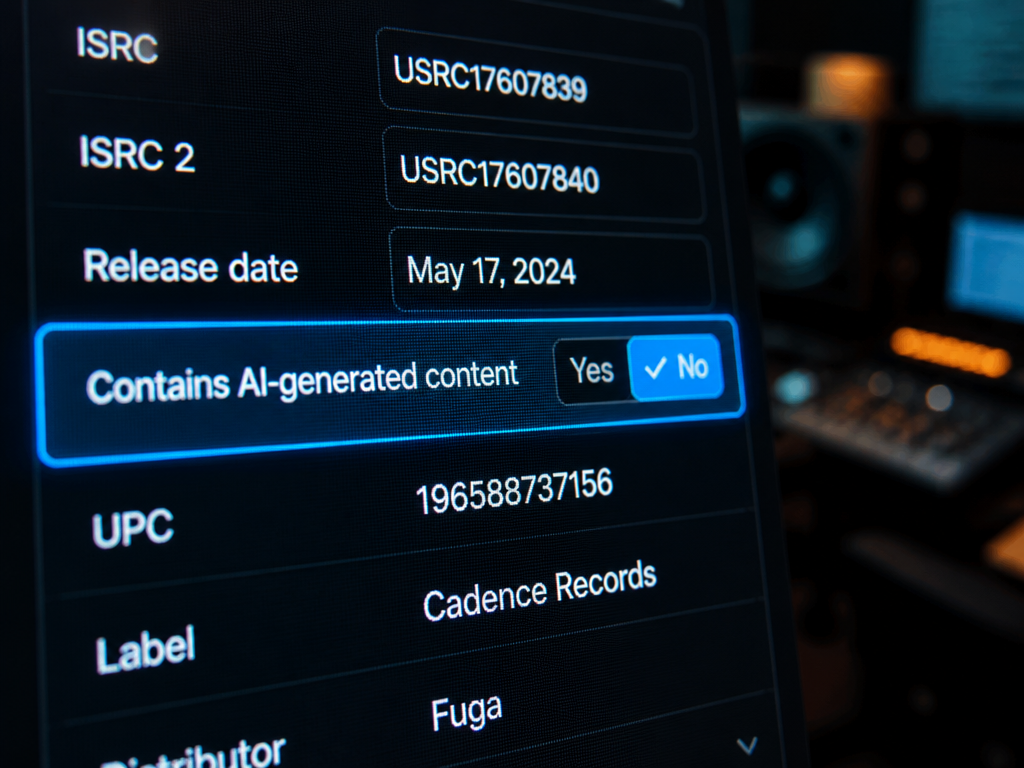
- Provenance metadata is the cheap hedge. Whatever the human-involvement test becomes, you will need to demonstrate the human contribution to any AI-assisted work you license. Capturing prompt logs, edit histories, and operator attribution now costs little and protects the authorship gate later.
- Segment your catalog by imitation risk. Works generated to resemble identifiable performers are your highest-exposure assets under any version of this reform. Flag them.
- Read your training-data warranties. If you license generative-audio output, the indemnity you actually want covers the upstream training set, not the surface guarantee that output is "original."
- Do not assume a timeline. The draft carries no confirmed enactment schedule. Building irreversible product decisions around an unpassed bill is its own risk.
Indonesia has also paired this with a separate signal — a stated intent to tighten piracy enforcement. Read the two together: a government offering creators statutory protection while promising to police infringement is constructing leverage, not just protection. That dual posture is the part most likely to survive redrafting, whatever happens to the involvement test.
Who should act, who should watch
If you administer rights for a platform operating in or licensing into Southeast Asia, this belongs in your active file — not because passage is certain, but because the metadata and warranty work is worth doing regardless of outcome. If your exposure to the region is marginal, watch the consultation drafts for one thing only: the day the human-involvement test gets a definition. That is when directional becomes operational.
Until then, do not compliance-plan against a clause that does not exist yet. Position against the one that will.
Not sure which tool to use?
Compare the top AI music and sound tools side by side — honest reviews, real pricing, no sponsorships.