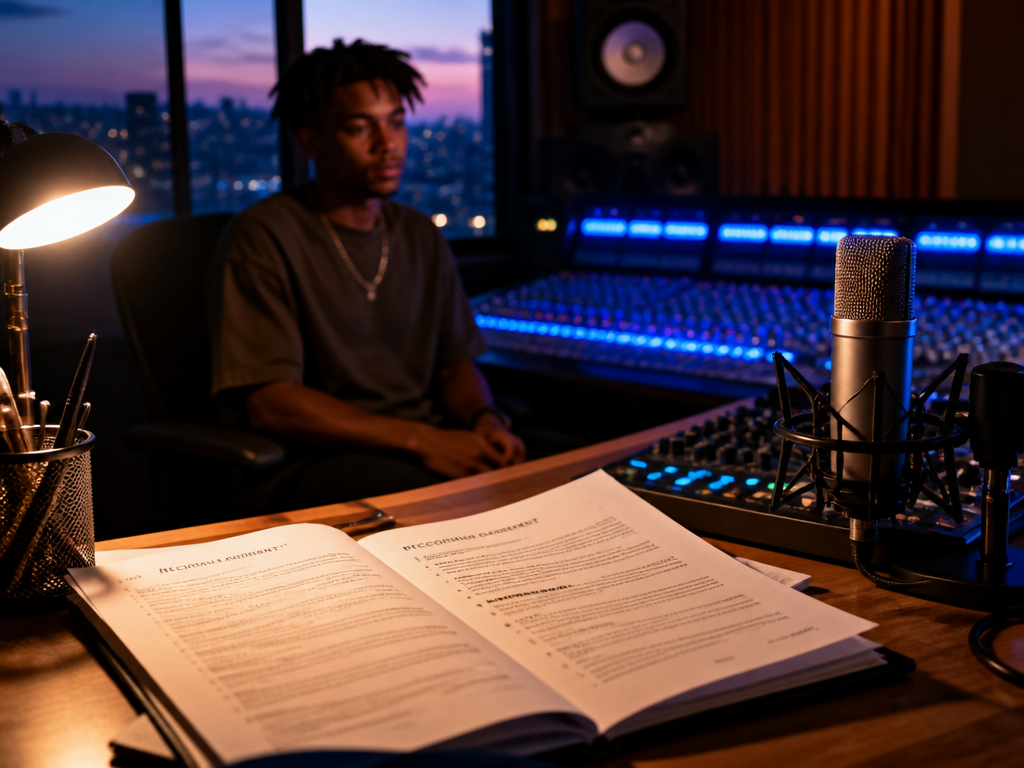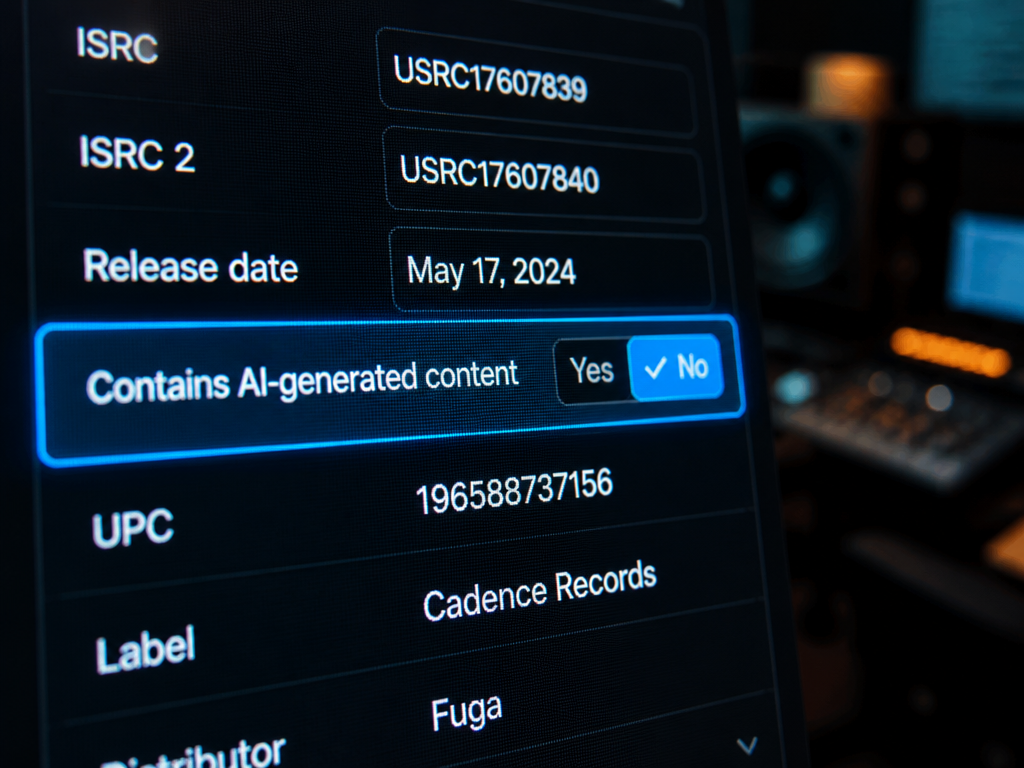
A producer in Katutura finishes a beat at 2am — an 84 BPM amapiano-adjacent thing, log-drum bassline, a vocal chop he built from a session singer's take run through a pitch tool. He exports a 48kHz WAV, hands it to his distributor, and somewhere in the delivery file there is now a field he did not have to think about a year ago: a yes/no on whether generative AI touched this track. That single flag is what AI music labeling comes down to. Not a courtroom, not a verdict on your creativity — a metadata checkbox that travels with your song into every streaming platform on earth.
For Namibian artists, composers, and rights holders, the honest question is not whether this is good or bad. It is: what does the label actually do, step by step, once you deliver? Because the way it moves through the system — from your export to your royalty statement — determines whether it protects you or quietly disadvantages you.
What AI music labeling actually is
It is a disclosure flag, not a copyright ruling. When you or your distributor deliver a track, you now indicate whether generative AI was used in making it, and to what degree. The flag rides along in the same metadata that already carries your ISRC, your songwriter splits, and your release date. Global industry bodies have pushed for this to become standard across streaming services, so that a listener — and a platform — can tell a fully machine-generated track from a human recording, with a middle category for songs that used AI as one tool among many.
That middle category is where most working producers actually live, and it is where the whole system gets slippery.
First: the disclosure, and the line nobody can draw cleanly
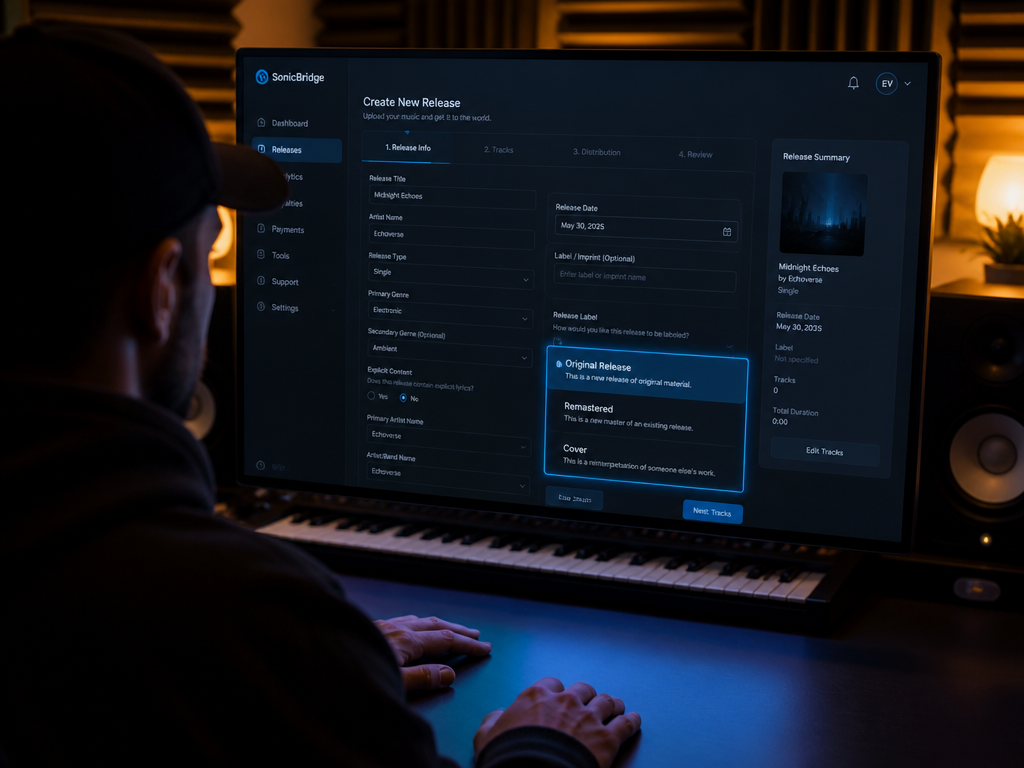
The mechanism starts with you. Before a track goes out, someone decides which bucket it falls into. Roughly three exist:
- Fully AI-generated — a text prompt produced the music, top to bottom.
- AI-assisted — you used AI for part of it: a generated pad under a live bass, a vocal cleaned or harmonized by a model, a drum loop prompted then chopped by hand.
- No generative AI — traditional recording and production, even if you used ordinary digital tools.
The line between the second and third bucket is not sharp, and pretending it is would be dishonest. Is auto-tune generative AI? Almost nobody says so. Is a mastering assistant that reshapes your EQ with a trained model? Grey. Is a bassline you prompted, kept, and never touched again? That one is clearly AI-assisted, arguably more.
The system asks you to self-declare across a spectrum that has no agreed midpoint. That is the first place things go wrong — not through bad faith, but because two honest producers will label the same workflow differently. If you run a label or publish for other writers, this is worth a written internal policy now, before a distributor's default setting makes the choice for you.
Next: the flag propagates, and the listener may never see it
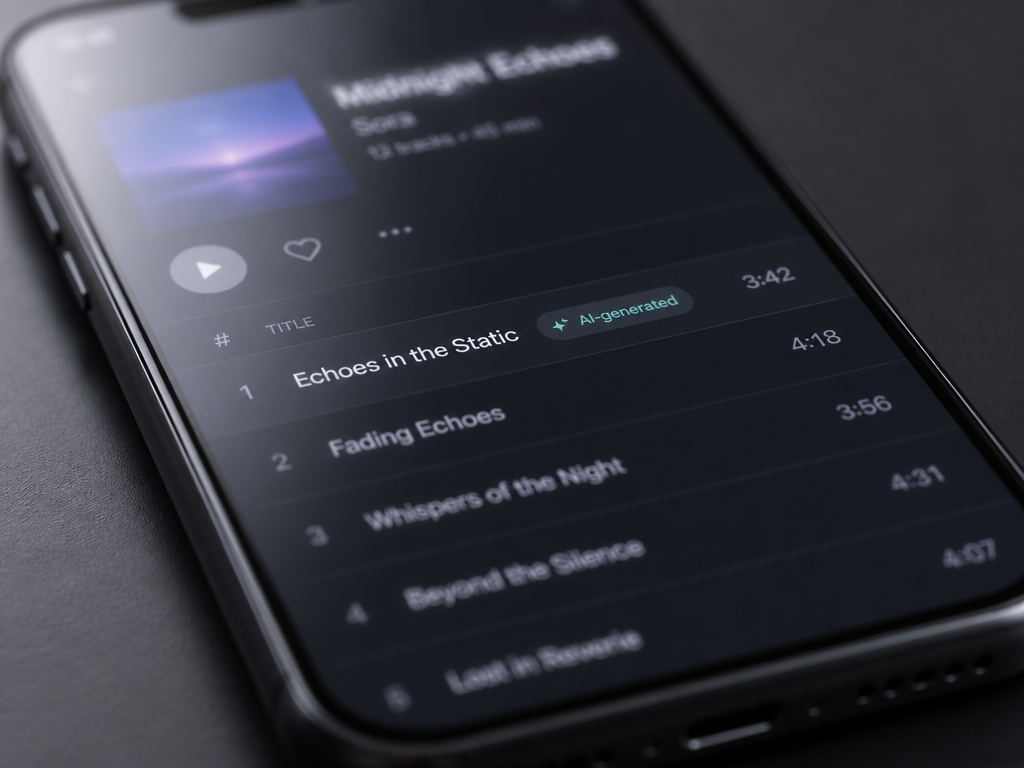
Once you deliver, the label moves into the platforms. Here the reader should temper expectations. A metadata flag is not the same as a badge on the now-playing screen. Some services have signaled they will surface AI disclosure to listeners; others treat it as back-end data used for filtering, recommendation, or removing spam uploads. As of writing, there is no single universal display, and the way each platform handles the tag varies and keeps changing.
What that means practically: the flag's first real audience is not fans. It is the platform's own systems — the ones deciding what gets recommended, what gets flagged as low-effort mass upload, and eventually, what gets paid. Streaming services have been vocal about the flood of fully generated tracks diluting the royalty pool. A reliable AI label is, from their side, a filter. Whether that filter ever helps or hurts a specific Namibian artist depends on how the platform weights it — and they are not obligated to tell you.
Then: what the label does to your rights (and what it doesn't)
This is the part that gets misread, so be precise: an AI label does not register, grant, or revoke copyright. It sits beside your rights metadata; it does not decide it.

But it interacts with authorship in ways worth understanding. In most jurisdictions, copyright protection attaches to human authorship. Purely machine-generated output, with no meaningful human creative input, sits on unstable ground for protection in several territories — and the details differ by country and are still being litigated globally. Namibia's own framework, and the way local collecting bodies handle AI-touched works, is still forming. Nothing here is settled law, and anyone who tells you it is settled is selling something.
So the label matters less as a legal instrument and more as a record of what you claim you did. If a dispute ever arises — over a split, a sync license, a sample of your voice used to train something — the disclosure you filed becomes part of the paper trail. Label a fully generated track as human-made, and you have created a contradiction that a rights administrator or platform can hold against you later. Label an AI-assisted track honestly, and you have a defensible position: humans made creative decisions here, and here is the disclosure to match.
The authenticity conversation, in other words, is not only artistic. It is administrative. Your credibility as a rights holder now includes whether your labels match your workflow.
Last: the market sorts, and emerging artists carry the risk
At the end of the chain, the market reacts — and this is where the local stakes get real.
The optimistic read is legitimate: labeling rewards human artistry as a signal. If listeners and platforms can distinguish a produced record from a prompt, then the craft that a Namibian gospel arranger or a live kwaito band brings becomes a mark of value, not a cost to be automated away. Some artists genuinely see the tool this way — as a new instrument in the studio, disclosed and used with taste, expanding what a small budget can produce.
The wary read is equally legitimate, and it lands hardest on emerging artists. The models generating the flood of tracks were trained on human music, much of it uncleared, and the volume they produce competes for the same finite royalty pool and the same playlist slots. A new artist without catalog, without a label's marketing, is competing not only with peers but with an effectively infinite supply of cheap, disclosed-or-not machine output. Labeling helps sort that supply. It does not shrink it.
Both things are true at once. The system is not a rescue and not a threat — it is a sorting mechanism, and where you land depends on decisions you make before you ever click export.
Before you deliver a track: a working checklist
For Namibian artists, composers, and rights holders, do this per release:
- Decide your bucket honestly — generated, assisted, or none. If you used a generative model for any kept musical element, "assisted" is the safe, defensible answer.
- Write down what the AI did — "prompted the pad texture, replayed by hand" or "vocal harmony generated." Keep it with your session files. This is your paper trail.
- Check your distributor's default — some flag everything, some flag nothing. Know which, and override it if it's wrong for your track.
- Keep your stems and project file — 48kHz WAV stems plus the DAW session are the strongest evidence of human authorship if a dispute ever comes.
- Confirm any voice or sample clearances separately — the AI label does not clear a session singer's take or a sampled recording. Those are their own agreements.
- Match your label to your copyright claim — never register full human authorship on a track you've flagged as fully AI-generated. The contradiction can be used against you.
None of this requires a lawyer to start. It requires a habit.
Back to the checkbox
That single flag in the 2am producer's delivery file is not the courtroom he might fear, and not the protection he might hope for. It is a checkbox that follows his log-drum beat into every platform on earth, quietly telling machines and, eventually, listeners what he claims he did. The system will not decide whether his music is authentic. It will only record whether he was honest about how he made it — and in a market about to be flooded with everything a prompt can produce, that record may be the most valuable line of metadata he owns.
Not sure which tool to use?
Compare the top AI music and sound tools side by side — honest reviews, real pricing, no sponsorships.