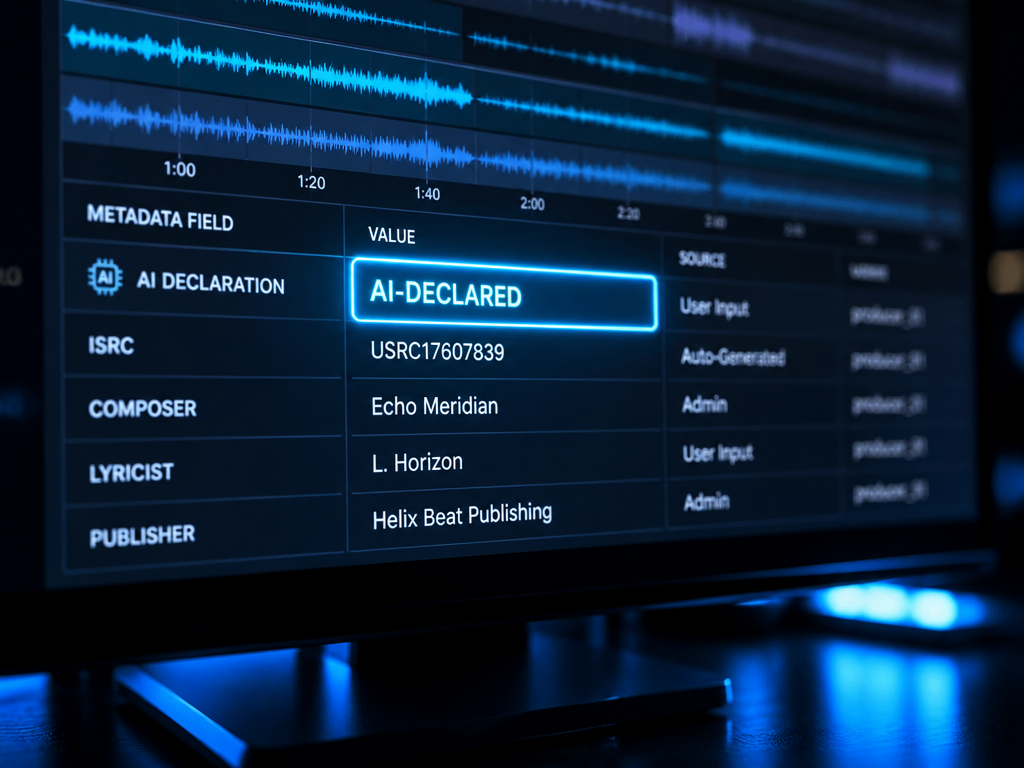
A track lands on a streaming service. Somewhere in its metadata sits a flag: this was made with AI, or this was made by a human. You would assume that flag was earned — that a detector listened to the audio, found the tells, and stamped it. Mostly, it wasn't. Most of the time, that label exists because the person who uploaded the file said so.
That is the thing to understand before anyone in this business spends another meeting on AI music labeling standards: the emerging framework is a disclosure system, not a detection system. It documents what you tell it. The industry is converging on a shared vocabulary for declaring how a song was made — and the coordinated push from trade bodies and platforms is real — but the label on the track and the truth about the track are two different measurements, and the gap between them is where every stakeholder is going to spend the next few years.
What the standard actually is
Strip away the announcements and the shape is simple. A cross-industry coalition — the major recording-industry federations plus a stack of platforms and distributors — has been aligning on a way to tag recordings by their relationship to generative AI. The taxonomy that keeps surfacing is a two-tier one: on one side, work created substantially by people; on the other, work where generative tools did meaningful compositional or performance work. The declaration rides in the metadata alongside the ISRC, the credits, the territory rights.
Three features matter more than the label names, and they rarely make the headline.
- It is voluntary. No statute compels it. Platforms adopt it because they want it, distributors pass it through, and the coalition sets the shared format. Compliance is a business decision, not a legal one — as of writing.
- It is self-declared at the source. The uploader — you, your distributor, or your label's supply-chain team — states the AI status. The platform stores and displays it.
- It is a spectrum problem crammed into categories. Almost nothing is fully one or the other. You wrote the topline, an AI stretched the pad, a stem-separator cleaned the drums, a mastering model touched the ceiling. Which box is that.
That last point is the whole story. The standard asks a binary-ish question of a process that is a gradient.
What the platforms actually check
Here is the part people conflate. Disclosure and detection are separate machines, and only some platforms run the second one.
Detection is a classifier trained to hear the statistical fingerprints of generative audio — the smearing in transients, the uncanny evenness of a rendered vocal, artifacts in the high frequencies where a diffusion model guessed. Some services report high accuracy on their internal test sets, and a few have publicly flagged that a striking share of daily uploads trip their detector. Those numbers are real and they are also lab numbers: measured against the material the classifier was tuned on, in the window it was measured.
Put a detector against tomorrow's model and the accuracy is unknown, because the thing it learned to recognize just changed. This is an adversarial setup. Every improvement in generation quality is, by definition, a degradation in the detector's job. A classifier that nails last year's renders can wave through this year's cleaner ones and, worse, can flag a human musician whose lo-fi bounce happens to share texture with a machine.
So the honest description of the stack is: a self-declared label that travels with the file, sometimes cross-checked by a detector that is confident about the past and guessing about the future. When those two disagree — you declared human, the classifier says otherwise — the dispute process, not the science, decides what appears next to your track.

The gap nobody labels
Consider the failure modes, because they land on different people.
A false positive hits the human artist hardest. A bedroom producer bounces a detuned analog bassline under a broken 808, uploads it as human work, and a classifier flags the render for its digital cleanliness. Now the burden of proof is on the person with the least infrastructure to carry it — no session files organized, no legal team, no appeal template.
A false negative hits the platform's credibility. Fully synthetic work sails through undeclared because the uploader stayed quiet and the detector missed. The label says human. It lied, and nobody caught it.
And the middle — the gradient case — hits everyone. There is still no shared line for how much machine assistance flips a track from one tier to the other. Is a generated pad in a human composition disclosable. Is an AI mastering pass. Is a vocal you sang and a model pitch-corrected past recognition. The standard names the buckets; it does not yet tell you which bucket the messy real work belongs in.
What to declare before you upload
Until the definitions harden, treat disclosure as a paperwork discipline, not a moral test. Keep the receipts and answer the question your distributor asks in the form.
| Element of the track | Usually reads as | Worth flagging |
|---|---|---|
| Full generative render (prompt to master) | AI-created | Yes, clearly |
| AI-generated melody or vocal you built on | Gradient | Yes, note the tool |
| Stem separation / cleanup on your own recording | Human | Keep the source files |
| AI mastering or mix assistance | Human, mostly | Depends on platform terms |
| Session written and performed by people | Human | Keep dated project files |
Two habits protect you regardless of where the definitions settle:
- Save the provenance. Dated project files, prompt logs, and stems are your appeal if a detector flags you. If you can play the isolated performance, you can contest the label.
- Read your distributor's specific declaration field. The coalition sets a shared format; each platform's form asks it in its own words. When you're moving fast and need original beds that won't trip a clearance or a classifier, a tool like City of Punk gives you a declarable, commercially-safe origin trail — but the point stands with any source: know what you're declaring and be able to prove it.
Who carries the burden
Voluntary standards distribute cost unevenly. A label with a rights team folds AI declaration into an existing metadata pipeline and moves on. The DIY artist inherits a new step, a new failure mode, and — if a classifier disagrees — a dispute they have to fight alone. The system rewards whoever already has infrastructure, which is the quiet default of most industry self-regulation.
None of this makes the effort pointless. A shared vocabulary beats twelve platforms inventing twelve incompatible flags, and listeners asking how a record was made deserve an answer that means something across services. The coalition is doing real, useful coordination work.
But the label is a claim, not a verdict, and it will stay that way until one question gets answered: can any detector reliably distinguish human from machine when the machines are trained specifically to close the distance — or are we building a transparency system on top of a measurement that erodes a little more with every model release?
Not sure which tool to use?
Compare the top AI music and sound tools side by side — honest reviews, real pricing, no sponsorships.