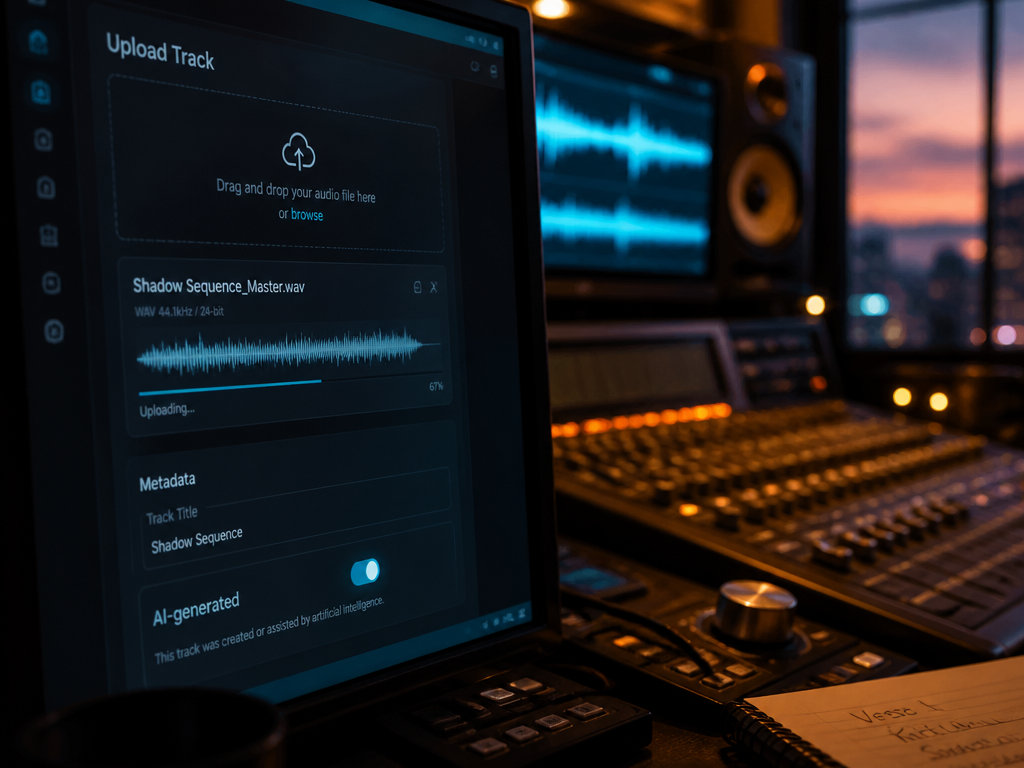
The pitch is seductive because it is simple: put a tag on the track, and the listener knows what they are hearing. A little badge — "made with AI," or "AI-generated" — sitting next to the play button the way an explicit-lyrics marker does now. Problem named, problem solved. That is the story the industry has started telling itself about generative AI labeling, and it is worth pulling on the thread before the whole sweater becomes policy.
Here is the verdict up front: labeling is a provenance signal, not an authenticity guarantee or a quality filter, and because the current models lean on voluntary self-declaration, a label tells you what an uploader was willing to admit — not what actually happened in the session. That is genuinely useful. It is also much narrower than the reassurance being sold on top of it.
How the field came to believe a tag would fix it
Rewind a few years. The first instinct, when generative models started producing listenable audio, was technical. Detect it. Fingerprint it. Bake an inaudible watermark into every AI render so platforms could scan uploads and sort machine from human at the door. That belief had a specific source: it worked, sort of, in adjacent fields. Image provenance standards were maturing, and the assumption was that audio would follow.
Audio did not follow cleanly. Watermarks survive an untouched export and then quietly die the moment a track gets re-encoded, pitch-shifted, run through a limiter, or bounced out of a DAW with three human overdubs on top. Detection classifiers, meanwhile, produce false positives on heavily processed human recordings and false negatives on clean AI ones. Anyone who has tried to prove a stem's origin after it has been through a mastering chain knows the forensic trail goes cold fast.
So the field pivoted. If you cannot reliably detect it after the fact, ask the person uploading it to declare it. Coalition announcements followed — trade bodies and rights organizations lining up behind a shared, opt-in disclosure scheme rather than a single platform's private rule. The register changed from enforcement to transparency, and that shift is the quiet part. Transparency is a lovely word that also means "we are trusting the uploader to tell the truth."
The belief that hardened into consensus — a label will restore listener trust — has a real source. But the source is thinner than the belief. It rests on the assumption that the people flooding catalogs with synthetic tracks will voluntarily flag them, and on the further assumption that listeners parse a small badge the way policymakers imagine they do.
The line that carries all the weight
Every serious version of this scheme depends on one distinction: AI-generated versus AI-assisted. Fully synthetic — prompt in, finished track out, no human performance — gets one label. A human songwriter who used a model to sketch a string arrangement, or an engineer who cleaned up a vocal with an AI de-noiser, gets a different label or none at all.
That line sounds crisp. In a working session it is mud.
Consider a plausible Tuesday. You write a chord progression in A minor at 92 BPM, hum a topline, then feed the whole thing to a model that returns a fuller arrangement — drums, a detuned Rhodes, a sub bass. You keep the bass, replace the drums with your own samples, resing the topline yourself, and generate three alternate bridges before writing a fourth by hand. Which label is honest? The song is neither "AI-generated" in the disposable sense nor "human-made" in the way that phrase used to mean. It is a collaboration with a very fast, tasteless intern.
The taxonomy assumes creation happens in one of two rooms. Real production happens in the hallway between them, and it is getting more crowded. Any labeling regime that forces a spectrum into two or three buckets will misdescribe the majority of interesting work — the work made by people who treat these tools as instruments rather than vending machines.
What sits under the label
Strip the announcements down and here is the machinery, as it stands at the time of writing:
- Disclosure is self-reported. The uploader picks the tag. There is no independent audit of the claim at ingest.
- There is no robust verification layer. No watermark survives the workflow reliably, so nothing checks the declaration against the file.
- Enforcement is a downstream question. Consequences for a wrong or absent label — takedown, demotion, payout adjustment — live in each platform's terms, not in the labeling standard itself, and those terms vary and change.
None of this makes labeling worthless. A self-declared metadata field is still information, and honest actors will use it honestly. Session musicians and small labels who want to be legible about their process finally have a place to say so. That is a real gain for the people who were never the problem.
The problem is the actor who uploads a thousand tracks a week and has every incentive to leave the field blank or lie in it. Against that actor, a voluntary tag is a sign on an unlocked door. The scale numbers that keep surfacing — the claims that enormous fractions of daily uploads to some services are wholly synthetic — describe volume produced by exactly the people least likely to self-report.
What it changes for you, depending on who you are
If you are a listener or a platform user: a label may eventually help you filter, the way you filter by genre. Do not read the absence of a label as proof of human hands. Absence means nothing was declared, which is not the same as nothing to declare.
If you are an independent artist: the upside is real but defensive. Labeling your own AI-assisted work protects you from later accusations and lets you compete on honesty. The downside is a taxonomy that may flatten a nuanced hybrid process into a scarlet letter. Read each platform's definitions before you tick a box; "AI-assisted" on one service may cover a de-noiser, on another only full generation.
If you are a label executive: treat labeling as a trust instrument for your catalog, not a moat against the flood. It documents your artists' integrity. It does not, on its own, stop synthetic volume from diluting the royalty pool your artists draw from. That fight is about payout rules and ingest gates, which are separate levers.
Who this helps, who should not lean on it
Labeling helps honest creators signal, helps platforms offer preference filters, and gives the industry a shared vocabulary. It should not be leaned on by anyone hoping it will authenticate a catalog, price out bad-faith uploaders, or answer the question "was a human involved" with any confidence. It answers a different, smaller question: "did someone say a human was involved."
That smaller question is still worth asking. Just don't mistake the answer for the one you wanted.
The myth: a generative AI label tells you whether the music you are hearing is real. The more accurate version: a generative AI label tells you whether someone was willing to say it was not.
Not sure which tool to use?
Compare the top AI music and sound tools side by side — honest reviews, real pricing, no sponsorships.