The most important AI-music copyright fight of the year is not in Brussels, and it is not in a US federal courtroom. It is a draft bill in Jakarta that, as of writing, has no passage timeline, contains at least one provision its own drafters have not defined, and may look nothing like this by the time it becomes law. You should read it now anyway. The Indonesia copyright reform effort is the clearest signal yet of where the next decade of platform licensing strategy gets decided — not because it will be enforced cleanly, but because it is forcing every question the mature markets have been politely deferring.
I spend most of my working life on the production side — stems, tempo maps, adaptive loops for game builds. But if you administer rights or track policy for a platform or a rightsholder, the draft coming out of Indonesia should be sitting open in a tab, because it does something the EU AI Act and the US case law have mostly avoided: it tries to write generative AI directly into the copyright statute, and it tries to protect a creator's style and voice as things a machine cannot lawfully imitate. That is a much bigger swing than a training-data disclosure rule. Whether the swing connects is a separate question, and most of this piece is about that separation.
What the draft actually proposes
Reporting on the draft (via Reuters) describes a rewrite of Indonesia's copyright law that would extend protection in two directions at once. First, it would restrict AI systems from reproducing or imitating a creator's distinctive artistic character without authorization — the sound, the identifiable signature, not solely a specific recording. Second, it would treat unauthorized voice cloning as an infringement of the person whose voice was captured.
Both provisions matter to anyone licensing a music catalog, and they matter in different ways.
A ban on reproducing a specific copyrighted work is old news; that is what copyright already does everywhere. A restriction on imitating a style is a different animal. Style has historically sat outside copyright's reach almost everywhere — you cannot copyright a genre, a groove, a production aesthetic, the particular way a vocalist bends a note. That has been a load-bearing assumption of the entire music business. Cover bands, soundalike production libraries, "in the style of" briefs handed to session players — all of it lives in the space copyright leaves open. If Indonesia writes a style-imitation restriction into statute, it is not extending an existing right into new technology. It is inventing a new boundary and pointing it at AI systems specifically.
The voice-cloning provision is more legible, because it tracks a right that other jurisdictions are already reaching for through publicity and personality law rather than copyright. Tools that can capture a vocal timbre from a short sample and re-sing arbitrary lyrics — the category that put Suno and its peers in front of the RIAA's lawyers — are the obvious target. Treating that capture as an infringement of the voice's owner is aggressive, but it is at least aimed at a describable harm.
The third piece, and the one platform licensing teams will care about most, concerns training data. The draft moves toward requiring authorization for the material AI systems learn from. The details available at this stage are thin, and I am not going to pretend a firm licensing mechanism exists in the text when it does not. But the direction is unambiguous: consent to train, not consent-after-the-fact to remove.
The undefined center of the whole thing
Here is where the draft earns both its interest and its skepticism. It reportedly leans on a "human-involvement test" to decide what gets protection and what does not — and the test is not defined.
That is not a footnote. It is the hinge. Every generative-AI copyright regime on earth runs into the same wall: at what point does human contribution turn machine output into an authored work? The US Copyright Office has answered with a case-by-case posture that denies registration to purely machine-generated material and grants it where human authorship is meaningful — leaving "meaningful" to litigation. The EU frames authorship around the author's own intellectual creation, a human-centered standard that predates generative models and was not built for them. Nobody has a crisp, administrable line, because nobody can locate one that survives contact with actual production workflows.
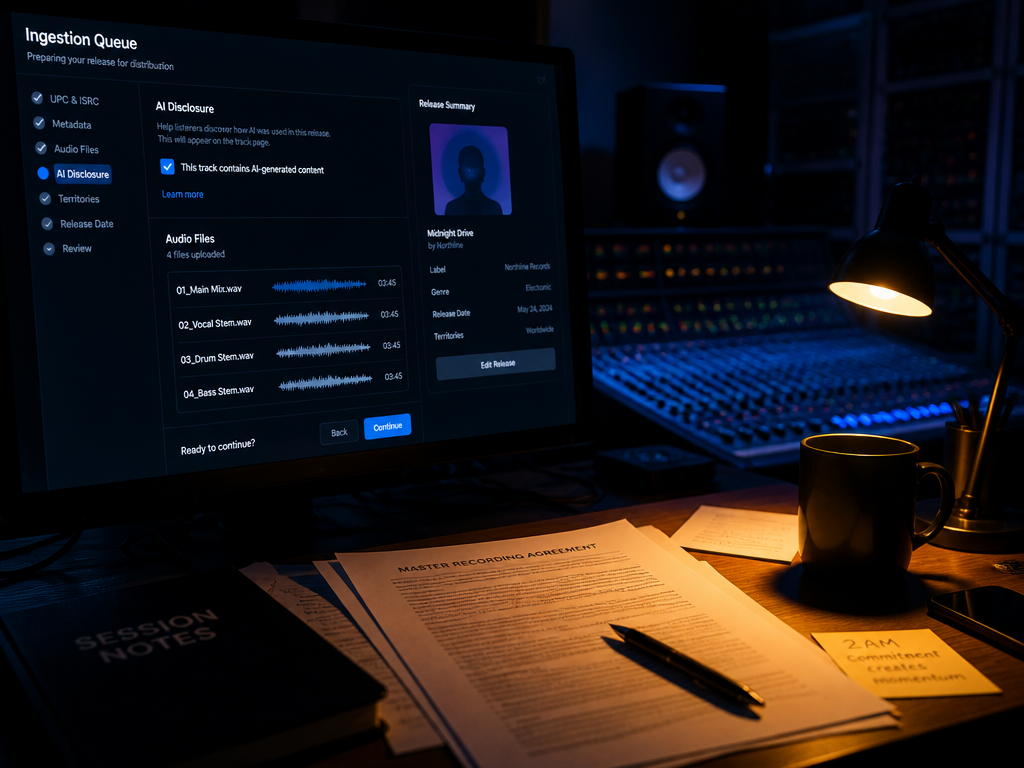
Think about what a real session looks like. You write a prompt, reject nine renders, keep the tenth, chop it into stems, replace the bass with a real take, re-pitch the vocal, re-time the drums against a 92 BPM grid, and bounce a 48kHz WAV. Where on that chain does "human involvement" cross the threshold? An undefined test means a regulator, or a court, decides after the fact — which is precisely the uncertainty that makes rights administrators nervous and platform lawyers cautious. Indonesia has not solved the authorship problem. It has named it and left a blank where the answer goes. That is honest, in a way, and completely unworkable until the blank is filled.

For a policy analyst, this is the most useful thing to extract: the drafting stage tells you what a jurisdiction wants the answer to be before the compromises set in. Indonesia wants human creators protected against machine substitution. The gap tells you they have not figured out how to say it in language an examiner can apply.
The pushback, taken seriously
Google has publicly opposed the direction, and its objection deserves to be read as more than corporate positioning, even if it is also that. The core of the industry argument is that broad, rigid mandates against imitation risk sweeping up legitimate research, transformative use, and the ordinary way machine-learning systems generalize from data. A model that has learned from a wide corpus does not store and replay styles the way a plagiarist copies a paragraph; it interpolates. A statute that treats "imitating a style" as infringement has to define imitation in a way that separates a genuine soundalike clone from a model that produces lo-fi hip-hop because lo-fi hip-hop is a well-populated region of its training distribution. The draft, at this stage, does not draw that line.
The creator-side argument is equally real and should not be waved off as sentiment. If a platform can capture a working vocalist's timbre and generate an endless supply of songs in their voice, the vocalist's market — session work, features, sync — erodes without a single copyrighted recording being copied. Existing copyright, built around the work rather than the person, does not obviously reach that harm. The Indonesian draft is one of the first statutory attempts to reach it directly rather than through the patchwork of publicity rights.
Both positions can be true at once: the harm to creators is real, and the proposed instrument is blunt enough to catch things it should not. Reserving judgment here is not fence-sitting. It is the accurate read of a document that has not been refined.
Where Indonesia sits on the map
The reason this draft matters beyond Indonesia is harmonization — or the conspicuous lack of it. Rights administrators are trying to build licensing strategies that hold across borders, and the borders are diverging fast on exactly the questions Indonesia is now poking.
| Jurisdiction | Text-and-data-mining / training posture | Machine-output authorship | Style / voice as a protected interest |
|---|---|---|---|
| Indonesia (draft, as of writing) | Moving toward authorization required for training data | "Human-involvement test," currently undefined | Draft would restrict style imitation and unauthorized voice cloning |
| Singapore | Broad computational-analysis exception, hard to contract around | Follows conventional human-authorship principles | No dedicated style/voice statute in copyright |
| Japan | Permissive training exception, long treated as pro-development | Human authorship required for copyright | Voice and likeness handled largely outside copyright |
| EU | TDM exceptions with a rightsholder opt-out; AI Act adds transparency duties | Author's own intellectual creation — human-centered | No harmonized style right; personality protections vary by member state |
| United States | No statutory TDM exception; fair use argued case by case | Purely machine-generated works not registrable | Style not copyrightable; voice via state publicity law and emerging bills |
| United Kingdom | TDM debate unresolved after a contested reform attempt | Special provision for computer-generated works, contested in the AI era | Style not copyrightable; passing-off and image rights partial |
Read the columns, not the rows. On training data, the world splits between permission-first regimes (where Indonesia's draft is heading) and permission-optional regimes (Singapore, Japan) that were designed to attract AI development. On authorship, almost everyone requires a human somewhere, and almost nobody has defined how much. On style and voice, Indonesia's draft is close to alone in trying to write a bright new protection into copyright itself rather than borrowing publicity or personality law.
That divergence is the whole story for platform licensing. A model trained lawfully in Japan or Singapore may be built on a corpus that Indonesia's draft would say required authorization. The output that model generates may then be distributed globally. Harmonization is the assumption that a rights position established in one place travels. These rules are quietly making that assumption false.
What it does to platform licensing strategy
If you run licensing for a platform, a style-imitation restriction changes the shape of the risk you are pricing. Today, most catalog licensing is organized around works and recordings: you clear the master, you clear the composition, you account per stream or per use. A statutory style right introduces a category that no existing license covers, because no existing license needed to. You cannot clear "the sound of this artist" in a standard sync agreement, because that was never a thing you had to acquire — it was free.
Three responses are available, and platforms will split among them.
- Comply and re-paper. Build licensing that explicitly acquires style and voice permissions from artists, priced as a new line. This is expensive and slow, and it presumes artists and their representatives will agree on what a "style license" even is. But it is the only path that treats the Indonesian direction as durable rather than as a nuisance to route around.
- Geofence. Restrict certain generation features or certain output categories in the jurisdiction, the way streaming catalogs already vary by territory. Technically feasible, commercially awkward, and it concedes that the feature was legally fragile to begin with.
- Exit or under-invest. Treat the market as not worth the compliance cost. This is the outcome creator advocates fear and tech firms sometimes threaten, and it is a real possibility for smaller markets — which is one reason the enforcement question below matters so much.

None of these is free, and the choice between them turns almost entirely on whether the draft acquires teeth. Which brings us to the part nobody in the press release wants to dwell on.
The enforcement problem is the actual story
A statute is a promise about behavior. Enforcement is whether the promise binds. On that, the honest assessment is: unknown, and probably harder than the text implies.
Consider what enforcing a style-imitation ban requires. Someone has to detect the imitation, attribute it to a specific system, prove the imitation was unauthorized, and establish that what was imitated is protectable style rather than unprotectable genre. Every one of those steps is contested terrain even for well-resourced regulators, and Indonesia would be attempting them against globally distributed models whose training and generation may happen entirely offshore. A voice-cloning claim is more tractable because the harmed party can often identify their own voice — but the tool that made the clone may be operated from a jurisdiction with a permissive training regime and no interest in cooperating.
There is also the matter of what the draft is bundled with. Reporting indicates the reform pairs new AI restrictions with a broader push on piracy enforcement — the familiar carrot-and-stick posture where a government offers rightsholders stronger protection while also promising to clean up the unlicensed distribution that has long eaten into the same market. That pairing tells you the reform is as much about the domestic creative economy and its long-standing piracy problem as it is about frontier AI policy. It is a coherent political package. It is not, on its face, evidence that the AI provisions come with the investigative capacity to make them real.
So the counterintuitive claim I opened with holds. This draft matters not because it will be cleanly enforced — there is little reason yet to believe it will — but because it is the first serious attempt to encode protections the mature markets keep gesturing at and declining to write down. It is a stalking horse for the arguments everyone else is going to have. When the EU or a US state next reaches for a voice right or a style protection, the drafting problems Indonesia is hitting now — the undefined human test, the style-versus-genre line, the offshore-model gap — will be the same problems, and someone will point back to Jakarta and say, look, this is where the questions got asked out loud first.
Who should be watching, and who can wait
If you administer a catalog with meaningful exposure in Southeast Asia, or you set generation-feature policy for a platform that operates there, this is not a someday concern; the consultation process is where the definitions get made, and definitions made now shape everything downstream. If you are a rights administrator in a market with no near-term Indonesian exposure, you can treat this as intelligence rather than compliance — but read it as a preview of the arguments coming to your jurisdiction, not as a distant curiosity.
Who can genuinely wait: anyone whose licensing is purely about specific master and composition clearances with no generative-AI feature and no voice-model exposure. The style and voice provisions are aimed at a category of tool you may not touch. Do not build a compliance program around a draft that could be redrawn. Build a monitoring habit instead.
And be honest about the limits of prediction here. The draft may narrow the style provision to something closer to a soundalike test. It may define human involvement in a way that tracks the US case-by-case posture, or it may leave it deliberately vague and hand the problem to courts. It may pass in a year, or stall for several. Any confident forecast about the final text is a forecast about Indonesian legislative politics, which is not the expertise most of us reading this actually have.
One thing to do this week
Pick a single artist in your catalog with a genuinely distinctive, identifiable sound — the kind a soundalike brief would target. Write one plain-language memo, two pages at most, answering three questions: (1) Does any current license you hold acquire rights to that artist's style or voice as distinct from their works and recordings? (2) If a style or voice right became enforceable in a market you operate in, which of your existing agreements would need renegotiation? (3) Who at your organization would even own that renegotiation?
You will almost certainly find the answer to (1) is "no, because we never had to," and that is the whole point. The Indonesia copyright reform draft is a bet that "we never had to" is ending. You do not need to believe the bet pays off to spend two pages finding out how exposed you would be if it did.
The regimes that win the next decade will not be the ones with the boldest statutes. They will be the ones whose definitions survive a working session.
Not sure which tool to use?
Compare the top AI music and sound tools side by side — honest reviews, real pricing, no sponsorships.