The advice you have heard is simple: you can always tell when a track is AI-generated music. Something in the voice will crack the wrong way, the lyrics will read like a horoscope, the artist will have no tour dates and no baby photos, and your ear will catch the seam. Trust your ear, the advice goes, and the fakes sort themselves out.
That advice is roughly right, which is exactly why it is dangerous. It works often enough to make you confident, and then it fails on the one track that mattered — the one that charted, got a sync placement, and racked up eight figures of streams before anyone asked who made it. This is a piece about where the usual tells hold up, where they quietly break, and what a more honest rule looks like for a listener who cares about authenticity.
The most common question, answered plainly
Can you reliably tell if a song was made with AI by listening to it? As of writing, no — not consistently, and the reliability is dropping. You can flag a lot of low-effort output by ear. You cannot flag the well-produced material, because a competent human now sits between the model and the master, sanding off the giveaways. The tells that survive are usually outside the audio: the release pattern, the missing human footprint, the way a "career" appears fully formed. Your ear is one instrument in the kit, and it is the one aging fastest.
Where the old tells still work
For fully synthetic, low-polish tracks, the classic signals hold up well.
- Vocal artifacts. Listen at the ends of long held notes and on consonant transitions. Cheaper AI vocals get a glassy, phase-smeared quality on sustained vowels, and sibilants ("s," "t," "ch") can shimmer or double in a way real breath does not. Solo the vocal if you have a stem; the seams show louder alone.
- Lyrical mush. Prompt-generated lyrics tend toward the universally applicable — love, light, rising up, the night — with rhyme schemes that resolve too neatly and images that never anchor to one specific place, person, or hour. Nothing costs the writer anything.
- The empty footprint. No live clips, no messy early singles, no collaborators tagging back, no photos from before the "debut." A discography that arrives complete and polished, with a large back catalog dated to a narrow window, is a pattern worth noticing.
- Release velocity. A human act putting out a fully mixed track every few days, indefinitely, is doing something a human act cannot sustain. Volume that outpaces any plausible studio schedule is one of the more durable signals.
Run those four checks and you will correctly flag a huge share of the disposable, mass-uploaded material flooding streaming platforms. That is the part of the advice that is earned.
Where it breaks down
Here is the part nobody wants on the flyer: every tell above assumes the person shipping the track did no cleanup. That assumption is collapsing.
A working producer with a hybrid workflow generates a base with a model, then re-sings the weak lines themselves, comps the vocal, tunes it, re-cuts the drums, replaces the mushy synth pad with a real one, and masters it properly. What comes out is not "an AI song" or "a human song." It is a human record with AI parts, the same way a record from 1998 was a human record with sampled parts. The glassy vowel is gone because someone paid attention to it. The lyrics have a real street name in them because the writer put it there.

The footprint tells break down too. Fictional personas can be given backstories, photo sets, and staged behind-the-scenes clips. And plenty of AI-generated music now rides under the name of real, living artists who license their sound or lean into the tools openly, which means "this artist exists" no longer means "this performance was sung."
So the honest position is not "AI music sounds fake." It is: unpolished AI sounds fake, and polish is cheap and getting cheaper.
The metric trap
This is where fans reaching for authenticity get burned worst, because the evidence they grab proves the opposite of what they think.
The instinct is to treat commercial performance as a verdict. It charted, so it must be real; it has forty million streams, so real people must love it; a major playlist added it, so a human curator vouched. None of those follow.
- Stream counts measure plays, not humans, and not enthusiasm. They are the most gameable number in the industry and were being inflated by bot farms long before generative audio existed.
- Chart position reflects a formula — streams, sales, sometimes radio, weighted and thresholded. A coordinated release strategy can move that formula regardless of who or what made the sound.
- Playlist adds, including editorial ones, are increasingly algorithm-assisted. "A curator chose this" is not the guarantee it reads as.
The uncomfortable takeaway: a viral metric tells you a track was distributed and consumed effectively. It tells you almost nothing about how it was made. Using chart success as proof of human authorship is using a marketing number to answer a production question. They are not the same question, and the people gaming the metrics know it.
A field guide that admits its own limits
Here is what to actually check, and how much weight each check deserves.
| What to check | What it suggests | Confidence |
|---|---|---|
| Sustained-vowel and sibilant artifacts | Low-polish synthetic vocal | Medium, and falling |
| Generic, place-less lyrics | Prompt-generated writing | Low — humans write filler too |
| No pre-debut footprint, complete instant catalog | Manufactured persona | Medium-high |
| Superhuman release velocity | Automated pipeline | High |
| High streams / chart position | Effective distribution only | None, for authorship |
| Label or artist disclosure | Actual authorship | Highest available |
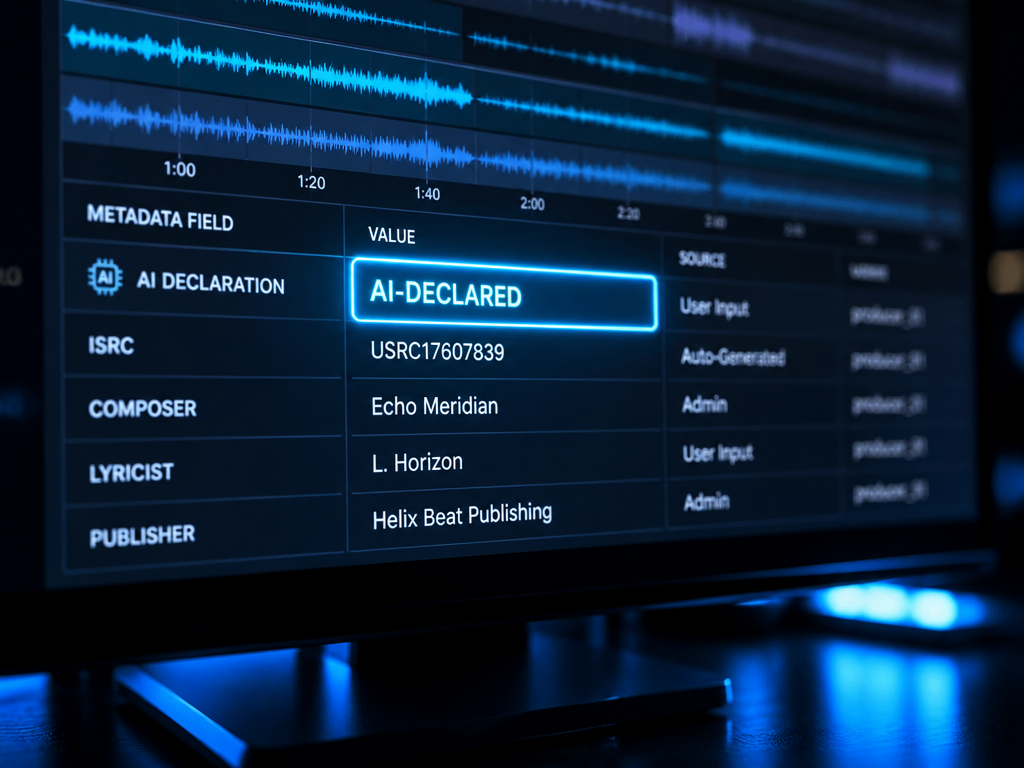
Notice the bottom row. The single most reliable signal is not in the waveform at all — it is disclosure, whether from the artist, the label, or a platform's own labeling. That is why the authenticity fight is really a transparency fight. Absent a stated credit, you are reading tea leaves, and the leaves are getting harder to read on purpose.
What the debate is actually about
Strip away the "creepy" framing and the argument underneath is about consent and credit — whose voice, whose style, whose training data, and whether the listener was told. Those are real stakes, and they do not get resolved by fans playing spot-the-robot in the comments, because that game is one the polished releases already win.
If authenticity matters to you, the move is not to sharpen your ear until it can do the impossible. It is to reward the acts that tell you what they did, to push platforms and labels toward labeling that means something, and to treat a viral number as a fact about reach, never a certificate of origin.
The myth: you can always hear which hits are AI-generated music. The truth: you can hear the lazy ones, the good ones hear you coming, and the only tell that still holds is whether someone was willing to tell you.
Not sure which tool to use?
Compare the top AI music and sound tools side by side — honest reviews, real pricing, no sponsorships.