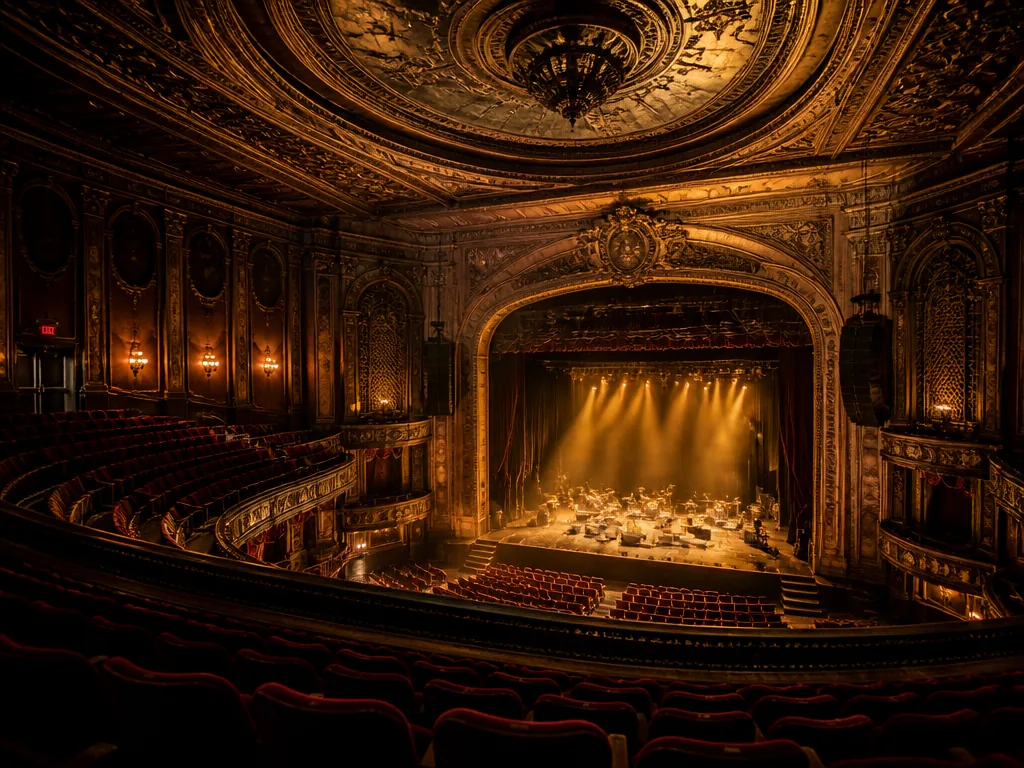
There is a persistent belief among people who model live-entertainment companies for a living: that the venue itself is the boring part. The brand has the pricing power. The promoter has the relationships. The ticketing rail has the data. The building, in this telling, is a cost center with a roof — depreciating concrete you tolerate because the shows have to happen somewhere. It is one of the more durable myths in music industry M&A, and it survives because it is half true. It also misreads why iconic venue operators keep ending up in play.
Watch the pattern in country music assets specifically. When a diversified operator that owns historic venues signals it is exploring strategic options for its entertainment arm, the headline is usually written about the brand — the radio franchise, the touring business, the festival calendar. But the reason a banker gets engaged, and the reason private equity leans in, frequently traces back to the buildings and the corporate structure wrapped around them.
Why would anyone break up a company that owns a famous venue?
The short answer analysts give is structure friction. When venue real estate sits inside a real estate investment trust, the operating businesses attached to it — live production, media, hospitality, merchandising — can be awkward tenants. REIT rules constrain how much non-qualifying income the parent can hold, which pushes higher-growth operating businesses into subsidiaries that dilute the tax efficiency the REIT exists to protect. At a certain scale, the growth of the entertainment operations starts working against the structure that houses the property.
That is the catalyst hiding in plain sight. A sale, a spin-out, or a minority stake to a financial partner is often less about disliking the asset and more about freeing the operating business to grow at a valuation multiple the parent structure caps. The venue stays iconic; the wrapper changes. For an investor evaluating the trend, the interesting signal is not "is the brand for sale" but "has the structure become a ceiling."
The evidence: venues trade on scarcity, not square footage
Generic real estate trades on comparable rents and cap rates. Iconic venues do not, because there is no comparable. You cannot build a second building with fifty years of broadcast heritage or a name that fills a room on reputation alone before a single act is booked. That scarcity shows up in the multiple.
Recent precedent in the sector points the same direction. Large financial sponsors have paid up for live-entertainment platforms — not for the depreciated concrete, but for the recurring, high-margin economics that a controlled venue lets an operator capture: ticketing, food and beverage, premium hospitality, sponsorship, and content rights. When a buyer controls the room, it controls the whole vertical inside it. That is why enterprise values on these deals routinely land well above what the property alone would fetch on a real-estate basis.
The country-music tailwind sharpens it further. Global demand for the genre and for live experiences has widened the buyer pool beyond domestic strategics to international operators and sponsor-backed platforms hunting for scaled, branded assets. A larger buyer pool is, mechanically, upward pressure on price.
The mechanism: what actually gets underwritten
Strip away the storytelling and a venue-anchored deal comes down to the quality of the cash flows the building generates and the optionality it carries. Analysts pulling apart one of these assets tend to separate the same components:
| Value driver | What it is | Why buyers pay for it |
|---|---|---|
| Owned iconic real estate | The building and its brand equity | Irreplaceable, scarcity-priced, defensible |
| Recurring in-venue economics | F&B, premium seating, hospitality | High-margin, controllable, per-cap upside |
| Content and media rights | Broadcast, catalog, licensing tied to the venue | Annuity-like, expands the addressable market |
| Booking and promotion flow | Show calendar and artist relationships | Drives utilization; harder to underwrite, more people-dependent |
| Structure optionality | Ability to move the asset out of a constrained wrapper | Unlocks multiple expansion on the growth pieces |
The building sits at the top of that table for a reason. It is the piece a competitor cannot replicate and the piece that anchors every other line beneath it. The booking flow — the part the market instinctively treats as most valuable — is actually the softest in diligence, because it depends on relationships and talent that can walk.
So the honest reframing of the myth is this: the venue is not the boring part. It is the collateral. Everything higher up the P&L is more volatile, more people-dependent, and more replicable than the room itself. When a deal gets done, the real estate is often what makes the financing work and what caps the downside if the operating business disappoints.
What this signals in a diligence process
If you are building a thesis around a venue-owning operator, a few things tend to separate the durable deal from the story that falls apart on the second earnings call.
- Utilization, not capacity. A famous room that runs dark half the calendar is a worse asset than a less-famous one booked two hundred nights a year. Ask for event-days and per-cap revenue, not seat count.
- Capex cycle position. Historic buildings carry historic maintenance. A venue mid-way through a major renovation and one that has already spent are very different cash-flow profiles. The live-events sector broadly has been in a heavy reinvestment phase, and deferred capex hides inside clean-looking margins.
- Structure friction as timing signal. When management language shifts toward operating "outside" a constraining corporate structure, that is usually the pre-deal tell — the point where a sponsor or a spin becomes the path of least resistance.
- Concentration risk. One flagship venue, one anchor franchise, one broadcast relationship. Iconic and concentrated are the same sentence from different angles.
The honest takeaway
None of this makes a venue-anchored deal a sure thing. These assets are cyclical — they get hit hardest when discretionary spending contracts, and a single bad touring year or a weather-wrecked festival season can dent a number that looked like an annuity in the deck. Pre-deal signals are also just that: an engaged banker and a strategic review produce no assurance a transaction closes, and the smart reader should treat any exploration as optionality rather than an event.
But the underlying point holds against the cycle. In music industry M&A, the buildings that seem like the least glamorous line on the balance sheet are frequently the reason the whole thing is worth buying — the scarce, financeable, downside-anchoring asset that the volatile operating businesses are stacked on top of. The market's instinct to discount the concrete is exactly the inefficiency the sophisticated buyer is pricing.
So when you next see an iconic venue operator described as exploring options, do not read the brand headline first — read the corporate structure, because the wrapper usually tells you why the asset is moving before the press release does.
Not sure which tool to use?
Compare the top AI music and sound tools side by side — honest reviews, real pricing, no sponsorships.