The most durable thing Bob Moog ever built was not a sound. It was an agreement about a voltage.
One volt, one octave. Push the control voltage feeding an oscillator up by exactly one volt and the pitch climbs twelve clean semitones. That convention is around sixty years old as of writing, and it is still the reason a module somebody stuffed on a kitchen table in Berlin last spring will track in tune with an oscillator topology from the mid-sixties. The ladder filter gets the reissues and the T-shirts. The volt is what let everyone else keep building.
It is an odd claim to make about a man whose surname is shorthand for a particular kind of fat, resonant low end. The rest of this is the work of earning it.
The circuit was not the hard part
Voltage control did not appear out of nowhere in Trumansburg, New York. Harald Bode had been building modular electronic instruments and publishing on voltage-controlled techniques before the R.A. Moog Co. shipped a synthesizer module; Moog read him, credited him, and later collaborated with him. The RCA Mark II at the Columbia-Princeton Electronic Music Center filled a room and was programmed with punched paper tape. Out west, Don Buchla was building voltage-controlled instruments in the same years, with sequencers, touch plates, and a principled refusal of the piano keyboard — a machine for composers rather than players.
Even the most-copied gesture in the entire field arrived as a request from a user. Vladimir Ussachevsky, at Columbia-Princeton, asked for an envelope generator with separate attack, decay, sustain and release stages. ADSR: four letters on the front page of every soft synth you have ever opened, four letters that began as somebody's written spec and got built to order.
What Moog added was legibility to strangers. Labelled jacks on the front panel. Published module specifications. Service manuals with full schematics, so a tech three states away could repair the instrument without phoning the factory. And a signal convention, so that a module from one bench and a module from another could agree on what a note was.
What one volt per octave actually means
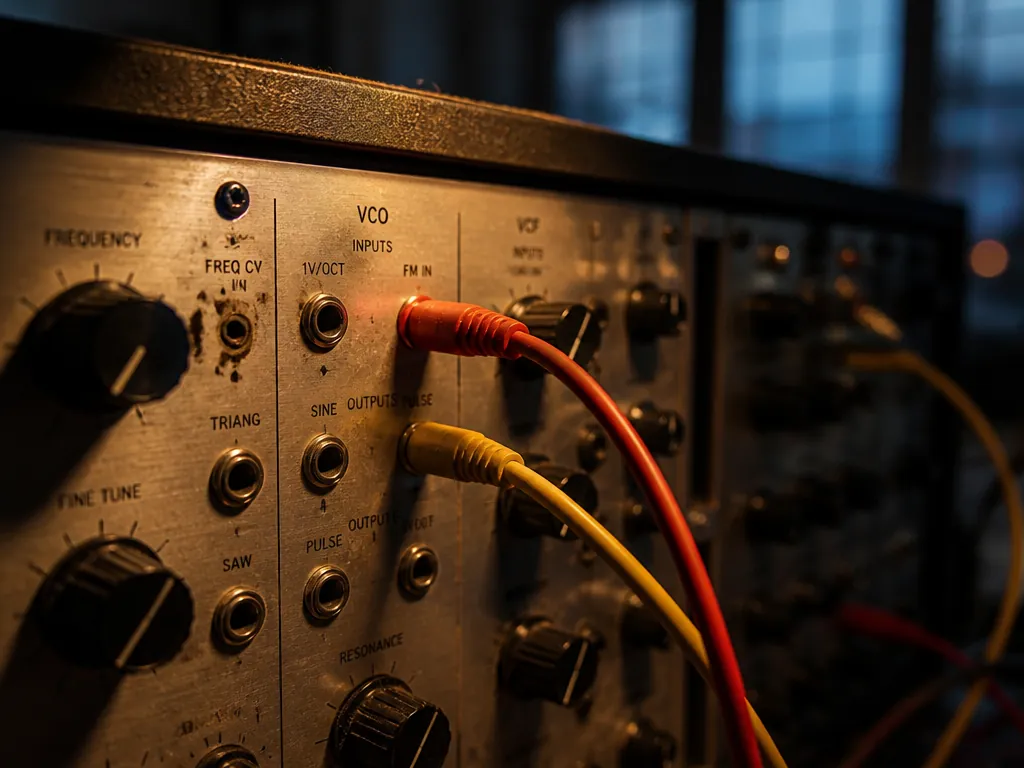
One volt per octave is a tuning agreement: raise the control voltage arriving at an oscillator by one volt and its frequency doubles. A semitone is therefore one twelfth of a volt, roughly 83 millivolts, and a five-octave keyboard spans five volts. Anything that speaks the convention — a filter tracking pitch, a quantizer, a sequencer, an envelope patched to pitch for a kick drum — connects to anything else that speaks it, with no translation layer in between.
It is not free. Pitch is exponential and control voltage is linear, so the oscillator core needs an exponential converter, and the transistor pair doing that job drifts as it warms. That is why old gear wants twenty minutes before a session, why temperature-compensating resistors live in those circuits, and why a second take sometimes comes back a few cents off the first.
Rival conventions worked too. Several Japanese instruments of the period used hertz per volt, where doubling the voltage doubles the frequency — internally consistent, and mutually unintelligible with the Moog scheme without a converter in the middle. One volt per octave did not win because the engineering was unarguably superior. It won because more instruments spoke it, and because enough had been published that other people could build things that spoke it. A standard is a social object that happens to be made of electricity.
The archive is the other half of the instrument
Which is why the paper matters as much as the walnut end cheeks. The Bob Moog Foundation, run out of Asheville by his daughter Michelle Moog-Koussa, has spent years assembling the documentary half of that career: schematics, lab notebooks, prototypes, purchase orders, photographs, and correspondence running to many thousands of pages, expanded by large transfers from the companies that have carried the Moog name since (inMusic acquired Moog Music in 2023). Cornell, where Robert Moog took his doctorate in engineering physics, has drawn on Moog material for public exhibition. The Foundation's Moogseum puts a slice of the collection in front of visitors and school groups.
The correspondence is the part a working engineer should envy. Wendy Carlos, deep in the sessions that would put this instrument into ordinary living rooms, wrote to the factory with requests and complaints — keyboard response, filter behaviour, noise — and the instruments changed in response. Read a certain way, a run of letters between a musician and a builder is a version-control history with the reasoning still attached: what somebody wanted, why they wanted it, what got changed, what got refused. That is a rarer document than a schematic, and we produce almost none of it now.
What a schematic promises that a prompt does not
Set that against an ordinary week with a text-to-music tool. You type a paragraph, get four takes, keep one, ship it. Six months later the client wants the cue extended, and the same paragraph returns something adjacent but not identical, because the model underneath moved.
| Documented instrument | Typical hosted AI music tool |
|---|---|
| Full schematic and service manual | A model name and a text box |
| Signal standard (1 V/oct, published levels) | A prompt string that means something different in every other tool |
| Same settings, same sound, next year | Output can change when the model updates |
| Repairable by a third party | Regenerable, not reproducible |
| Terms fixed in the manual you own | Terms on a page the vendor can revise |
None of that is villainy, and none of it is an argument for going back to hardware. A hosted model is a different shape of product with a different cost structure, and some vendors are genuinely working the problem: seeds you can reuse, stems you can download, 48 kHz WAV instead of a 128 kbps MP3, terms that carry a revision date. Those are the tools that survive contact with paid work. A tool that hands you a stereo MP3 and a vibe is fine for a mood board and a real exposure in a shipped game build, where somebody may ask you eighteen months from now to show what you used. (We track which tools expose what on our comparison pages, because the answers keep moving.)
The lesson from the archive is not that the old way was better. It is that documentation used to be treated as part of the instrument, and nobody is going to do that on your behalf now.
Keep your own archive
- Save stems, not only the mix. If the tool offers them, take them at delivery rate — 48 kHz WAV for video and game work, 44.1 kHz for music release.
- Write a plain text file next to the audio. Date, tool, model or version string, the exact prompt, the seed if one is exposed, sample rate. Five lines beats memory every time.
- Snapshot the licence on the day you render. Save the terms page as a PDF. Terms get revised; your delivered project does not.
- Note the tempo and key you actually used after your edit, not the ones the tool claimed on the way out.
- Keep one bounced reference mix. If you ever re-render, you can hear the drift instead of arguing about it.
The magazine that made him
His own origin is the argument in miniature. As a teenager in Queens he found plans for a theremin in a hobbyist electronics magazine and built one with his father. Then he wrote up his own version, and sold kits, and the kits came with instructions clear enough that the next teenager got to the same place faster. A person made by published documentation made publishing part of what he sold.
That loop is the thesis. The sound was the thing everybody noticed, and the sound is also the part that got cloned inside a decade — in silicon, then in software, then in models trained on the results — well enough that most listeners cannot pick the original out of a lineup. What did not get cloned, what had to be boxed, digitised, catalogued and held at stable humidity by a small nonprofit, was the record of how and why. Instruments get copied from documents. Judgement gets copied from records of decisions.
Every cue folder on my drive has a file called notes.txt, and the first five lines are always the same fields: date, tool and version, prompt, seed, sample rate. In March I rendered a two-minute ambient bed for an indie horror build — 62 BPM, low strings under a tape-warped choir pad — and last month the studio came back wanting eleven more seconds of it. The re-render arrived brighter, with a different tail, because the model had moved under me, so I cut the extension out of the stems instead. The stems folder is 900 megabytes. notes.txt is four kilobytes. The four kilobytes is what saved the job.
Not sure which tool to use?
Compare the top AI music and sound tools side by side — honest reviews, real pricing, no sponsorships.