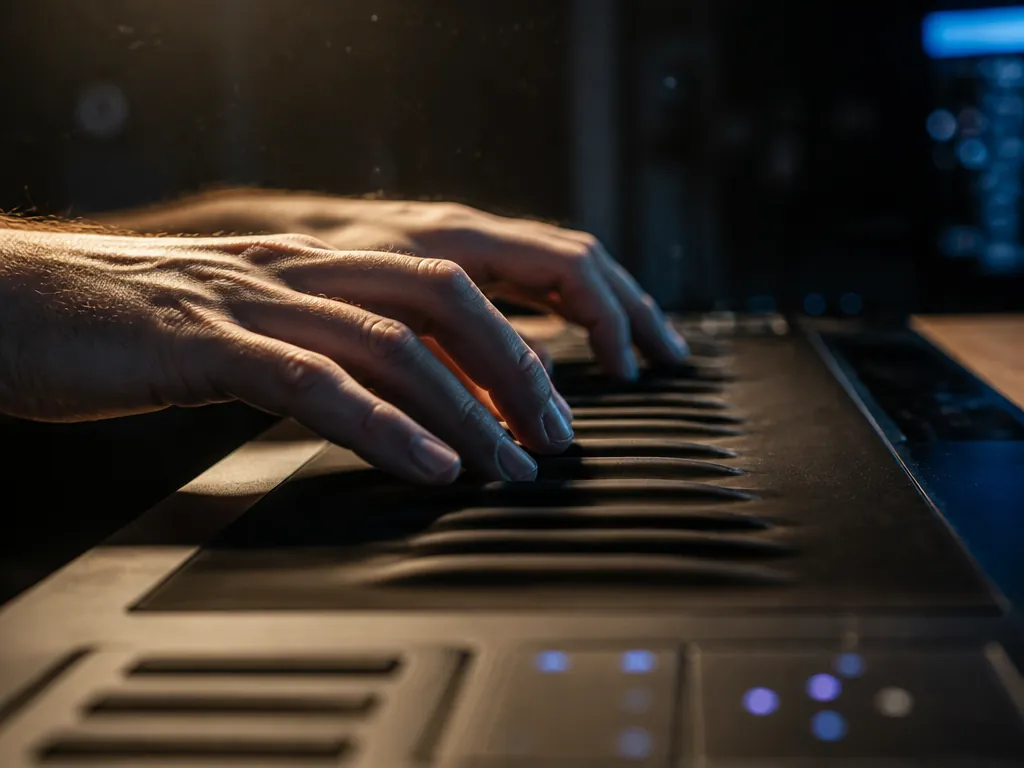
The patch was a bowed metal thing — filtered noise pushed into a resonator sitting somewhere near D, no oscillator in the traditional sense anywhere in the signal path — and for about ten minutes I was convinced the Noisy 2.6 synth update had solved a problem I've been circling for years. Then I did what I always do before I trust an expressive instrument: killed the reverb, killed the delay, and played the same four-note phrase dry. It still moved. Most expressive instruments fail that test.
Which brings me to the question I suspect you've already asked yourself, probably while looking at an Osmose you've owned for a year, or a Continuum, or the Touché sitting next to your interface with a thin layer of studio dust on it: is the expression actually happening in the synthesis, or is it a control signal driving a wet effects chain?
Those two things feel identical for the first ten minutes and completely different by the third week.
The one-sentence verdict
In Noisy, the expression is structural — pressure and slide change how the sound is being produced, not how it's being processed afterward — but whether that's worth new money depends almost entirely on what's already under your hands.
That second clause is doing more work than the first. Hold onto it.
Why a noise-and-resonator engine changes the question
Most synths bolt expression on at the end. You map pressure to filter cutoff, slide to a wavetable index, lift to release time, and what you get is a well-behaved parameter sweep. It's musical. It's also a fader with better ergonomics.
A resonator-based engine has a different relationship with continuous control, and it's worth understanding why rather than taking it on faith. When your excitation source is noise — broadband, unpitched, structureless — the resonator isn't filtering a tone, it's deciding what the tone is. Change the excitation and you don't get a brighter version of the same sound; you get a different physical object being struck, bowed, or blown. That's the difference between turning a knob on a synth and changing how hard you hit a thing.
What the 2.6 update pushes further, as of writing, is the breadth of that idea: synthesis approaches that would normally be their own separate engines get routed through the same excitation-and-resonance logic, with expression available at the component level rather than at the output stage. FM feedback, various poly behaviours, the semi-modular patching between blocks — these aren't a feature list, they're a bet that if you make expression available upstream, the player will find things the designer didn't plan.
The honest limitation: Expressive E's documentation is not generous about what's happening under the hood in some of these modules. You end up learning the instrument by ear, which is fine if you like that, and irritating if you're the kind of sound designer who wants to know exactly what a parameter is scaling before you commit it to a project template.
MIDI to MPE, and who that's really for
The part of this release that will matter to more people than the synthesis expansion is the translation layer: taking ordinary MIDI gestures and mapping them into per-note MPE-style control.
If you own an Osmose, this reads as a footnote. If you don't, it's the headline. I spent a stretch of testing away from my MPE controller entirely, running Noisy from an Ableton Move — a device with pads, no poly aftertouch in the Osmose sense, and a very different physical vocabulary. The instrument still felt like an instrument. Not the same instrument. Pressure applied to a whole chord is a fundamentally different musical statement than pressure applied to the third of that chord while the root sits still, and no translation layer can invent the resolution your controller doesn't have.
What it can do is make the patches playable rather than static, which is the difference between a preset library you audition and one you actually use on a deadline.
How I'd decide
Four tests, all of which you can run inside a demo period. None of them require you to trust a review, including this one.
The dry test. Bypass every effect in the chain. Reverb is a liar; it makes any sustained tone feel three-dimensional and any gesture feel intentional. If the patch is still interesting with nothing on it, the expression lives in the engine.
The one-parameter test. Disconnect everything except pressure. If pressure alone produces a range of results you'd describe with different nouns — not "brighter" and "less bright" but "bowed" and "struck" — the mapping is doing something structural.
The known-phrase test. Play something you've played a thousand times on a normal keyboard. Your hands already know what it's supposed to sound like, which makes any added expressivity immediately legible and any awkwardness immediately obvious.
Twelve-month cost, honestly counted. Check current pricing yourself; software pricing here moves and I won't quote a number that's wrong by the time you read this. But count the upgrade path, not the entry point, and count whether you're also going to want the controller that makes this sing.
Where the answer is genuinely "it depends"
If you own a Continuum or another EaganMatrix instrument, you've already been living in a world where excitation and resonance are the primary controls. The 2.6 update will feel less like a discovery and more like a convenient, considerably cheaper second seat at a table you're already sitting at. That's not nothing — but it's not the revelation it'll be for someone coming from a subtractive-plus-MPE workflow.
If you're a Touché owner primarily, your gestural vocabulary is macro-scale: whole-patch morphing, not per-note articulation. Noisy will reward you, but you'll be driving a per-note instrument with a per-patch controller, and some of what you paid for will sit unused.
And if — no judgement — your actual playing style is one finger, a sustain pedal, and a lot of arrangement work afterward, expressive synthesis is a solution to a problem you don't have. Buy a better reverb.
Who this is for, who should skip it
For: Osmose and Osmose CE owners who've exhausted the onboard engine and want something with a comparable expressive ceiling that runs in a DAW. Sound designers doing foley-adjacent work — bowed metal, breathy tuned percussion, things that need to sound touched. Anyone whose MPE controller is currently sitting under a stack of preset patches they didn't make.
Skip: if you need vocals, if you need conventional bread-and-butter poly pads with a saved recall you'll never edit, or if your delivery format flattens everything into a busy mix where per-note articulation will be inaudible anyway. That last one is real and under-discussed.
The part nobody has settled
Here's what I can't tell you, and what I don't think anyone can yet: how much of this the listener actually receives.
I know the dry test works for me — that a resonator responding to pressure feels categorically different under my hands than a filter responding to the same gesture. But the research on how continuous, per-note timbral variation is perceived by someone who isn't playing is thin and mostly borrowed from acoustic-instrument studies where the gesture and the sound have co-evolved for centuries. We don't have that history here. A bowed violin's timbral shift carries meaning partly because listeners have thousands of hours of prior exposure to what bow pressure means.
So the question I keep coming back to, and the one I'd genuinely like an answer to: when you spend a decade learning to shape a synthesized note with your fingers, are you communicating something to the audience — or are you building a feedback loop that makes you play better, with the listener only ever hearing the second-order effect?
Not sure which tool to use?
Compare the top AI music and sound tools side by side — honest reviews, real pricing, no sponsorships.