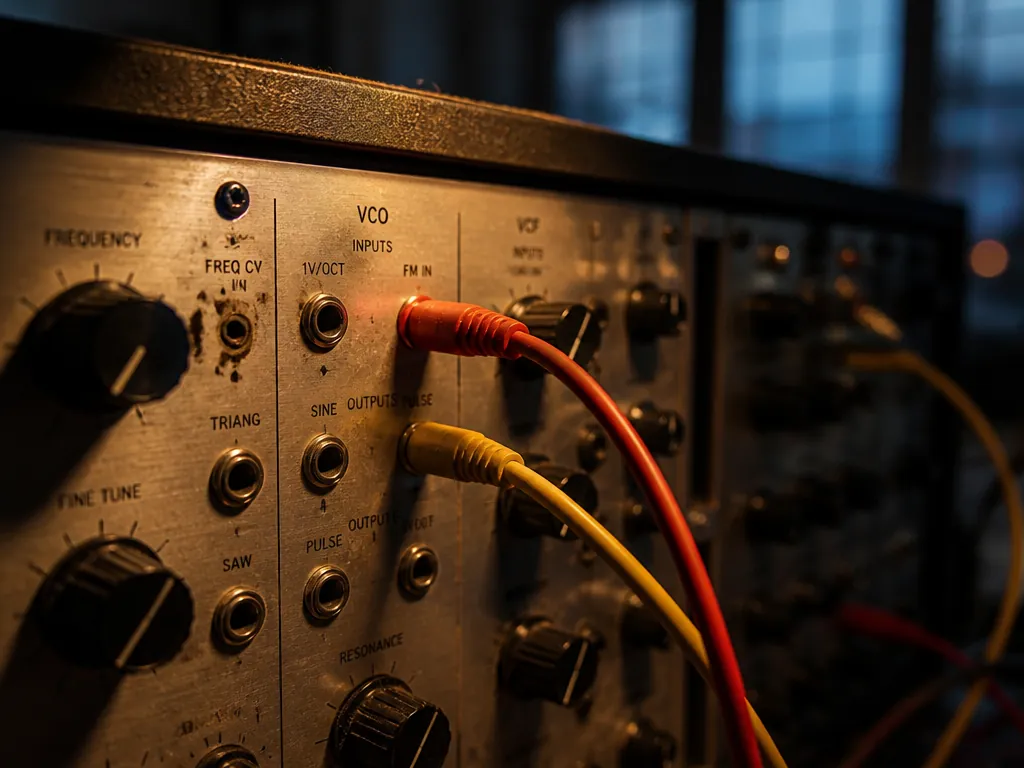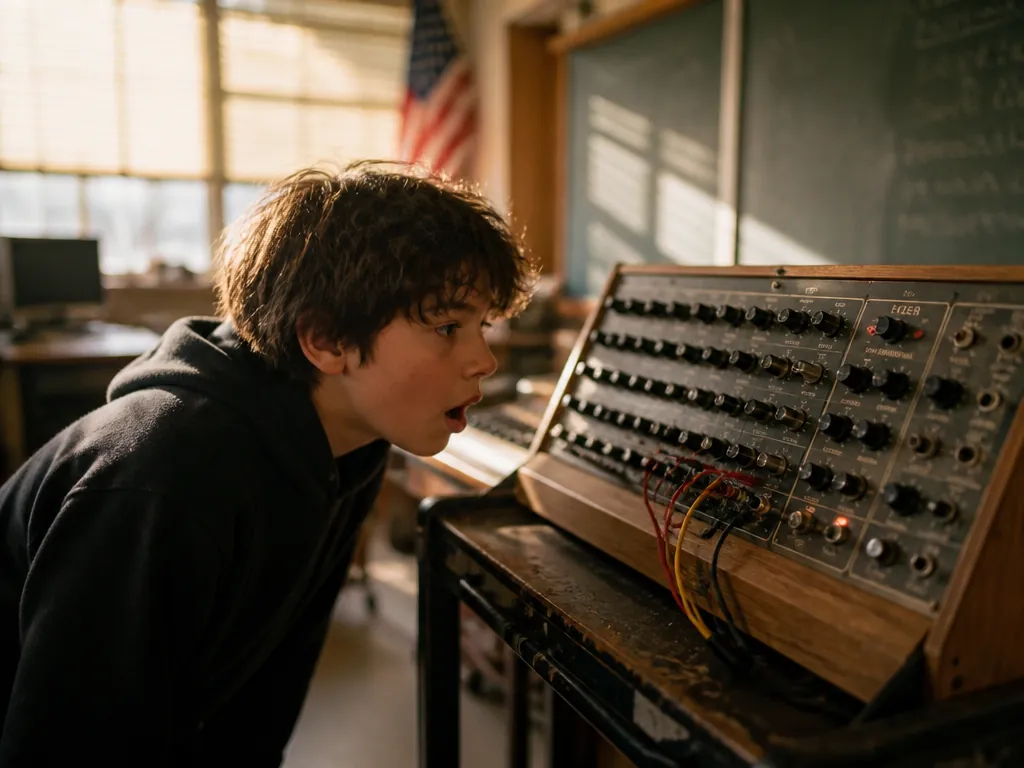
There is a moment in a middle-school classroom, usually about eleven minutes into a session, when a kid sweeps a cutoff knob for the first time and the room changes. The buzzsaw sawtooth loses its top end, the sound goes from thin to fat to underwater, and the kid's face does something that no worksheet on wave physics has ever produced. Whatever else is true about the Bob Moog Foundation, it built a program around engineering that moment on purpose, in a public school, with a cart of equipment that has to survive being wheeled down a hallway.
That program is one of three. The foundation — a 501(c)(3) independent of the instrument company that carries the same name — runs a classroom science curriculum, a physical archive of Bob Moog's papers and prototypes, and a museum in Asheville, North Carolina. Supporters tend to encounter all three as a single mission statement. But they are not one thing. They compete for the same donated dollar, the same volunteer hour, the same weekend of your attention, and they fail in completely different ways when the money gets thin.
So this is a comparison, not a survey. Three programs, four criteria, and a verdict I did not expect to reach when I started thinking about it.
The criteria
I'm judging these the way I'd judge any three tools competing for one budget line.
Reach per dollar. How many people does a given contribution actually touch, and how directly? A program that reaches thousands cheaply is doing something a program that reaches dozens expensively is not.
Permanence. If funding stopped for three years, what would still exist afterward? This is the criterion most donors never apply, and it is the one that separates these three most sharply.
Depth of encounter. Does the person come away with a durable change in how they hear or think about sound? A pleasant hour is not the same as a rewired ear.
What it can't do. Every one of these has a hard ceiling. Naming it is the difference between a review and a brochure.
Dr. Bob's SoundSchool: the widest net
The classroom program takes the physics of sound to elementary and middle-school students through hands-on work with oscillators, filters, and envelopes — the same conceptual chain that runs through every subtractive synth ever built. Kids build simple circuits. They hear what a low-pass filter does before anyone hands them the term. The curriculum lives inside STEAM standards, which is the thing that lets it into public schools in the first place; a teacher can justify it on the science-standards paperwork rather than defending it as an arts enrichment nicety.
On reach per dollar, it wins outright and it isn't close. Classroom instruction scales through teachers. Train one, and the same lesson runs for every cohort that comes through that room. Cumulative student counts across its run climb into the tens of thousands, which no gallery and no reading room can match on the same budget.
On depth of encounter, it does something the other two structurally cannot: it reaches people before they've decided what they're interested in. Nobody drives to a museum about synthesizers by accident. Every ten-year-old in a public school classroom is there by accident, including the ones who would never have found this on their own. That is the whole argument for the program and it's a strong one.
On permanence, it is the weakest of the three. A curriculum is a set of instructions plus the people trained to run them, and both decay. Teachers move districts. Equipment breaks and cart-based gear breaks faster. Stop funding it for three years and what remains is a PDF and some fond memories. It has to be re-lit every single year.
What it can't do: it cannot make the historical case. A kid who learns filter behavior in fifth grade doesn't necessarily learn who Bob Moog was, why the Model D's ladder filter sounded the way it did, or what was at stake in the transition from modular systems to keyboard instruments. The program teaches the physics honestly and mostly leaves the history to the other two.
The Archives: the one that can't be rebuilt
The foundation holds a large body of Bob Moog's working material — schematics, correspondence, notebooks, prototype hardware, business records, recordings. Tens of thousands of items. It is the least photogenic thing the organization does. It is also the only one that is genuinely irreplaceable, and that word is doing real work here.
On permanence, nothing else is in the conversation. Archival work is measured in decades: acid-free enclosures, stable temperature and humidity, item-level cataloging, digitization of formats whose playback machines are themselves becoming artifacts. Reel tape sheds oxide. Foam rots. Thermal fax paper — and there is always thermal fax paper in an engineer's files — fades to blank. Every year a collection sits unprocessed is a year of loss you cannot buy back at any price later. Fund it, and the material exists in 2075. Don't, and some fraction of it simply stops existing.
On depth of encounter, the archive is strange. Its direct audience is tiny — researchers, a documentary crew, the occasional engineer trying to understand why a particular circuit was laid out that way. But it's upstream of everything else. The exhibits pull from it. The books and documentaries that shape how a generation understands electronic music pull from it. Depth here is not measured in visitors; it's measured in what becomes knowable.
On reach per dollar, it looks terrible on paper, and this is precisely why it struggles. Nobody's donation page converts on "we stabilized 400 linear feet of paper." A conservation-grade box costs real money and produces no photo op.
What it can't do: it cannot generate its own constituency. Museums make visitors; classrooms make students; archives make researchers, and researchers are few and mostly already convinced. An archive has to be funded by people who understand a counterfactual — what would be lost — rather than by people who saw a kid smile.
The Moogseum: the encounter you can't stream
The Asheville museum puts the artifacts in front of civilians: interactive exhibits, a circuit you can trace with your hands, instruments in glass, the theremin demonstrations that remain the single most reliable way to make a stranger understand that electricity can be played. Attendance runs to the tens of thousands cumulatively — respectable for a single-subject museum in a mid-sized city, and it does something for Asheville's identity as a place where this history happened.
On depth of encounter, it beats both others per person. Scale matters physically. Reading that early modular systems were furniture-sized is information; standing next to one is a different kind of knowing. You understand patch cables when you see how many are required to make one sound and how quickly the whole thing becomes unrepeatable. That's the origin of every "save your patch" feature you've ever used, and it lands in about four seconds of looking.
On permanence, it's middling and its dependency is worth naming: the museum is a display layer over the collection. The artifacts persist because they're conserved, not because they're exhibited — exhibition is, if anything, mildly hostile to objects, since light and handling and vibration are how things wear. A museum can close and reopen. What it shows can't be re-created.
On reach per dollar, it sits between the other two, with the catch that its reach is geographic. It serves people who can get to western North Carolina. That's a real limit, not a small one, and no virtual tour has ever reproduced the specific experience of a theremin field responding to your own hand.
What it can't do: it cannot reach the kid who will never travel. That's SoundSchool's job, which is the honest reason all three exist rather than one.
The verdict
If you care about instrument history specifically — if you're the reader who wants to know why the ladder filter sounds the way it does, and what Bob Moog actually wrote to a customer in 1971 — the archive is the program to protect, and it's the one least likely to get your money without someone arguing for it.
The reasoning is asymmetry of failure. Underfund the classroom program and you lose a year of students, which is a genuine loss but a recoverable one; the curriculum can be restarted. Underfund the museum and it closes, and museums have reopened before. Underfund the archive and a specific 1968 notebook page crumbles, and no amount of money in 2040 brings it back. Two of these three programs are renewable. One is not.
That's not a ranking of importance. SoundSchool almost certainly changes more individual lives per dollar, and if what moves you is a child discovering that sound is a physical thing they can shape, fund it without apology — that's a good and unhedged reason. The Moogseum is the right target if you believe cultural memory needs a physical address, which is defensible. But if your instinct is that this history matters and should still be legible in fifty years, the least glamorous line item is the one that carries that weight.
Who each is for
- Fund the classroom program if you want measurable reach and you believe access early beats depth later. Best for donors who want to see impact numbers.
- Fund the archive if you're a synth historian, a researcher, a builder who reads schematics for pleasure, or anyone who has ever gone looking for a primary source and found it missing.
- Visit and support the museum if you're within driving distance of Asheville, or if you're bringing someone who doesn't yet care and needs to stand next to the thing.
- Skip all three — honestly — if you were hoping a donation gets you access to gear or a discount on instruments. This organization is separate from the company, and conflating them leads to disappointed donors.
One thing to do this week
Spend twenty minutes archiving your own studio. Find the box or the folder — the patch sheets, the notebook with the settings for that one bass sound, the hard drive of session files from a project that shipped in 2016 — and do three things: write the year on it, write what's inside it in plain language, and note the format. "2016 — game score stems, 48kHz WAV, Ableton 9 sessions." Ten minutes of labeling now is the difference between a resource and a mystery box.
Then, if you're inclined to give, name the program when you do. Unrestricted gifts flow toward whatever is most urgent, which is usually whatever is most visible. The quiet work gets funded only when someone asks for it by name.
Everything you love about how a synthesizer sounds was documented by someone who thought it was worth writing down.
Not sure which tool to use?
Compare the top AI music and sound tools side by side — honest reviews, real pricing, no sponsorships.